
☆Aaron Lange Interview☆
an adult from Cleveland

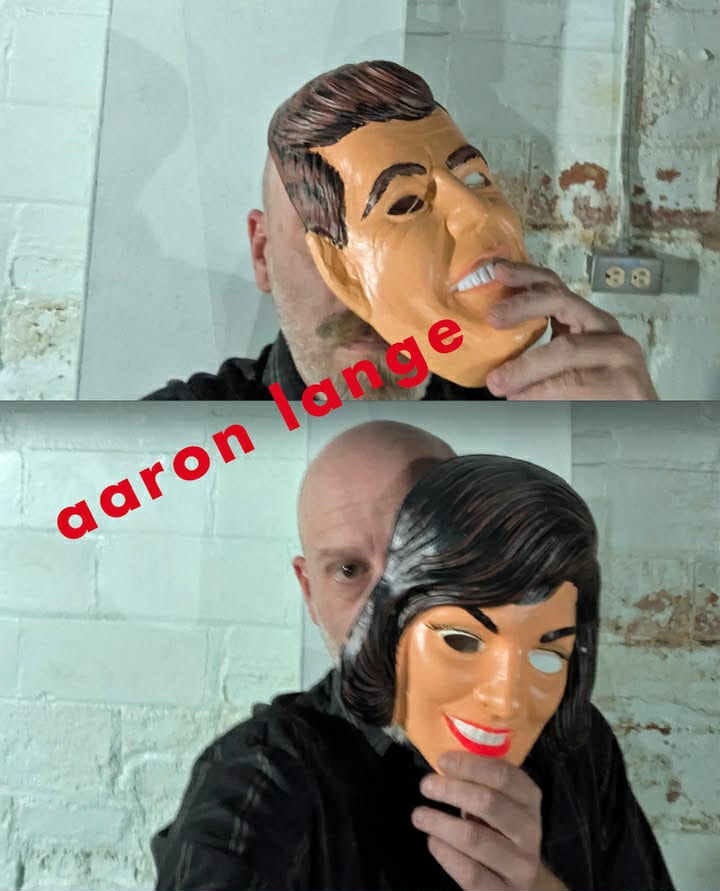
The second of our contributors to be interviewed is Cleveland-based artist Aaron Lange, one half of our illustration team.
IN THE 1990S, DANIEL CLOWES COINED THE TERM “INK STUDS” TO REFER TO THE KIND OF PHYSICALLY POWERFUL, TECHNICALLY PROFICIENT, SOLAR-PHALLIC CARTOONISTS WHO MONOPOLIZE PUBLIC ATTENTION AT THE EXPENSE OF MUSICIANS AND OTHER LESS SUPERFICIALLY APPEALING CREATIVE TYPES. WHY DO YOU THINK THE FIGURE OF THE INK STUD HAS EMERGED INTO PROMINENCE AGAIN, AND HOW DOES THIS FIGURE STAND AGAINST THE BACKDROP OF THE INDEPENDENT COMICS INDUSTRY?
Clowes was being ironic, as I suspect you are too. But the funny thing is, he may have accidentally been on to something. I know this isn’t cool to say, and it’s considered to be “right-coded,” but alternative comics and the arts in general truly have been feminized. This began in a symbolic way, but down the line the repercussions have been literal. For example, I’ve done a little teaching on the side, and the young art students are almost entirely female and the few male students seem to be some form of queer. Young straight men appear to have been banished, and I can’t help what wonder what I would have done as a teenager if I found myself in a similar situation. Would I have become some video game addict with weird incel politics? Probably! So obviously this is not a good situation, and the arts should be serving our young men better.
And just so nobody thinks I’m a manosphere guy, I’ll add that I find the historical lack of female film directors to be appalling. That’s one talking point where I don’t mind sounding woke. But we are starting to see an uptick in films made by women and I think that’s great. It doesn’t matter if I like the films or not—women have a different perspective and film is a large enough tent to make room for that.
IN THE NEO-DECADENT MANIFESTO OF COMIX, YOU CALL FOR SYNCRETISM, NON-LINEAR TRANSITIONS, AND ALTERED VISUAL CONTINUITY WHILE PRESENTING A SET OF APPROACHES THAT SEEMS LIKE IT COULD LEAD TO RESULTS WILDLY AT ODDS WITH WHAT WE MOSTLY SEE IN THE CURRENT COMICS LANDSCAPE. AS FAR AS WE CAN TELL, WE ARE THE ONLY EXISTING ART MOVEMENT WITH CONCURRENT DEVELOPMENTS IN POETRY, PROSE FICTION AND COMICS/VISUAL ART. ARE THERE ANY CURRENTLY ACTIVE CREATORS YOU THINK OF AS EMBODYING A NEO-DECADENT APPROACH TO COMIX? IF NOT, WHAT POTENTIAL THINGS DO YOU THINK COULD BE ACHIEVED WITH THE APPROACH?
Dan Heyer is the only other comic artist I know of who is explicitly involved with Neo-Decadence, but there are some other people who are doing work of interest that could be considered ND, even if that’s not their intention. Josh Bayer is one, and I hooked him up with Colby Smith // YUUGENPRAXIS for a project in which he illustrated one of Colby’s poems. Josh is a real wild artist with a wide set of influences both high and low; he lives in New York, but I try not to hold that against him.
And there’s Katherine Dee, who is a writer not a visual artist, but she did a recent book for 2dcloud called EGIRL, with some artist collaborators. I think it’s an extremely ND book, even though it’s safe to assume that nobody involved has even heard of Neo-Decadence. But I’ve been talking with Katherine and hope to work with her in the future.
There are other “experimental” comics being done, of varying quality, but most of them have the distinct odor of art school about them. And alternative comics in general are still largely obsessed with superficial identity politics, trauma narratives, etc. The scene has been milquetoast for some time now, but for anyone willing to look, there are glimmers of disruption on the fringes.
CLEVELAND FORMS AN ESSENTIAL ELEMENT OF YOUR WORK IN THE SAME WAY NORTHAMPTON DOES FOR ALAN MOORE, AND THERE’S A SENSE IN WHICH YOU REGARD IT AS A “SECRET CITY” WITH A PULSING CREATIVE CORE. ANOTHER WRITER, Caleb Caudell, INHABITS INDIANAPOLIS. TO WHAT EXTENT DOES NEW YORK NO LONGER MATTER NOW THAT THESE OUTLYING AREAS HAVE BEGUN POSING SEEMINGLY UNANSWERABLE AESTHETIC CHALLENGES TO THE DENIZENS OF THE FIVE BOROUGHS? IS THERE A SENSE IN WHICH CONTEMPORARY NEW YORKERS ARE NOSTALGIC BED-WETTING COWARDS LOOKING TO THE “ROMANTIC” PAST RATHER THAN ADDRESSING THE LITERARY CHALLENGES OF THE PRESENT?
I’ve read Caleb’s Hardly Working, but not much else, and I didn’t get the sense that he writes about Indianapolis with any kind of psychogeographic specificity. That said, his voice does seem distinctly Midwestern, though it’s not easy for me to define exactly why. Perhaps its just an underdog perspective that I instinctively recognize.
As far as New York, the problems are twofold. One, it’s just ridiculously expensive. And two, New York is the capital city of all these increasingly irrelevant institutions: the big publishers, museums, and other various media and cultural outlets. All the people in charge of these organizations need to find ways to keep the money rolling in so they can continue to afford their unsustainable Manhattan lifestyles and their outrageous overhead. They can’t afford to take risks and the result is cultural products that are on par with Netflix or Instagram reels. When you buy a book from a Big Five publisher, you are not supporting the arts—ultimately what you are supporting is the ecosystem of New York landlords and real estate.
YOUR ONGOING SERIES PEPPERMINT WEREWOLF IS A TRULY EXPERIMENTAL COMIC WHICH SEEMS TO EXIST AT THE INTERSECTION OF THE FASHION INDUSTRY, OLD SCHOOL SEX MAGS, AND THE OCCULT SCENE. WHILE LACKING ANY SORT OF CONVENTIONAL NARRATIVE AND USUALLY VEERING WILDLY INTO DISJUNCTIVE TEXT AND IMAGERY, EACH VOLUME HAS SO FAR ENCAPSULATED A FAIRLY COHERENT SET OF “PARANOIAC-CRITICAL” THEMATIC CONCERNS. DESCRIBE THE CONCEPTION OF THIS PROJECT AND YOUR USUAL PROCESS FOR CREATING IT.
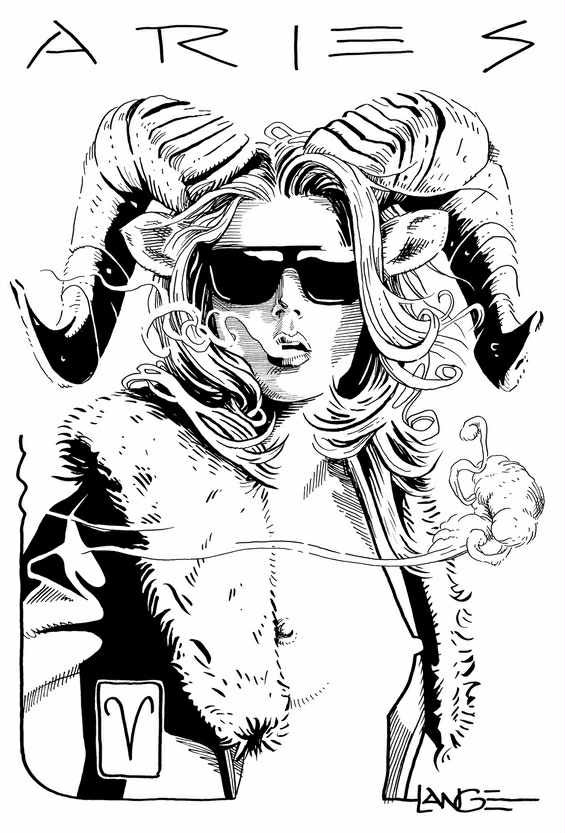
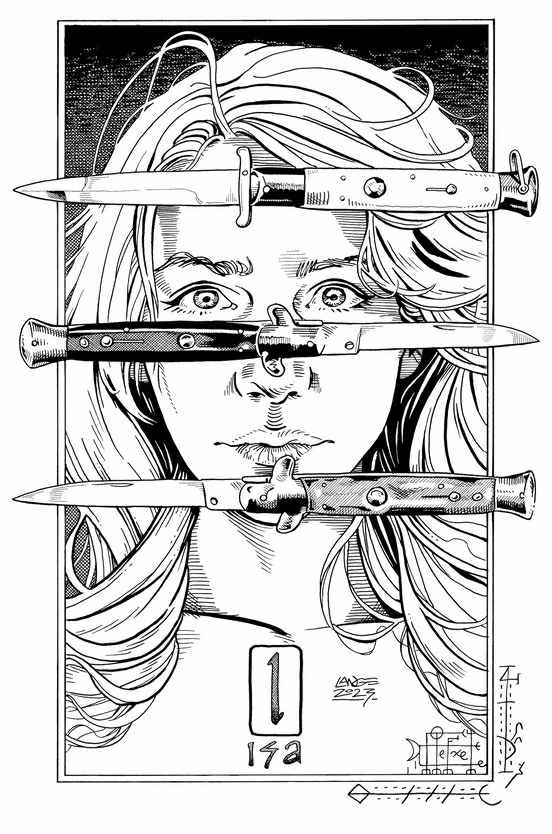
I don’t think the project makes any specific reference to the fashion industry per se, but there is an overriding theme that relates to the idea of glamor, in both the contemporary use of the term and also the archaic use related to the casting of a spell. Even more broadly, the project is concerned with lunar ideas—that’s baked right into the title: A werewolf is controlled by the moon. I suppose there’s also a bit of the “divine feminine” in there, but bisected into the sacred and the profane. To be clear, I am in no way endorsing goddess worship in the Wiccan sense, nor am I placing lunar energies over solar/masculine. Personally, I think these energies are only useful when they are in balance with each other. That said, Peppermint Werewolf is expressly lunar—that’s just the premise of the book, and it also provides an excuse for drawing lots of women, which I enjoy.
More specifically, each volume has a more focused esoteric theme. The first installment started as an attempt to make a comics version of an ASMR video, which eventually expanded to include aspects of both astrology and the writings of J.-K. Huysmans. The second installment concerns the Germanic runes and sacred geometry, which are ideas that might sit side-by-side better than the previous examples. The third volume, which I’m currently working on, is probably the most focused, and the premise revolves around Arthurian legends; the water symbol of the Holy Grail, and the figure of Morgan le Fay are both uniquely suited for my lunar investigations. At some point I’d like to do an installment that’s concerned with Faust and Goetic magic, and eventually I’d like to do a final entry which covers alchemy—a sort of epilogue which also repeats ideas from the previous iterations and ties everything together.
Beyond the explicitly occult influences, Peppermint Werewolf is also deeply informed by the Situationists, and I see the project as a direct and logical continuation of their work—though I split with them by not engaging expressly with politics in the polemical sense. Visual inspiration for the series includes the Pre-Raphaelites, Barry Windsor-Smith, Jeffrey Catherine Jones, Patrick Nagel, Dave Sim, and the early black-and-white work of Trevor Brown. Needless to say, people are often very confused by this project!
YOUR MONUMENTAL WORK AIN’T IT FUN IS BOTH A HISTORIOGRAPHY AND PSYCHOGEOGRAPHY OF CLEVELAND, USING THE FIGURE OF MUSICIAN PETER LAUGHNER AS ITS CENTRAL CONNECTING CONCEIT. WHAT LED YOU TO PURSUE THE SUBJECT THIS DEEPLY, AND WHAT INTERESTS YOU ABOUT CLEVELAND’S MUSIC SCENE?
I got real interested in punk music as a teenager in the ‘90s, but was mostly only aware of the stuff from England, NYC, LA, etc. Over time, I started to learn more about the early Cleveland punk scene, and this was a source of fascination. Information was harder to come by back then, so you’d get little bits and pieces here and there, like a friend would put on a record at a party, or tell you about some article they read in a zine. These exchanges were almost like the traditional transmission of folktales, and some of the participants of the old scene took on the role of local folk heroes. Being both dead and obscure, Peter Laughner was a prime candidate for this sort of mythmaking.
In my 30s I began researching Laughner more seriously, and it became clear that he was extremely active in his short life. Beyond the punk scene, he as also involved with folk music, poetry, and music journalism. He really got around, he wrote lots of amphetamine-fueled letters, and his record reviews were often peppered with weird details from his personal life. So from surviving fragments a portrait could be assembled, and it struck me that his story was inseparable from the story of Cleveland itself. So I added that all together and it consumed seven years of my life.

YOU ARE WORKING ON EDITING A HYBRID TEXT AND IMAGE CRITICAL WORK CALLED HUYSMANIA!, DEALING WITH THE SUBJECT OF J.-K. HUYSMANS. DESCRIBE THE GENESIS OF THIS PROJECT AND YOUR INTEREST IN HUYSMANS.
Well, once again Peter Laughner is to blame. Like Patti Smith and Tom Verlaine in New York, Peter was interested in 19th century decadent writers—he even wrote a song called “Baudelaire.” I started reading some of the books Peter read, so I could get into his head more, and to my surprise I found I really liked some of the old decadent writing, and somewhere along the line this led me to Huysmans. I think plots are kind of overrated, so the meandering nature of À rebours was a selling point, not a detriment.
As far as HUYSMANIA!, I’ve got some material assembled, but am still looking for more. If anybody is reading this and thinks they may have something to contribute, I encourage them to contact me through the CHURCH GHOST website. Interestingly enough, I was recently on the phone with Charlotte Pressler, Laughner’s ex-wife, and she expressed interest in writing an essay about Huysmans in relation to Michel Houellebecq’s novel Submission. I really hope she’s able to get that together. Charlotte used to do a lot of writing for zines and poetry journals, and I’d love to help facilitate her return to the small press scene.
ALONG WITH Dan Heyer, YOUR ILLUSTRATIONS FOR THIS SUBSTACK FORM A LARGE PART OF ITS APPEAL AND OBVIOUSLY SET IT APART FROM SUBSTACKERS WHO SEE FIT TO USE GENERIC STOCK IMAGES, KITSCHILY WELL-KNOWN PAINTINGS, OR EVEN MERE AI SLOP. WE’VE TALKED A BIT BEFORE ABOUT DOING ENTRIES ENTIRELY IN COMIC FORM, AND THIS MAY STILL HAPPEN. DO YOU SEE THE SUBSTACK MODEL AS BEING A WORTHWHILE WAY OF GETTING YOUR ART OUT THERE?
God, the AI slop is just the worst, and I see writers using it who should know better. These are people who would absolutely bristle at the idea of AI writing, but they’ve got no problem using slop images for their Substack entries. Forgetting the ethics or politics, it’s just really trashy and low class.
As far as Substack being a model for promoting my own work, I don’t know. The platform seems pretty choked with phonies, wannabe gurus, and purveyors of quickly expired culture war potshots. Of course, there are exceptions. I mentioned Katherine Dee earlier, and her Substack (default.blog) about fringe online cultures is really interesting and she’s managed to assemble a large and enthusiastic audience.
YOU’VE VISITED TOKYO TWICE NOW. WHAT ASPECTS OF THE CULTURE INTEREST YOU ABOUT JAPAN, AND HOW DO YOU SEE CONTEMPORARY JAPANESE ARTISTIC TRENDS AS DIFFERING FROM THOSE STATESIDE?
On the bluntest level, Japan is attractive simply because it is functional as a society. I love all the trains and the ability to get around easily. You can always find something good to eat, get some water from a drinking fountain, sit down on a peaceful bench, or use a bathroom that doesn’t have diarrhea sprayed all over it. These are simple objectives, and American cities fail at all of them. The train system in Cleveland is basically a mobile homeless camp, and when I have to ride it I carry a collapsible baton. Whenever I leave the house I’m bombarded with blaring music from passing cars, and the stink of skunk weed is now everywhere. Americans are perpetually stoned, and if they aren’t stoned they’re on some sort of prescription medication; and for some reason, all these people want to talk to me about sports.
Then there’s all the terrible real estate development in America, which has been uniformly cheap and hideous for at least the last three decades. Japan is much better about this. I don’t necessarily like some of the more eccentric Postmodern buildings, but at least they are considered and don’t resemble gigantic boxes made of drywall. What I greatly appreciate is traditional Japanese aesthetics as filtered through Modernism—and examples can be found endlessly, often in the most banal of places, like the entryway to a hotel, or a little rock garden in the airport. There are all these little pockets where space itself is considered, and it’s pleasurable and comfortable to just occupy these spaces. It’s like a Feng Shui thing.
As far as artistic trends, I’ve got some interesting books by Japanese artists and a small collection of Japanese records—I’m not really into “city pop,” mostly noise or ambient stuff—but I’m afraid I have little firsthand experience in the way of genuine artistic culture in Japan. Most of what I’ve encountered has just been the Japanese version of mainstream culture, which is different, but is still ultimately just thin pop music, serialized melodramas, and every other form of disposable distraction. I will say this though: The Japanese still seem to find all forms of print media viable, and the bookstores have gigantic selections of weird niche magazines and manga. And you can tell people are actually buying this stuff, because on trash day they set it out on the curb for recycling, in extremely neat stacks bound together with twine.
FIRE BACK BRIEF REACTIONS TO THE FOLLOWING:
ALEX TOTH
On a purely technical level, Toth might be the most brilliant comic book artist to ever live. His compositions and use of line are unmatched. Unfortunately, he had a difficult personality and the tastes of a dullard, so he mostly put his talents towards forgettable and second-rate projects.
J. SCOTT CAMPBELL
His Danger Girl comic series is really great as a guilty pleasure, and his kawaii-porno way of drawing women really taps into core adolescent (mis)conceptions about sex. But he’s also an idiot, so the writing of Danger Girl is basically just a gender-flipped version of James Bond, and lacks even the self awareness of an Austin Powers film.
TUXEDO SAM
Tuxedo Sam is my guy. Out of all the Sanrio characters, I love that friendly penguin the most; I smile every time I see him. Last year I learned that he is a Taurus, which is also my sign—so it would seem the attraction was written in the stars.
GARY GROTH
I met Gary Groth for the first time at a comics event in Brooklyn, over ten years ago. I walked up to his table and gave him a small Xeroxed mini-comic I’d made. He looked me straight in the eyes, took the comic, and then tossed it on the ground.
PETER LAUGHNER
Poor Peter. There was a span of years there where I thought about him everyday, and he would sometimes visit me in my dreams. I suppose you could say that I love him… though I don’t think about him much anymore.
MC HAMMER
Sometimes, when my wife wants to annoy me, she’ll sing his song from the The Addams Family movie.
SARAH MICHELLE GELLAR
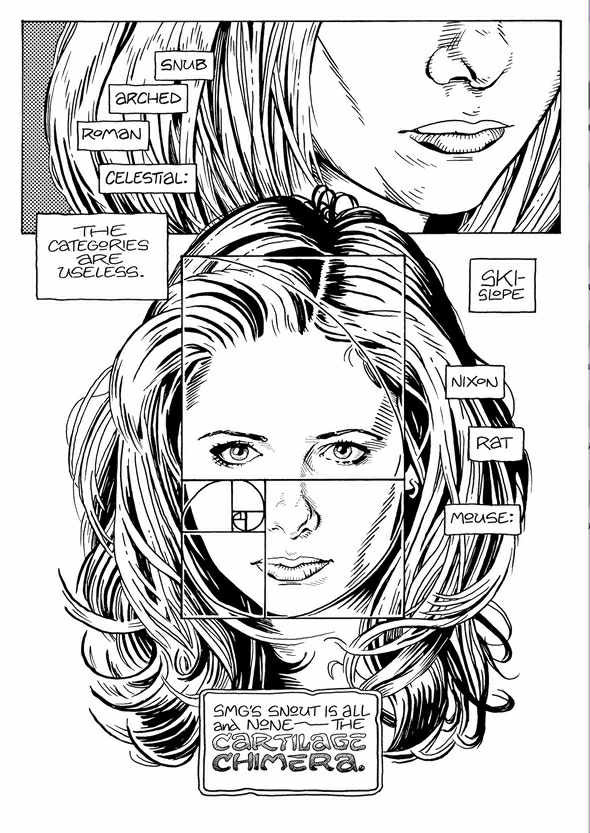
Well, I wrote about her nose at great length in Peppermint Werewolf: Murkstave, as I think this feature of hers embodies the mysteries of sacred geometry and the beauty of the natural world—it’s just an incredible fleshy and phallic nose, and I could study it for hours. Despite this, I’ve never actually seen an episode of Buffy the Vampire Slayer.
MICHAEL MOORCOCK
One of my favorite writers. The War Hound and the World’s Pain, from his Von Bek cycle, deserves special mention.
ED PISKOR
Ed and I knew each other when we were younger. Over time, I came to find his persona extremely annoying and his work to be overrated. That said, his passion for comics and his work ethic were undeniable, and he had knack for tapping into a market and audience that exists in a liminal zone between mainstream and alternative comics. But I can’t forget his suicide note, which seemed to be written by a teenager and not a man in his 40s. This is depressing on multiple levels.
EMILIO ESTEVEZ
A bad actor, but he’s good in Repo Man.
GUSTAV KLIMT
I came to his work late. Same with Egon Schiele, Alfons Mucha, and a bunch of other artists that I wish I had been studying in my formative years. But better late than never, and at present Klimt is one of my favorites.
XENOPHANES OF COLOPHON
If I understand correctly, it seems he rejected polytheism for a vague form of monotheism. Counterintuitive as it may be, I’m not convinced that this is an either/or scenario. I think a polytheistic pantheon can perhaps be best understood as a Voltron situation—where the various pieces can be assembled into the formation of a singular godhead.
THE NEO-DECADENT REFORMULATION OF EVERYDAY LIFE CONTINUES APACE. WHICH AREAS OF ART, WRITING, FASHION AND INTERPERSONAL RELATIONS ARE YOU MOST EAGER TO SEE ALTERED?
I don’t need to see my own tastes and interests amplified or reflected back at me. All I really want is for people to do their own thing, for people to actively engage in their own lives and to pursue culture and art in a way that is not passive. There is so much information available, yet the vast majority of the population just seems to be surrendered to the ebb and flow of algorithms; they use the internet the way people used to mindlessly channel-surf the television. It doesn’t take much energy to do better than that. I’d also like to see people act their own age. Middle-aged adults should not be reading YA books, collecting Funko Pops, or crafting hot takes about Ghost Busters sequels. Put on a shirt that has buttons and read a real book. Watch a film with subtitles. Explore political opinions that are outside your own. Talk to a stranger. Get on a random bus and ride it until it stops. And Jesus, you guys—stop smoking so much pot!
I like this
This was a recondite pleasure.