
Agriculture
hatred of farmers is the beginning of all virtue?👩🌾🌱

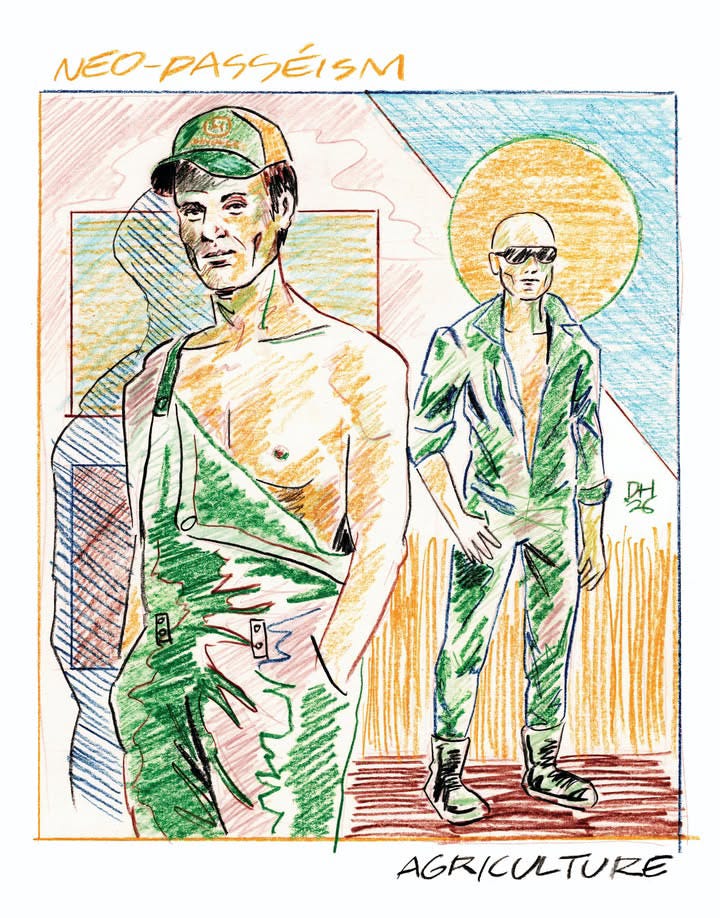
“What we ask of ‘unnatural vices’ is that they be consistently interesting, diverting. On this count, agriculture fails: it is as ‘unnatural’ as office work, yet involves us in a dreary slavery to the seasons that is barely worth even the ‘stability’ it affords.
It has been argued that the agricultural revolution led to increased disease, malnutrition, vitamin deficiencies, stunted growth, and social inequality. This is all probably true, but even without precise statistics, it’s not difficult to arrive at similar conclusions through purely subjective means. Anyone whose youth was spent stalking prey in the woods, in orange cap and vest, knows the absorbing rhythm that arises from the alternation of movement and stillness, the immediacy of hunting, killing and cooking: so different from the phlegmatic drudgery of the farmer’s existence.
The problem inherent in human civilization is this: how to maximize the advances in lifestyle allowed by urban living while minimizing personal involvement in agriculture? There are no clear answers here, but we find that, generally speaking, enthusiasm for even hunting has a sort of adolescent time limit, or that one eventually grows tired of rural life (‘I hate the countryside so much,’ as Mark E. Smith sings in the Fall classic ‘Contraflow’). The contradictions here, perhaps, can never truly be resolved: it would seem that a rewarding existence swings sharply between the poles of nomadic hunting—the primitive communism of constant action—and modern urban living; the hunter and the flâneur share spiritual DNA, while the farmer is merely an indentured wretch.”
—Justin Isis
“Although in the mid-to-late 1980s I had begun to gravitate towards the gaming systems of Nintendo, I never totally abandoned my support of the Commodore 64, and even into the early 90s I was still playing games on it, one of my favorites being Seven Cities of Gold. This computer game, created in 1984 by Danielle Bunten Berry, casts you as a late 15th-century explorer working under the patronage of the Spanish Crown, and tasks you with assembling a fleet, sailing across the Atlantic Ocean, and exploring the New World. Though it might seem crude and simplistic by today’s standards, it’s also seen as one of the earliest ‘open world’ games, and one that had a big influence on a number of other innovative game designers, such as the great Sid Meier (who has credited it as an inspiration to both his classic games Pirates! and Civilization). Certainly it inflamed my own imagination, and I enjoyed how there were a variety of ways to play the game and interact with the natives of the New World, be it as a peaceful proselytizer or a bloodthirsty conqueror. It created within me a fascination with the discovery of the New World, and the resulting clash of civilizations between Europe and Mesoamerica. Around the same time I was enjoying this game, I was also developing a dual fascination with the Aztecs, thanks to Warwick Bray’s 1968 book Everyday Life of the Aztecs, a copy of which could be found in the library of my middle school (though I would acquire a copy of the book for my own personal library many years later).
I found myself split on the nature of this subject, however. There was a part of me that was fascinated with the civilization of the Aztecs, which in many ways was glorious, but also horrible (such as all of the human sacrifices, for example). But I also could identify with the wanderlust and eagerness to explore of the Conquistadors, even while being appalled by their greed and their own violent actions. Over the last few years, I’ve come to the conclusion that the Conquistadors (and, indeed, all destroyers of sacred images, from the iconoclasts of Byzantium, the Dutch Calvinist mobs of the Beeldenstorm, Middle Eastern terrorists destroying lamassu statuary) are agents of Absolute and Transcendent Evil. This is, I feel, a big difference between the Conquistadors and other famous world conquerors who came before them, be it Genghis Khan (who did not seek to enforce his Tengristic belief system on the peoples he conquered) or Alexander the Great (who actually ended up at times embracing some of the customs and beliefs of the people he conquered, such as the Egyptians and the Persians). The Conquistadors, however, didn’t wish to merely conquer their enemies in a physical sense, but also in a spiritual way, destroying the native faiths and replacing them with their own, hence why I ultimately side against them. The true secret behind the extraordinary success of the Conquistadors, however, can all be traced back to something as basic as agriculture.
In her 2019 book Fifth Sun: A New History of the Aztecs, Professor Camilla Townsend looks at a number of factors that led to Spain’s victory over the Aztec people, from the fact that many of the neighboring nations long victimized by the Aztecs were eager to join up with the forces of Hernán Cortés, who they saw as a liberator (somewhat like how the Ancient Egyptians welcomed the conquest of Alexander, who they saw as liberating them from the bondage of the loathed Persians), to the introduction of Smallpox and other foreign diseases, and so on and so forth. One of the biggest advantages that the Conquistadors had, however, was their iron armor and weaponry, to which the Aztecs had nothing comparable. As mentioned above, much of this can actually be traced to agriculture. Townsend observes how 10,000 years ago, the first full-time farmers began establishing cities in the Fertile Crescent of what we now classify as the Middle East, which led to a less nomadic and more sedentary way of life (as opposed to the hunter-gatherers of Mesoamerica, who did not begin to farm corn until sometime around 3500 B.C., a delay of several millennia in comparison with the Old World). As Townsend writes, ‘They had no way of knowing that in the Old World, people had been full-time farmers for ten thousand years. Europeans had by no means been the first farmers, but they were nevertheless the cultural heirs of many millennia of sedentary living. They therefore had the resultant substantially greater population and a panoply of technologies—not just metal arms and armor, but also ships, navigation equipment, flour mills, barrel-making establishments, wheeled carts, printing presses, and many other inventions that rendered them more powerful than those who did not have such things. In the New World, people had been full-time farmers for perhaps three thousand years. It was almost as if Renaissance Europe had come face to face with the ancient Sumerians. The Mesopotamians were stunningly impressive—but they could not have defeated Charles the Fifth of the Holy Roman Empire working in combination with the Pope.’ Ergo, one could argue that it was the development of agriculture that led to the downfall of the Aztecs. And this is why I think agriculture is a very bad thing.”
—James G. Champagne
“The next phase of agriculture will involve the industrial resurrection of extinct animals. It is naive to the nth degree to think that this enterprise will stop at re-introducing them into the ever-steaming wild. Mammoths would be given motion for suet and meat. Dodos will become deluxe ducks prized for their flavorful fat. Thylacines would be bred as guardian sheepdogs and racing greyhounds. And should we transgress beyond our prejudice against cloning and bring back our belov'd Neanderthal, we would have a better excuse than prisons and undocumented immigrants to render them slaves. Appreciate the present factory farms while you can.”
—Colby Smith // YUUGENPRAXIS
art by Dan Heyer
Not read this yet, but I think when you trailed it, I commented briefly on the use of "agricultural" as a descriptor that hardly sets the pulse racing. Ie. a description of anything unrelated to say, getting shoulder deep in a cow's uterus or wrangling your own Channel 5 reality farming show (cutting the bollocks off animals while spawning human progeny at a pace)