
Communal Activity
The Tiny Other

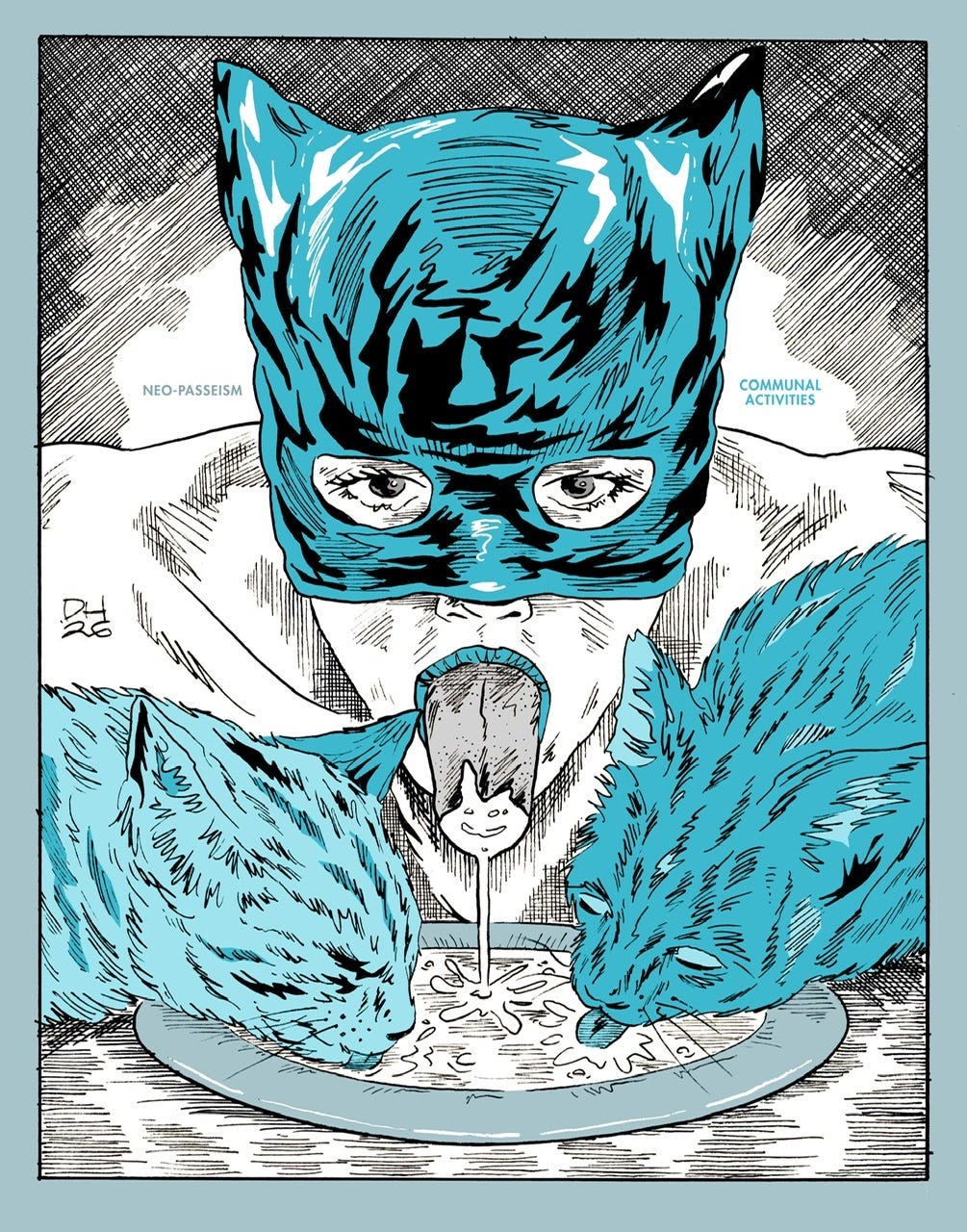
“Regardless of where you stand ideologically, the human soul instinctively gravitates towards ugliness, stupidity and conservatism. These traits are amplified in tight-knit local communities. It would not be an exaggeration to describe a hatred of ruralism as the beginning of all virtue.
The admirable drive of Modernity to destroy localism and provide us with urban atomization has been one of the truly rare and saintly expressions of human ingenuity. Unfortunately, the spectre of communal activity continues to haunt us. Daily we hear manufactured problems discussed: various ‘loneliness epidemics’ are put forward as if they constituted serious social problems rather than marketing schemes for unnecessary palliatives.
Only the true plebeian of the soul ever experiences anything like loneliness; natural aristocrats gorge themselves on solitude as if it were marzipan. The truly lonely individual is usually lazy, and uses their loneliness to mask their laziness.
Do you rarely initiate contact or invite other people out, yet still find yourself deluged with requests for time, attention, sexual favors and the like? If so, you are possibly a natural aristocrat.
Do you struggle to make connections and find yourself constantly conscious of your aloneness? Communal activity might destroy ‘the problem’ here, but it won’t solve it.”
—Justin Isis
“Perhaps it was in a Sufi or Zen parable where I read that true loneliness is ‘not knowing how to be by yourself.’ Communal activities strike me as séances where the ghost of collectivism, a faceless puppet crafted out of compromises, is clumsily conjured to try and fill that vacancy. The larger the group the more it needs to be managed, and management always replaces the nuances of genuine bonding and collaboration with protocol, killing them the same way an infection kills living tissue.”
—Ramon Alanis
“The more words a person has said, the more, objectively, fascist they are, language wasn’t designed to be used, nor was it designed to ‘use you,’ an even more fascist position, invented by Heidegger at a party in the woods, he couldn’t handle the sunny German girls, ‘how about we let language use us this time,’ so it goes, everyone who tries to alter their ‘relationship with language’ in some kind of ‘radical way’ ends up even more fascist, any direct contact with individuals or groups accelerates your fall into fascism, one must chart a course between the Scylla of mano-a-mano Brief Encounter style heterosexuality and the Charybdis of light-hearted American swimming pool orgies, the only way out, and it’s not a way out, is the ‘threesome,’ the ‘threesome’ is the last site of genuine resistance against fascism, it achieves this by the immediate and irreversible annulment of all possible enjoyment, the trick is, don’t do it, but keep thinking about doing it, with this technique you can annul all possible enjoyment, but not irredeemably, you can delay your fascist turn until it’s already too late, until you’re ‘forty,’ when you’re ‘forty’ you can say ‘I’m a fascist’ or ‘I’m not a fascist’ until the cows come home, no one will bat an eye, and rightly so, you’ve passed out of the light of history into some personal agricultural darkness, you can do what you want, until then you must devote yourself to the continual imagination of, e.g., the girl at the grocery and the girl at the post office, when you can’t handle it anymore—you’re ‘forty’—then you can start taking steps to ‘realise your dream,’ by means of slow-motion message-based meaning accrual, you must finagle, with superhuman awkwardness and subterfuge, a final ‘encounter,’ wherein no one has any idea what to do or say, or whether to do or say anything, at most about four words are spoken, over a period of about six hours, in accordance with various pre-established rules concerning words, the number of times you’re allowed to say them, the accent in which you can say them, how wide your mouth can be at the beginning of the word and the end of the word, within minutes the whole thing devolves into a kind of muddy turn-based strategy game, or, fuck it, go to China, being unable to engage in fascist communal/fascist individual activities you will eventually forget that activities, communal and individual, exist/are fascist, you’ll learn the language but still be excluded from it, not for fascist, nor even for racist, reasons, but rather on account of a ‘secret law,’ you will find, eventually, spontaneously, in KFC, two friends, and form a trinitarian centre of willed self-exclusion that floats down the river of itself, there it goes, but unfortunately bathing in the river are many beautiful women, they have these long black one-pieces that seem longer than themselves, that seem to be stretching them in all kinds of hitherto unconceived directions, brother your tripartite river of silence couldn’t thread itself through the legs of a woman if it trained for a million years, who invented communal activity, men or women, who invented loneliness, men or women, which animal invented loneliness, and which interfering God converted that loneliness into communal activity, then back again, then back again, laughing?”
—Philip Traylen
“In his book Literature and Evil, the somewhat potty-minded philosopher Bataille (whose secret society, Acéphale, we view as being something of a failure, in that it was built around the idea of human sacrifice, yet failed to actually sacrifice anyone) opined that ‘Humanity is not composed of isolated beings but of communication between them. Never are we revealed, even to ourselves, other than in a network of communications with others.’ A wise man, however, rebutted this notion many years later: ‘Individually, every human being is as beautiful as a Botticelli portrait. Collectively, the human race is as horrifying as a Bosch hellscape.’ (a sentiment, incidentally, shared by Barbey d’Aurevilly, who in his short story collection Les Diaboliques wrote ‘Beauty is single. Only ugliness is multiple, and even then its multiplicity is soon exhausted’).
Experience has shown that anytime a large group of people gather for a common goal or purpose, the results are usually less than salutary. Think of any single picture you’ve seen of Nazis: 9 out of 10 times it’s not just one single Nazi, but giant crowds of them. The same can be said about war. Think of any painting you’ve ever seen of a battlefield. Is it just two adults fighting in a vacuum? No, it’s a giant surging mass of frightened people baying for each other’s blood. Political protests often descend into unruly mob violence…at rock concerts most people don’t want to enjoy the music but just want to dance, get drunk or engage in some low grade illicit pharmacology, or take pictures and videos with their hateful smartphones…weddings are just excuses for getting drunk and dancing badly in public…barbecues force one to spend time in the hated outdoors while annoying tedious relatives, food poisoning, and bees…so-called piñata ‘celebrations’ are actually horrifying public spectacles involving the sadistic mutilations of hapless papier-mâché burro simulacra, just so the unhealthy tooth-decaying contents of their innards can be consumed by squalling overweight ragamuffins…orgies are often spiritually joyless and lead to the spreading of antibiotic-resistant venereal disease…sporting events are nothing more than opportunities to spend money on overpriced unhealthy food/lose money on gambling/get drunk (starting to see a pattern here?)/hurl racial epitaphs at strangers…religious congregations mechanically and listlessly repeat sacred utterances by rote, with all the fervor and enthusiasm of Steven Wright on valium (surely the Messiah did not err when he remarked how the best prayers were the secret, unseen ones). Communities of monks and nuns often descend into sexual hysteria and demonic possession (see, for example, the Loudun possessions), etc. In the arts, it’s even worse. It took six people to write the movie Dumb and Dumber To. It took nine people to write Ava Max’s hideous feminist pop anthem ‘Kings & Queens’ (half of them being dudes). Most wretched of all is that communal activity known as ‘going out to eat,’ which usually amounts to eating overpriced food in a crowded and loud environment, and perversely flaunting into the faces of others one’s gastronomical orientation; sheer gustatory exhibitionism. Eating, like prayer, is best done in privacy, away from the roving eyes of the profane.
Perhaps once upon a time communal activity had its place, such as in the era of Antiquity, when the pharaohs of Ancient Egyptians (realizing that the Great Unwashed Masses, when left to their own devices, were good for practically nothing, but who could be employed in tasks that both glorified the magnificence of the ruling elite and also gave a spiritual and artistic purpose to the otherwise empty lives of the little people) ingeniously employed the corvée system to build not only the Pyramids but other monumental works, or in the Middle Ages, when men erected the glorious cathedrals the sight of which today still stirs one’s soul. Alas, those days are done, and communal activity has shown itself to be the withered fairy fruit that it perhaps has always been. ‘But without the help of a community, how can I build a church?’ That’s something you might ask, perhaps if you happened to be Amish. But we would reply, the church you build in your imagination will always trump the one that could be built in reality. We say, leave communal activity to the social insects.”
—James Champagne
“Solitaire and mahjong—neither no more or less a game. We are the gnu that can become a hermit, the jaguar that can enter a hippy commune. The moshpit is bonobo praxis. Betting on horses and greyhounds is skinny dipping in a hazmat suit. Telepathy is not far off—van Vogt’s slans seemed like a lonely bunch. Woodcutters and the ghosts of Christmas knew how to party. Make like migratory birds and maggots and play sports without cameras, puke up dinners before tipping, build online presences with bot accounts, give heed to no mating season or seasonal mating. Touch, then retreat.”
—Colby Smith // YUUGENPRAXIS
“Dear fellow weightlifters, it is not without a certain unwillingness that I debase myself to engage in communal activities with the poor and mentally debilitated here on Substack. God knows I don’t actually read most of the newsletters I subscribe to, when most of the enjoyment to be derived out of them lies in assuming the persona of the impermeable reader. I enjoy being wooed by the mediocre, the time-wasters, the rising stars, the social climbers. My friend Serge argues I’m not so much a whore as a tease. Whatever the case may be, I remain impassive at the centre of my web, waiting for the highest bidder, the newsletter I will actually read and the book I will actually buy, occasionally sending out alluring little vulgarities in the comment sections. On this particular marketplace of attention, I want to fuck and leave richer than I was when I arrived. I want them to want me to read their writing. Stop being so sad and boring.
‘I dunno it all sounds like a lot of disassociated wanking,’ my fellow basket weaving enthusiast Pierre observes. I had just attempted to explain why it might be worth the while to engage in the critical project known as Neo-Passéism, which I myself barely understand but decidedly vibe with. I had suggested that the cultural practice of ‘being in a group’ might initially feel liberating for understanding our immense cultural emptiness. A well-proportioned, bulky Mark Fisher reading group opposed to ‘the thought that it could well be the case that the future harbors only reiteration and re-permutation’ and in favour of the view that ‘a culture that is merely preserved is no culture at all’, as Fisher writes on the first few pages of Capitalist Realism before your attention inevitably fades away.
I tell Pierre that we ought to be loud and derogatory, that it makes sense to assume a critical stance against everything and everyone, that it is imperative to point out why all that is generally liked is, in fact, terrible and the enjoyers should feel ashamed for enjoying it. Pierre is not impressed and urges me to focus on the real ‘world’ and its ‘suffering’, instead of ‘some spectre of what culture should look like’. Precisely what a Pierre would say. He agrees to a degustation of selected Substack accounts I have recommended and comes back with the impression that it is all ‘a little inward facing’. He calls them ‘Content Posters’.
Over dinner I try to convince my friend Clarissa that our cultural era sucks. Sadly, it doesn’t take me more than five minutes to do this, and the victory feels hollow and unearned and inconsequential. I would have much preferred delayed gratification, but it is refreshing to see how liberating, unexpected and familiar the realisation feels to her. We agree that the opera productions we’ve recently seen might as well have been staged fifteen years earlier. ‘There is no alternative’, except there is. Clarissa remarks that our era sucks more generally, not only with regard to culture. There’s just been an almost week-long blackout in the lush southwest of Berlin. We both know people who have been killed in Ukraine. To be European now is to be at war. ‘From a situation in which nothing can happen, suddenly anything is possible again’, as Fisher writes on the last page of Capitalist Realism, which you read to avoid the embarrassing impression of having only read the first few pages of the book. The future is war.
I hate communal activities. I hate social media. I hate reading and writing groups. The only serious reading you’ll ever do is alone in your living room. The only good friendships are one-to-one friendships. All that is necessary to know about the current cultural moment can be found in your own feeling of disappointment, dread and dysphoria which you experience at the very thought of reading a book that has sold fifty-thousand copies or more. No need to waste your time on Substack, join a circle-jerk Discord server or regularly read the Neo-Decadent boomer Facebook group. It doesn’t bode well for me that nonetheless I find it worth my time doing just that. Please forgive me for hating you. We should go to war for Beauty together. Love, Martin.”
—Martin Lohrer
“Communal activity is the means by which we reinforce a common rhythm—a sense of time—as we share our lives. The time that is commenced, spread, and enforced through our shared spaces and activities has become frenetic and paranoid, channeled through fevered simulacra of community, which exist primarily as constraints on the shapes our lives can take.
The axes of community and the activities that occur along these axes have their origins in prior configurations of communal life. For this reason, demands of regression are common: resurrect a multi-generational family structure; reestablish third places; bring back guilds and lodges; recenter community life around neighbors and religious activity; and bring back the lifelong career. As we critique the exhausting time offered by current forms of communal activity, we must also carefully acknowledge that their antecedents were repressive in their own ways, and that going back to an imagined golden age is neither possible nor desirable.
What are some of the forms of communal activity that encourage us to experience time as a jagged hustle, and how did this frantic and uneven beat evolve from a deliberate and endless pulse?
The cadence of our days and weeks is defined by work, paired with school for the young, or for those privileged or foolish enough to pursue higher education. Automation and thorough financialization have combined to destroy the brief post-war flame of middle class life, defined by a five-day work week and a deeply stifling set of workplace cultures, and, often, by mental and physical exhaustion. The thorough capitalization that has been in-process for 50 years has meant eliminating many of these middle-class jobs, while offering the few remaining as a privilege or a dreamt-of prize. To extract more profit, we have minimized the benefits of labor via increasingly precise metrics applied to wages and prices. Similarly, a regime of testing has replaced learning in schools. Hoping to extract a patchwork survival from their effort, people now long hours across multiple jobs, side hustles, and gigs. Many of us run through life as fast as we can, never finding rest. Where once we were lucky to be numbed by middle class life, now we are lucky to live at all.
These breathless days and weeks are bundled into years, which in turn revolve around a calendar of holidays that demand certain communal rituals, almost always completed via some financial outlay: gifts of some kind, such as at Christmas, Valentine’s Day, birthdays, and days celebrating our parents; candy and decorations for Halloween; fireworks and specific foods for various national celebrations. These holidays are joined by a schedule of other theoretically enjoyable events that have been transformed into intricate tapestries of financial obligation: sporting events and conventions, along with less predictable events, such as weddings and baby showers. Celebration is an obligation, and we fail if we do not meet that obligation by living life at an even greater clip than usual. All of these events are descendants of the festivals that once marked seasonal changes, along with various other structural changes in communities, such as weddings, births, and the arrival of newcomers. Festivals acted to stabilize communities and distribute responsibility. Unfortunately, the festival was also commonly imbued with pride in one’s own community along with opposition to other communities, often resulting in insularity and even violence. The enforcement of community rules was often carried out through ritualized inversions of celebration, where the community came together to punish or even execute transgressors publicly.
We can and should reject the jouncing and jogging time that our communal lives now force upon us. Our challenge is to imagine and experiment rather than evoking what we have lost and hoping it might be reestablished. What rhythm, what sense of time do we want our lives to imbibe? And what forms must communal activity take to allow and encourage that sense of time?”
—Siobhán M. La Grippe
art by dat Dan Heyer
"Unfortunately, the spectre of communal activity continues to haunt us."
Hurrah and calloo callay and an unambiguous full-throated YES. Two small niggles only:
1. Insofar as communal activity is inextricable from observing while being observed, and insofar as observation (committing and being subjected to) is inextricable from change, can it be argued that a preference for solitary (thus unobserved) activity is an argument for stasis?
2. I would still argue for reading on public transit. Yes, I assume I am observed, and no I do not wish to get into a discussion of performative reading. Reading on public transit is not only prophylaxis against My Brother In Victoria Line, but an engine of pure focus.