
Occulture
esotericapitalism

“There are reservoirs of knowledge that can only be filled by knowing and not revealing. Even minor acts of secrecy can kindle a light for those who know how to seek in the dark.”
—A Token Derangement of the Senses
“Occulture, at best, is a contradiction in terms. Occult means ‘hidden’ and occulture is public, pertaining only to the outer layer of whatever practices and traditions it encompasses. By definition, it excludes the secret heart of everything that falls in its domain, yet it still has value as the porchlight of a temple whose interior remains concealed. It fails where the former is mistaken for the latter.
Currently, keeping in mind that I can only speak for the Anglosphere, occulture is in a far more interesting place than I would have expected it to be twenty years ago. Innumerable elements have emerged into the semi-public eye that far surpass the limited range of popular occultism in the 1990s or early 2000s—things like necromantic conjuration, Cyprianic sorcery, Thai Spirit Cults, and the folk magic of the Balkans, to choose just a few examples. It’s not that these things didn’t exist in the past, but scarcely any trace of them could be found on the shelves of the average occult bookshop. Whether or not this newfound exposure is a good thing is open to debate. There’s something to be said for traditions and practices that are known to very few. There are vast and intricate arcana that still haven’t been revealed and probably never will be. The existence of secrets that will never be known is essential to the field as a whole.
Even a cursory glance at the current esoteric landscape reveals several enticing elements—conferences in various parts of the world that bring together chthonic radiesthesists, modern funerary howlers, and ecstatic adepts of the Mantikē Apollōnios; Mao-Shan Taoists who mingle their ching with fragments of the Ghayat al-Hakim; legitimate blacksmiths immersed in the revival of the initiatory mysteries of the Dactyls and Kabeiroi; dissident Tantrikas who receive initiations from line cooks in underground kitchens in Queens. These eclectic manifestations are signs of peak occulture. As we increasingly fall under the shadow of autocratic rule in so many parts of the world, these things seem to be emerging as if forced to the surface by the pressure from above. In any case, the practitioner who can adhere to their chosen practices without being distracted by the glamorous ephemera displayed in every corner of the online world will have a definite advantage.
For all the positive developments that have emerged in recent years, it’s disappointing to see the degree to which commodification has become enmeshed with popular occultism. Charging for one’s services is customary in various traditions and is certainly historically valid, but do people really want to violate their connection to their gods and spirits with multi-level-marketing schemes and other manifestations of capitalistic excess? A targeted ad campaign on social media just doesn’t seem to hold the same archetypal resonance as the discreet exchange for services rendered. When handled with prudence, the act of paying for occult assistance can be an essential part of the community aspect of the art and is subtly linked with those of offering and sacrifice, yet defiling one’s arcanum with ad-generated revenue invokes a host of dubious associations that I wouldn’t think would be desirable.
There are other issues, some of them glaring, that cloud the surface of the jewel. As much as I extol its finer manifestations and acknowledge that it’s a necessary thing overall, I have to admit that the term ‘occulture’ makes me cringe a little when I hear it. The worst associations immediately come to mind, many of which can be reduced to a single, seemingly immutable principle: Occulture is capable of encompassing breadth, but it rarely encourages depth.
The following list of grievances is anything but exhaustive:
Occulture is a mindless drive to ‘make a business’ out of every facet of the Mysteries.
Occulture is relegating the most important decisions of your life to whatever happens to be trending on social media at the time.
Occulture is obsessively collecting initiations which are never followed up on, blithely displaying your list of fancy titles in your email footer and on Instagram.
Occulture, above all, is obsessed with being right, refusing to accept that all occult experience is ultimately subjective.
Occulture is shamelessly shilling your gnosis for a pittance’ worth of advertising revenue or karma on Reddit.
Occulture is scampering from one branch to another while completely neglecting the trunk.
Occulture is furiously scanning Wikipedia in a desperate attempt to parade your so-called expertise online.
Occulture is lining the shelves in your apartment with limited-edition books bound in goat leather and never reading them, bragging about all the tech industry money you’ve spent on easily-obtainable trophies as if clicking a ‘buy’ button somehow makes you a learned adept.
Occulture is innumerable different authors publishing the same material over and over and over again with slightly different emphasis and under slightly different titles.
Occulture is pretending to know the central secrets of various pseudo-Masonic orders in the erroneous belief that anyone cares.
Occulture is calling yourself an adept when all you’ve really done is been marched around in a circle while your hoodwink is raised at various points, 3D-printed some admission badges, and memorized a short list of basic correspondences.
Occulture is employing words and gestures that look commanding and exotic, yet which have absolutely no effect.
It’s not that these inadequacies should cease to exist. False doors are a legitimate feature of the temple, after all, and serve as valid a function as the genuine entrances. The occult will keep its true face hidden, no matter how much people try to expose it. Meanwhile, there are those who know how to act in deference to something whose nature is to remain concealed. Even arbitrary secrecy can be used to great advantage, depending on how it’s wielded.
The tendency to churn out books of instruction that reveal far too much is at once disadvantageous and an insult to the earnest student. If the material is made too user-friendly, it weakens the potential for development. More than with any other art, the aspiring occultist needs to grope their way through the dark. Not only is this the only way they’ll ever truly learn, but it serves as an acknowledgement of the general principle. Manuals of practice are like arithmetic handbooks. They serve a necessary purpose, but they obfuscate the true arcanum. The more their author understands this, the more they can use it with intention and provide something of genuine aid.
The claim that all paths are ultimately one is an aspect of occulture that reaches back to antiquity. Those who believe it have been thoroughly duped. The incredible variety of possibilities even within a single practice or tradition is one of the greatest strengths of the entire art in all of its manifestations. To equate prana with the astral light, nirvana with apotheosis, or the Met Tet with the Holy Guardian Angel is like confusing a Bordeaux with a bottle of Armagnac under the general idea that both of them are alcohol. It’s fine to do so in the early stages of one’s practice, but as one cultivates proficiency one must refine one’s discernment.
A more pernicious and embarrassing blight is the identification of modern theoretical science with various aspects of occultism. Ignoring the problem as to how the average practitioner might go about making use of recent developments in quantum or astrophysics, it’s nothing but blatant speculation and almost never goes beyond the most rudimentary definitions. One can imagine a council of accomplished adepts blitzed out of their minds on cocaine going on and on and on and on about how quantum entanglement explains talismanic magic or the etheric link. After a night of excess, the discerning occultist will forget about these vain diversions and return to the work at hand.
Is it even worth mentioning the more tarnished facets of the overwrought, incongruous gem that is occulture? TikTok witches, cryptocurrency illuminati, esoteric trading cards, the countless workshops and bootcamps that promise Knowledge and Conversation in six intensive weeks—I think I’ve criticized enough, and in any case none of these things will deter the ardent seeker in their pursuit of true development. The cultivation of ability and genuine connection, as with mantic inspiration and innumerable varieties of gnosis, is not something that translates well to social media blurbs or snapshots of one’s altar. Trends will always come and go. Groups will always succumb to internal power struggles and petty conflicts. No matter how valuable the teacher, there will always come a point when the student has exhausted their teachings and must take up the torch for themselves. The Neo-Decadent occultist will do well to take a cue from Ernst Jünger’s figure of the anarch—never fully identifying, never fully belonging, always, at all costs, maintaining their autonomy, answering chiefly to their contacts on the inner planes, whether celestial or chthonic, deific or hierarchical, the dictates of the Holy Daimon or the regal splendor of the Peacock Angel. Genuine authority is always invisible and impervious to corruption, no matter how fallible its outer-world vehicles. Occulture is no more than an alluring façade that obscures the inner sanctum.”
—Damian Murphy
“To understand Occulture, one must first look back at Ultraculture, which was a sort of ‘movement of one’ spawned from the collective bowels of the Barbelith message board (which I admit that I once used to frequent, when I was a younger man; sometimes I go back and look at my old posts when I feel like killing myself) and Disinformation, the latter being a company built on the foundation of co-founder Richard Metzger’s arched eyebrows. Ultraculture’s founder (who previously had edited the Disinfo book Generation Hex) had big dreams for this nascent movement, but all that really came out of it was one (self-published) journal that was mostly discredited and disowned by some of the very people who contributed to it, some T-shirts and coffee mugs sold on CafePress, along with a lot of bad blood, acrimony, and internet flame wars that erupted when various associated parties, in the now-defunct Ultraculture Google Groups community, made various bigoted statements against the practice/practitioners of Vodou. Really, the whole thing was a giant cock-up, and these days Ultraculture mainly exists as a podcast (which is where all dreams go to when they die), and its founder (who perhaps could be described as kind of the Ryan Howard of Hipster Occultism) spends his time offering online courses teaching ‘Advanced Chaos Magick’ to become a ‘Corporate Sorcerer’…when he isn’t on X ranting against Islam and genuflecting before the altar of Elon Musk, that is.
Yet out of the smoldering and toxic debris of the Ultraculture debacle there has arisen, like some moribund and stillborn phoenix, yet another esoteric pop culture ‘movement,’ entitled Occulture, which seeks to establish magic as a ‘source of genuine counterculture.’ Ignoring for a moment the fact that throughout history one can find numerous examples of state-sponsored religions that utilized the very practice and methods of the Old Science (Ancient Egypt being one of the more famous examples), one thing that strikes me here is that the origins of this new contender are quite murky: Googling ‘Occulture’ brings up a book with the title (written by a ‘subcultural entrepreneur’), some conference set to take place (to no one’s great shock) in Germany, and an Australian jewelry shop. Supposedly the word was coined by Genesis P-Orridge, who seems to have become the go-to archetypal template so beloved by the occult ‘tricksters,’ modern shamans and cultural terrorists of today, and whose post-Throbbing Gristle/Psychic TV activities mainly consisted of writing generically vague blurbs for other people’s occult books (as a good rule of thumb, you can pretty much know you’re reading a Disinfo/Ultraculture/Occulture-type book without even looking at the front cover by seeing if the back cover has any blurbs written by P-Orridge, R.U. Sirius, Ken Wilber, Grant Morrison, or Douglas Rushkoff).
I suppose what I find most amusing about all of this is that many of these would-be countercultural ‘rebels’ pretty much employ the exact same marketing strategies and middle manager buzzwords as the very monolithic corporations to which they profess to stand in opposition. It’s all advertising and data harvesting and global audiences and conferences and retreats and newsletters and workshops and lectures, and for such gatherings the use of the word ‘ritual’ is just code for saying ‘team-building exercises mixed with a little LBRP.’ It’s like an occult version of The Office, and it would all be even funnier if it were being written by Mindy Kaling. Unfortunately, the mercantile ambitions and entrepreneurial enthusiasms of these self-proclaimed tricksters and strange attractors are only all-too earnest. One gets the impression that they take Grant Morrison’s old POP MAGIC corporate viral sigil essays much too seriously…it’s worth noting that Morrison, more perceptive than some of their peers/followers, seems to have realized that some of the cultural hijacking techniques long endorsed by the saints of the Occulture movement (Pope Bob, Malaclypse the Younger, Hakim Bey, P-Orridge) have spectacularly backfired and come back to bite them in the ass (see the 2017 interview where Morrison observed, ‘I was reading about Operation Mindfuck earlier and I thought ‘Jesus this is happening now but it's been perfected by the other side,’—it's on a scale, with a reach, that's beyond anything the Discordian originators ever have imagined’).
To reluctantly return to the Occulture Conference (which bills itself as a ‘…unique opportunity to experience, learn and connect with other international scholars and practitioners in the field of esotericism’), when looking at the roster of guests one is struck by the usual congregation of body piercings, black clothes, Edwardian cosplay cue balls, and poorly groomed beardy-weirdies. It’s a regular rogue’s gallery of rum coves, and now I understand why Austin Osman Spare chose to become a solo practitioner. ‘Deluded, sick outcasts with some firearms and a few books on hypnosis,’ with contraband Phil Hine books in unmarked brown paper bags, ordering yet another posthumous Coil release (perhaps a 4th version of their Backwards album) while listening to a podcast on the application of Chaos Magick to cryptocurrency. ‘I am perplexed. Satan, get out!’”
—James Champagne
“Harold Bloom once declared, with apparent earnestness, that Gnosticism was ‘the religion of literature.’ Which particular flavor of Gnosticism he meant would seem to be beside the point; the mere suggestion that writers were beholden to an antinomian tradition existing at the fringes of mainstream religion and conveying a frisson of heresy was probably thought to be enough to prompt a self-satisfied reaction in the sort of people who read Harold Bloom books.
It should be remembered too that Bloom later published a characteristically lengthy work classifying his favorite novelists and poets by the Kabbalistic sefira spheres to which he attributed them; this led him to present the alarmingly absurd concept of Emily Dickinson and Wallace Stevens hanging out in the martial sphere of Gevurah, where the belle of Amherst and the portly insurance executive presumably had a scenic view of the corresponding qliphoth of Golachab (‘The Burning Ones’)—the Dark Mars—and its battlefields of black flame: the birthing-grave cemetery-sewer of endless ontic teratomas with enormous, eyeless, screaming black heads like erupting volcanos.
Of course, if considered seriously for more than a few seconds, it’s impossible to imagine Bloom actually PRACTICING any sort of Gnostic or Kabbalistic discipline, much less skrying the Enochian aethyrs or attempting any other form of applied occultism, however well-known to the Western esoteric tradition. The idea of a vague Gnostic Kabbalism functioned for Bloom as a shroud of productive obscurity, useful at best as a source of organizing schematics for book outlines, but not likely to impinge too much on his regular, secular, professorial duties.
Bloom’s rather trivial use of esoteric frameworks has its parallels in the more recent wave of occulture-influenced writing. The field here is both vast yet shallow, and it’s possible to detect elements of it in everything from the ‘transgressive’ output of small presses like Amphetamine Sulphate, to the pathetic referencing of Grant Morrison-style Poptimist magick by overhyped wannabe-mainstream failures like Alex Kazemi. We note that even those who claim to be influenced by the likes of Guénon and Evola usually neglect the practical side of their heroes’ interests, thus missing the point entirely; simply declaring one’s self a ‘Traditionalist’ has very little to do with enacting and embodying the intensely disciplined and consistent practices advocated by these writers.
If occulture remains a recherché garnish rather than an integral and vital element of current writing, it’s worth examining why and how this situation came to be, and why the Current is still stubbornly arising at all, even in these stunted forms.
For most of the 20th century, ‘serious literature’ was seen as the domain of atheistic liberal humanism (often given shiny varnishes like existentialism or post-structuralism). With even mainstream religion pushed to the margins, occultism in writing became, for the most part, a sparsely-attended sideshow. Something like Graham Greene’s Catholicism might have been tolerable for the ‘moral gravitas’ it supposedly lent his fiction, but Yeats’s spiritual system and Golden Dawn membership could only be embarrassing anomalies to be explained away or ignored. A mystic like Machen could be dismissed as a ‘horror writer,’ a mere precursor to Lovecraft, while Crowley’s fictional output could be ignored entirely. These and other writers, like the even more terminally obscure yet genuinely occult-infused Gustav Meyrink, were safely sidelined, while the most staid and unimaginative materialist ‘Realists’ were upheld as the true purveyors of ‘serious literature.’ The ongoing gentrification/genrefication completed the process; there is obviously no place for the occult in ‘literary fiction’ of the MFA kind.
As the 21st century approaches the end of its first quarter, we can witness the legacy of the situation just described. It’s worth recalling here the words of Nietzsche concerning the secular successors to Christianity and their drives: ‘To become thinner, more good-natured, more prudent, more comfortable, more mediocre, more indifferent…there is no doubt that man is getting ‘better’ all the time.’
From our current vantage point, this seems to be an accurate summation of the sort of advice one would find dispensed in any number of Instagram and TikTok reels, including those promising lifestyle results through magickal means. More to the point, can we recognize these spiritual ‘ambitions’ in the literature of the 21st century and those who produce it? The answer here is an obvious yes; we have only to look at the products of MFA workshops and their pipeline to the mainstream publishing industry to see the sort of Last Man Liberalism approach taken by ‘successful’ fiction writers. For the past twenty years, the assumptions of these types have been at the forefront of what remains of the traditional publishing industry and its supporting apparatus of online platforms.
The preoccupation with guilt (often taken to imply ‘racism,’ ‘colonialism,’ or some other secular evil), ‘goodness’ (or in other words, ‘diversity’ within a safely monocultural and monolingual framework, mandatory ‘therapy,’ and an absence of ‘toxic masculinity’), authenticity, autofiction, sincerity, etc. which was on such thorough and revolting display in the 2000s and 2010s has given birth to the current impasse: the desire for a Romantic rupture with the present, which will presumably cleanse us of the relentless self-improvement schemes and ‘moral’ mandates of literature. The recent disgusted turn against writers once thought to embody all the best secular virtues (Ocean Vuong, for example) has been amusingly sudden and sustained.
Under these conditions, occulture becomes understandable as a grasping for ANY alternative, however poorly-understood. The present consensus seems unsustainable, intolerable; yet simply retreating to the past doesn’t seem possible either. What can be done? Surely we can all keep improving while ‘manifesting’ our ‘best selves,’ right? And doesn’t chaos magick license us to draw a few pictures and have fun, like back when we were in kindergarten?
Unfortunately, sustained and disciplined engagement with any real occult practice is not likely to result in anything like the outlook just described. The catastrophic transvaluation of consensus thought that results from deep engagement with the rigors of something like the G∴D∴ or A∴A∴ system, not to mention the work of Crowley, Guénon, Jake Stratton-Kent, Michael Bertiaux and others, clashes violently with the assumptions underlying almost all conventionally-lauded literature of the past hundred years, let alone the past twenty-five.
What if transgression is as outdated a concept as redemption? What if Faulkner’s ‘old verities’ have corroded into cliches? What if literature ISN’T about the Neo-Passéist preening of victimized voices? What if it ISN’T a moral beauty contest dependent on academic institutions? What if its roots DO reach down to Hell, or the chthonic realms beyond reason—and what would this even mean for 21st century writers? Whatever the answers here might be, it’s certain that most writers remain too scared to seriously ask themselves these questions.
Occulture, then, is neoliberal secular humanist marketing-as-manifestation; it is to occultism what industrially-processed almond milk is to a hot, frothy, bacterially-infused blast straight from the cow: the former isn’t even close to what it bills itself as, while the latter might actually contaminate you.
Harold Bloom, despite his very real merits, was obviously wrong: Gnosticism isn’t the religion of literature any more than Christianity, Taoism, Vajrayana or Islam is, because literature has no single religion: an exciting and appalling polytheism prevails at all times, if we’re receptive to it. True occultists have always recognized this, and it’s time they took the stage. The monoculture has fallen; the institutions have collapsed; the center cannot hold. The Tower is blasted! The purveyors of Last Man Liberalism and all woke sheep in wolves’ clothes are about to be stripped and devoured. Beyond, perhaps, is Dark Mars. Are you ready for the Burning Ones?”
—Justin Isis
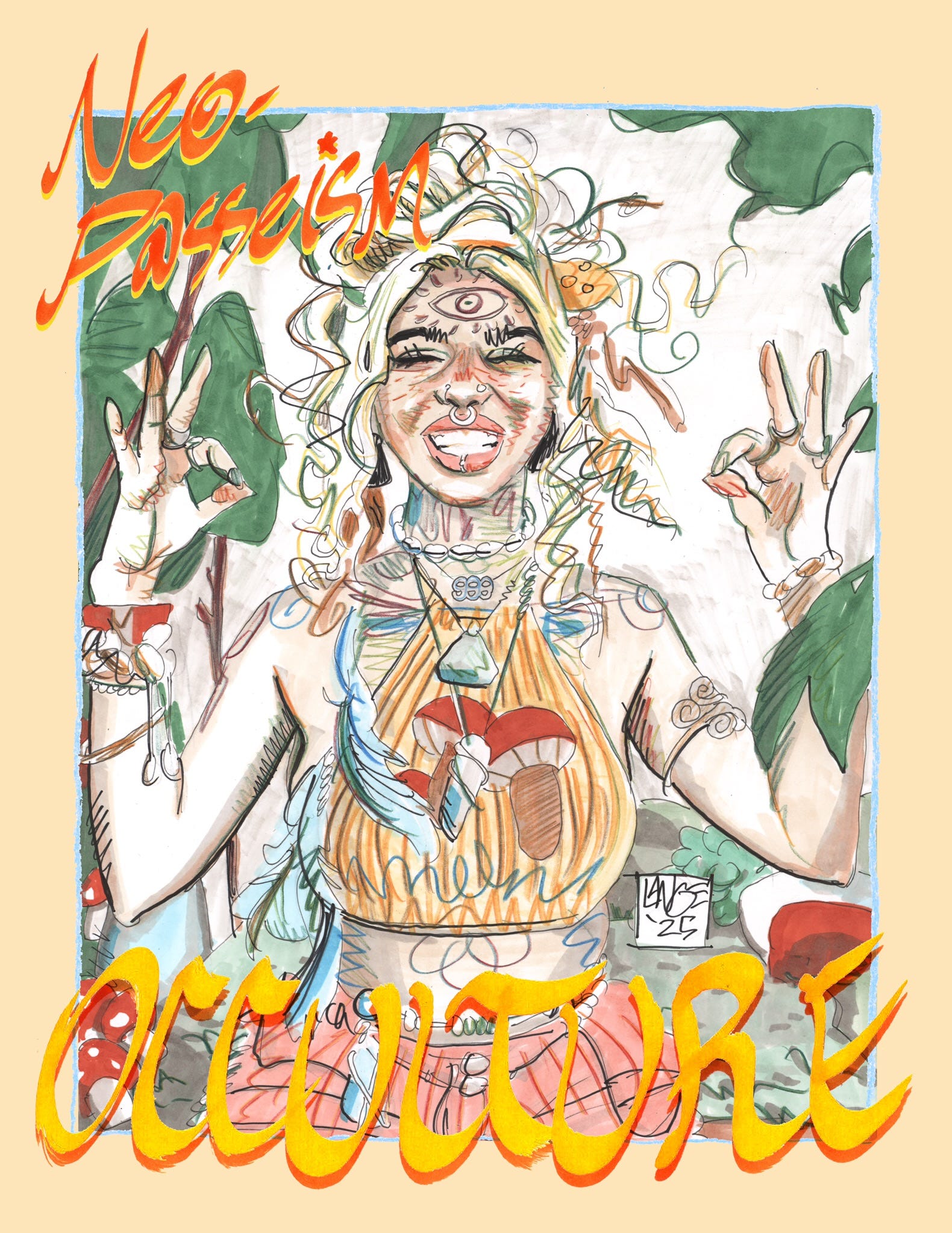
art by Aaron Lange and Dan Heyer
Worth noting that it was once almost universally the case that prospective students had to actively search out their mentors, who actively hid from prying eyes so they could cultivate their silence, vision, and craft.
With the internet the search was abbreviated, losing much of its significance and risk, and hence much of its sorting power. Those of us too picky and careful with our trust had to teach ourselves.
Excellent post! I’d like to try and articulate a response, when I get the time.