
Readers
what no visionary writer wants

“Lately we’ve noticed many so-called writers who appear to publish volumes of fiction and poetry solely to milk validation from the class of citizens known as readers. This is the simpiest and most cucked-out thing we can imagine, when it is remembered that most of these ‘readers’ are simply eye-skimming simpletons possessing neither taste nor distinction. Having numerous ‘readers’ hardly merits esteem; one may as well publicize the number of filthy indigents encamped in one’s living room. If you’re still writing books with the hope of amassing a puerile cult of readers for financial or other reasons, you should consider your life choices very carefully.
All of this should be obvious, yet many needy, talentless and otherwise cow-like typists have achieved publication, moderate acclaim, etc. in the ‘world of contemporary letters,’ which at present exists mostly as a minor side quest pursued by various business concerns in the interstices of their real publishing priorities. Exposing the deficiencies of these arriviste mediocrities is a worthy pursuit. But it is equally important to attack the contemporary class of book-reading types who in most cases are little more than over-pedigreed PMC ingrates with flabby bodies, bad clothes and minds full of rank cliches + the most juvenile of predilections.
Readers over the age of 70 are usually made of better stuff and are capable of intelligent discourse. But with younger generations—those around 65 and below—a tendency to read books is mostly a ‘red flag’ that we should be aware of when choosing friends, lovers, business associates, etc.
The task of cataloguing the least tolerable kinds of readers is an important public service and should be taken more seriously. Needless to mention, the readers of ‘Young Adult’ books, ‘Genre Fiction’ and the like are not to be tolerated for a moment. Similarly, the ‘transgressive’ class of aging bourgeois adults presents an occasionally amusing spectacle but is too pathetic to really be contemplated for long.
And the sort of reader who undertakes ‘challenges’ or otherwise views books as a Protestant self-improvement scheme of strenuously applied self-discipline is the worst of all. We note that these types are often enabled and abetted by the dreary productions of the George Eliot or John Gardner sort of novelist and their modern descendants, whose prosy moral concerns should not be permitted to intrude for even a moment on anyone’s mental equilibrium. These types and their readers alike would be better-suited to working on some sort of local council or even soup kitchen rather than concerning themselves with literature.
The logical bind of writing books is this:
A. Non-readers are, on the whole, better-educated, more worldly, more personable, more sexually attractive, more trustworthy and more perspicacious than readers.
B. Non-readers don’t read.
Can a better class of reader be magicked into existence through raw persistence? Can non-readers be CONVERTED, missionary-style, into readers? Judging by the available evidence, it seems unlikely. Boosterism and recruitment schemes tend to attract only the worst sorts.
So, why write? Irrepressible boredom with human life is probably the only remaining motive for producing worthwhile books, as well as the masturbatory joy to be derived from typing out crude pornographic fantasies and works of philosophical Idealism that posit the world to be something other than what it clearly is. After attaining comprehensive success in business, exhausting all conceivable sexual excess, exploring drug abuse, and eating many varieties of chocolate rolls and strawberry-studded sponge cakes, there is very little for the active-minded person of some intelligence and facility to do with their time. Family life is at best an inconvenience, and the gushy spiritual diversions of the charismatic and credulous produce mere disgust. The noble advances made by TikTok and Instagram have done much to palliate our boredom, but there are only so many short form videos it is possible to watch in a day, and after a while, the work of writing must commence. The struggle continues, but READERS must have nothing to do with it. Do not allow these types to vandalize your prose with their filthy, unwashed, middle-class eyes.”
—Justin Isis
“A rare event. Celestial even, like the conjunction of all the planets. I agree with Justin Isis on something.
Truth be told, I also think the writer shouldn’t write with the reader in mind.
Now where we diverge. He says the reader is finicky. To use my own words, possibly retarded. The reader has bad taste and bad judgment. Writing for the reader guarantees your work will never be remembered.
However, I think the reader is a spook. A pure abstraction. Therefore, we cannot rely on anticipated readership as a reference point for our writing. I often see phrases like, ‘readers may not’ dot dot dot, or ‘readers tend to’ dotcetera, but no one, NO ONE can predict how the market reacts.
How do I know this? Because publishers fail consistently at this game and it’s their job to do it. The reader is an amorphous blob. Fuck em. Write things and then write more things. Take as many risks as you can because risk doesn’t matter—you’re going to fail anyway! Might as well swing for the fences, right?”
—C.J. Heath
“A few years ago, I wrote about the IDEAL READER. I wondered what would happen if all literature were broken down into a one-to-one correspondence, texts on the novel form, with each person writing each text for one other (random) person who may not even yet be born, perhaps forcibly—who knows what the future might hold? Would we fantasize painfully about the reader? A woman in a skyscraper above a constantly burning city with an uninterpretable gaze, a man stranded on some trash island in the middle of nowhere, clinging to a piece of paper, or perhaps even the last reader ever, clinging to the dead religion in some dungeon reserved for erstwhile Luddite sects.
At the time, I was trying to understand the bullshit that writers spew when talking about their audiences. Stephen King writes to and for his wife; others write for themselves. Most people, though, are writing for a mean or an ideal mean, and the reader has come to embody this formless statistical concept, an egregore of marketing and slop. This is the current reader, molded out of the imprint of decades of workshopped writing. The loathsome fan who reads books like they watch television, and people clamor, at least they’re reading, at least they’re reading.
At the time, I was concerned with all the concern about ‘content overload’ and figured that, if we are reading all the time, even if it’s mostly bullshit, some truly fascinating subjectivities (the point of being a reader is consolidation towards interestingess): ‘We’ve Made TOO MUCH CONTENT’; ‘The Internet Is Rotting’; ‘Drowning in a Sea of Information’; ‘When There’s Too Much Information About Writing To Actually Write’; ‘Individuals and Information Overload in Organizations: Is More Necessarily Better?’; ‘Every second around 6,000 tweets are tweeted on Twitter’; “CAN YOU READ…TOO MUCH?’
I thought, maybe drowning in slop could pave the way for people not being able to not-drown, but perhaps to drown in something more refined. The result of this, however, almost impressively quickly since I marked them down in 2022, has been that the children, sick of all this, are unable to read. Which was foretold pretty much as soon as photography as a thing dropped.
This means that ‘the reader’ will, in the near Neo-Passéist future, land somewhere in the same category as the dreaded Jazz Dad. I’m convinced that the Harry Potter/fantasy adults are really just TV addicts who use the big fantasy books like heroin users use suboxone. I’m not sure they should really be considered here at all.
The academic types aren’t completely hopeless, depending, and anyone who uses books to get laid, i.e., ‘performative readers,’ must be having more interesting sex than people who use, say, designer clothing, but probably less interesting than people who use weird injections. Ironically, the people who shut themselves up and read all the time are just about as boring as the people who don’t, unable to translate their immense bibliomania into anything resembling social behavior. I applaud this near-feral state, but don’t think we can pin our hopes there either.
The only option that seems realistic, perhaps, would be to ban reading. This could, in the stretch, add some stakes to the game. The arcane knowledge would proliferate underground for ages and sharpen everyone’s comprehension to a slick blade, ensuring the quality of every minute read, so when the data centres eventually burn out, and the nuclear reactors go quiet, they can emerge again, walking out into the world to find, with true-knowledge from generations of silent, unseen reading, their ideal reader.”
—Ben Dryth
“By any reasonable use of the term, I am a reader, and I have been since I learned to read, when I was well into the first grade, the last child in my class to pass the reading exam. According to the standards of the American school system, this means that reading came late to me. This is very late by the standards of other readers, who often carefully specify their precocious grasp of the written word. A typical report: ‘At two I could barely enunciate mama and papa, but I was certainly reading the carefully crafted prose of John Updike. As I mounted my tricycle and attempted to cross the street, I felt the spirit of Rabbit Angstrom take me, and I was on the Run, away from the suburban mire that was slowly sapping my vitality.’
Setting aside my severe astigmatism, uncorrected and as yet undiagnosed, the hesitancy with which I learned to read was primarily driven by a belief that the words on the page served to restrict my imagination. My parents read to me before bed, almost every night, but my favorite books were the ones with elaborate pictures and no words. I liked to make up my own story to go with the images, and I remember feeling, on more than one occasion, that the words my parents read off the page forced my own story to dissolve. My breakthrough was in the realization that I need not hold those words as sacrosanct.
After I learned to read, I read everything I could see, often reading, out loud, any words that I encountered: restaurant menus, grocery store labels, traffic signs. Shortly into my career as a reader, an uncle who did not yet know me well came to visit and took my sister and I to the toy store. When I used the toy store bathroom, my uncle was shocked to hear me emitting a constant stream of curse words from the other side of the door. Later, he confronted my parents about the circumstances that had led to me not only knowing all of these cusses, but also unabashedly singing out cock and shit and fuck at full volume. My parents, equally disturbed, interviewed me, and I reported that I had just been reading what I saw on the wall of the stall.
I quickly graduated from picture books and signage to what we, at the time, called word books, because they only (or mostly) contained words. From that point on, what trouble I got into in school was typically related to my reading. It was common for me to be punished for reading a book on my lap rather than paying attention in class. I often skipped assigned readings to read a book I preferred. My reading habits have continued into my adulthood. Books are central to my life. I read every day and I try to write, at least briefly, about every book I read.
So, again, this time with evidence, I confess: I must be a reader. What, then, is there for me to criticize?
A digression is in order. In The Beach Beneath the Street, McKenzie Wark relates a story about the Italians who came to France after the Second World War to help repair the vast number of buildings with damaged stonework—Italy, at the time, had many more people who were skilled at doing this sort of work than France, due to elaborate stone facades having fallen out of favor in France. The French typically referred to these visitors as stonemasons, viewing them as workers. This was very offensive to the Italians, who viewed themselves as artisans who did stonework. To identify them as stonemasons—workers—was to vulgarize and trivialize their skill, taking away the active and caring parts of their effort. To these Italians, it was their artisanship that had brought them to France. As they restored these centuries-old facades, what mattered most was that care be taken, so that through restoration these buildings would once again be made beautiful. Through their objection, they resisted being made into interchangeable tools, foregrounding the need to employ aesthetic judgements as they worked to undo the damage that had been done. Their purpose was not in the restoration itself, but in the beauty that was brought forth through the restoration.
Trapped within the single concept of the reader, there are two senses of reading, mirroring the worker and the artisan. For the reader-as-worker, reading is an act of utility, though the utility varies widely: Among other possibilities, reading a book might be a way to build skills, gain knowledge, contemplate morality, pass time, distract oneself from the horrors of living, or be entertained. The artisan-reader, instead, approaches reading from an aesthetic perspective: reading acts as a pathway to manifold aesthetic modes, to varieties of beauty.
Allowing that distraction and entertainment are utile, we might reclassify the worker-reader and the artisan-reader as the utilitarian and the aesthete. The utilitarian reads in service of a task, any task. This need for specificity of purpose allows the utilitarian to be easily integrated into the consumer classifications that drive so much of our culture. Analyzing the habits of utilitarian readers leads to a glut of faerie fuckbooks and guides to maximizing your potential. To read for utility is to become an interchangeable target of the consumer machine, just as the French who referred to visiting stonemasons made the Italian artisans interchangeable. The aesthete, instead, reads in service of recreating the world they inhabit, by encouraging encounters with beauty, but also by allowing what they read to touch upon and change who they are and how they encounter the world around them. The reading of the aesthete is often driven by whim and accident. I have often stumbled into a book that has rushed into me, changed me, and, temporarily at least, seemed to cure some sickness that I felt in my soul.
The utilitarian and the aesthete, of course, are ends of a range, with most readers occupying the mixed modes between them: The most hardened utilitarian has, I pray, experienced a rush of pleasure or sorrow at encountered words; and every aesthete has, at some point, read an assigned book. Each of us, however, has it in their power to set purpose aside and lean towards caprice. For those to whom this does not come naturally, it can be hard to escape utility. If you see the utilitarian in yourself and are inspired to move away from that mode, be careful not to treat aesthetic engagement as one more task.”
—Siobhán M. La Grippe
“Octavio, 26, his body already incubating the carcinoma that will end him, edits his Tinder profile to update the latest book he read, along with its rating (4 stars) and a short review (‘almost as good as the movie!’). He switches over to Instagram; his bio reads «reader & daydreamer—fueled by caffeine and sighs—down for anything decolonizing,» three phrases that function as heraldic devices: the declaration, the confession, the moral credential. His posts alternate between selfies and pictures of books, some arranged by size and colour in shelves, others stacked over the desk with post-its blooming from their margins, and a few more lying open over his bedsheets. In truth, he reads very little: he prefers to read the books’ Wikipedia articles or, if available, watch an adaptation because, as far as he is concerned, knowing the plot of a narrative is tantamount to having read it. He would never dare imagine that reading can be an act of intellectual, emotional, or even spiritual dismantling. The captions under his photos are pilfered from other readers’ accounts, and more often than not include apocryphal quotations he never bothers to fact-check («‘one day you’ll be loved for who you are, not for who they want you to be’—Franz Kafka»). He only buys books he thinks will translate into something marketable for him: relatability, authenticity, sentimentality...anything else is discarded as indulgent. Back on Tinder, he swipes left on women who do not seem sufficiently bookish while he sips on his decaffeinated mochaccino. As Octavio waits for all the effort he puts in ‘being a reader’ to finally pay off, he remains blissfully unaware that his own body is writing the final chapter to the one story he will be unable to skim through.”
—Ramon Alanis
“You are in the only checkout lane at a local grocery store. The elderly lady in front of you, laughing, pulls out her coupon book. Welp, might as well do some reading while I wait.
>Reading through a Wikipedia article once
>Skimming through an online news article
>Actually reading a book
>Realizing you have to read a book more than once to actually read it
>Turning to page 69 so you can rip it out and eat it (perfection)
I love reading, I think I always have in a sense. It’s my favorite hobby, and something which I think I will take to the grave with me. On the other hands, I treat reading as a prayer—I try not to be too public with it, and I try not to really virtue signal about it. I’m a low performance male, and I’m happy about that.
K Punk is defined as ‘hi tek, low life’, but I guess for me, I try to embrace a ‘hi lit, low life’ attitude instead. Even then though, I’m not opposed to smut or other things (Reading Anne Rice and Ramses the Damned, for example—damn, he’s quite fine, and if you can get past the sex, it’s a really interesting book). I think reading bad literature is the equivalent of eating junk food, but virtue signaling about good literature is the equivalent of taking a photo of your fancy 5 star dinner for Instagram, when you should be damn well eating it instead. Most readers, I think, are like this. They barely take the time to digest what it is that they read, they have poor reading comprehension, and they’re jumping from big book to big book. Slow down a little, enjoy what you’re reading, taste the wine or the mountain dew—whatever floats your boat.
Reading bold books doesn’t necessarily change the readers, though we think it may (or may make us richer people overall). It all depends on how we read, and the ability we have to immerse ourselves in what we read. I do think that for a society that is all about speed, convenience, and optimizing information to be used to capture attention, we have a dearth of real readers.
Whatever you read, whatever you write—make sure you really put yourself into it. Make sure that you take the time to be slow, to be chill, to have fun, to smell the flowers, to really read behind the lines and within the words. If you’re reading a book a week, if you’re speedreading essentially, you ain’t doing that.
Nurgul sits alone in a musty, submarine Covilhense apartment trying to write a shitty novel. He remembers the writing on the wall, the cubicle wall of the local taverna’s toilet to be precise. ‘Cumslut Craig’ left his mobile number and apparently gives amazing blowjobs.
He notices the fungus is acting up again. Someone chop off his hands so he can never type garbage like this again.
Anyways, to get back to your experience back at the grocery store checkout—the old lady finished long ago. You’re currently paying for your things, but now the tables have turned. You are the one tying up the line, you are the one forcing the people behind you to read whatever they can on their phones. You made the mistake of giving the cashier a large bill and every time you think you’ve stuffed the last coins into your wallet, the grinning cashier shoves another fistful of coins towards you. The angered shouts of the faceless masses behind you intensify with each new fistful of coins shoved into your hands.”
—Nurgul Jones
“Contrary to what some may believe, the dawn of so-called ‘reality’ programming and social media platforms, which in turn have led to a degree of excessive performativeness in a number of sectors, is not some new development into areas where it previously had not established a toehold, but is in fact a neo-conservative and reactionary devolution to a period in history where, in regards to the preliterate civilizations (when large swaths of the populace were unable to read), reading was not a private affair but a public one, with a strong oral component. But as human civilizations evolved and more and more people became literate, this oral component mostly fell out of fashion (aside from, of course, situations like parents reading books to children, or taking part in book clubs, or attending author/poetry readings, etc.), and reading became less a social interaction and more a private and introverted ritual, the almost intimate act of personal psychic communication between the writer of the text and the reader who read it. Using religious orders as a metaphor, it became a contemplative exercise, as opposed to an active/apostolic one.
Now, in light of the cultural degradations mentioned above, one cannot simply ‘read’ a book, one also must react to it, preferably in a very public and demonstrative way. Whereas in the past this may have amounted to nothing more than writing thoughtful reviews online or recommending it to a close friend, for many people it has simply become an excuse to act out their individual psychoses and neuroses on a very public stage, broadcasting their reactions and opinions to as many people as possible, not only family and friends but also total strangers. Hence the advent of digital arenas such as BookTok, which, while occasionally in some cases influencing people to seek out books of some literary value (Dazai’s No Longer Human and Ellis’ American Psycho spring to mind), for the most part just serves as a platform and megaphone for the deplorable performativeness that is the Scarlet Letter that blots our febrile, anile century. I’ve seen many a video online showing people reacting to the books they’re currently reading in various bizarre fashions: yelling, screaming, whooping, dancing, gasping, swooning, sobbing hysterically, and so on and so forth. I’m fully aware that, like almost any art medium, many books often do have the ability to induce in the reader powerful emotional reactions such as laughter and tears, and I myself have often been moved in such ways, but within moderation and with temperance, and, most crucially, privately, in stark contrast to many of these BookTokers, who act with all the restraint of Swifties glutted on Red Bull energy drinks. In this respect, they remind me of the typical 21st-century hipster novelist, where the importance is placed not on the book that one has written (which is usually nothing more than an empty prop anyway), but on the social status that one has gotten for having written a book in the first place. When this critique is applied to the modern reader, we quickly see that the actual book that one has read is less important than the act of having read it (along with the reaction that accompanies it). Put crudely, in pornographic terms, if the book itself is the perfunctory narrative to the pornographic scenario, the reaction to reading the book is the ‘money shot.’
Another annoying characteristic of modern readers are those who reject novels that aren’t written in the first person mode, as detailed in a recent article on Slate entitled ‘I Before She,’ by Luke Winkie. These readers, who more often than not typically fall into the Romance fan category (or, even worse, Romantasy), for whatever reason find books written in the third person narrative mode impalpable because (among other things) it prevents them from self-inserting themselves into the text in question (this is hardly surprising, as most people in our society have only the most tenuous grasp on the 3-dimensional world at best, and perhaps could not even fathom the idea of life in a 4th-dimensional space, let alone the third). This is representative of a condition that afflicts many modern Romance readers, who (and here they remind me of the female equivalent of the male comic book nerd who has very specific tastes that must be catered to at all costs, or watch out!) not only have very narrow parameters of what they expect to get out of a book (usually some variety of enemies-to-lovers plotlines, girlboss dragon rider fantasies, gay hockey players, and Greek gorgons updated à la pop culture feminism, typically spiced up with a little housewife kink), but who also have a tendency to reject any book in which they cannot see any aspects of themselves, or in which they feel unrepresented. What these people are really looking for is not a book, but a mirror, and while they often claim they read not to think, but to escape, I would in fact argue that they read not to escape, but to wallow, like swine, in the narcissistic slime of their own petty, vainglorious egos.
Furthermore, another loathsome development of the cult of BookTok and its army of influencers is a sort of narrowing of one’s literary horizon, in that they often fuel in their followers a desire to ‘follow the herd’ and ‘do as I say,’ rather than encourage one to seek out the hidden pathways that make life interesting and rewarding. What all this leads to, of course, is a breed of lazy and conservative readers, readers who are incapable of seeing in a book anything other than an excuse to embark on a little mindless entertainment (or, even worse, to indulge in self-promotion), readers who are either afraid or simply indifferent to the idea of seeking out books that do not reflect their own worldviews back at them, or books which might even unsettle (or, at the very least, challenge) them or force them to look at or consider things in a different light. In other words, Kafka’s famous quote about how ‘…we need books that affect us like a disaster, that grieve us deeply, like the death of someone we loved more than ourselves, like being banished into forests far from everyone, like a suicide. A book must be the axe for the frozen sea within us’ is a sentiment that is perhaps utterly threatening to most modern readers, a gauntlet thrown down that they are ill-disposed to pick up. Understand that I’m not arguing that one should only read difficult or challenging books, or that one should never read books just for fun, or that I’m so elitist I think that just because something is popular it must therefore suck, for certainly I’ve found things of worth in books that are otherwise very mainstream and beloved by many (although I will admit that I did enjoy the following quotation when I first came across it in Nietzsche’s Beyond Good and Evil: ‘Books for everybody are always malodorous books: the smell of petty people clings to them.’). What I am arguing for is balance. I know a fair amount of people, myself among them, who on average read not just for pleasure, but who also seek out the lesser-known books, the more difficult books, the sometimes sadly ignored books, the stones rejected by the builder. Sadly, I also know just as many (if not more) people who, while docilely accepting the books that the Mainstream holds out to them, have no real inclination to strike out on their own path in search of books that may take them out of their own cyclopean reality tunnels and into new, occult vistas of novelty and glory. Reading, like many things in life, is an art form and a talent in and of itself, and one in which most people are, tragically, deficient.”
—James G. Champagne
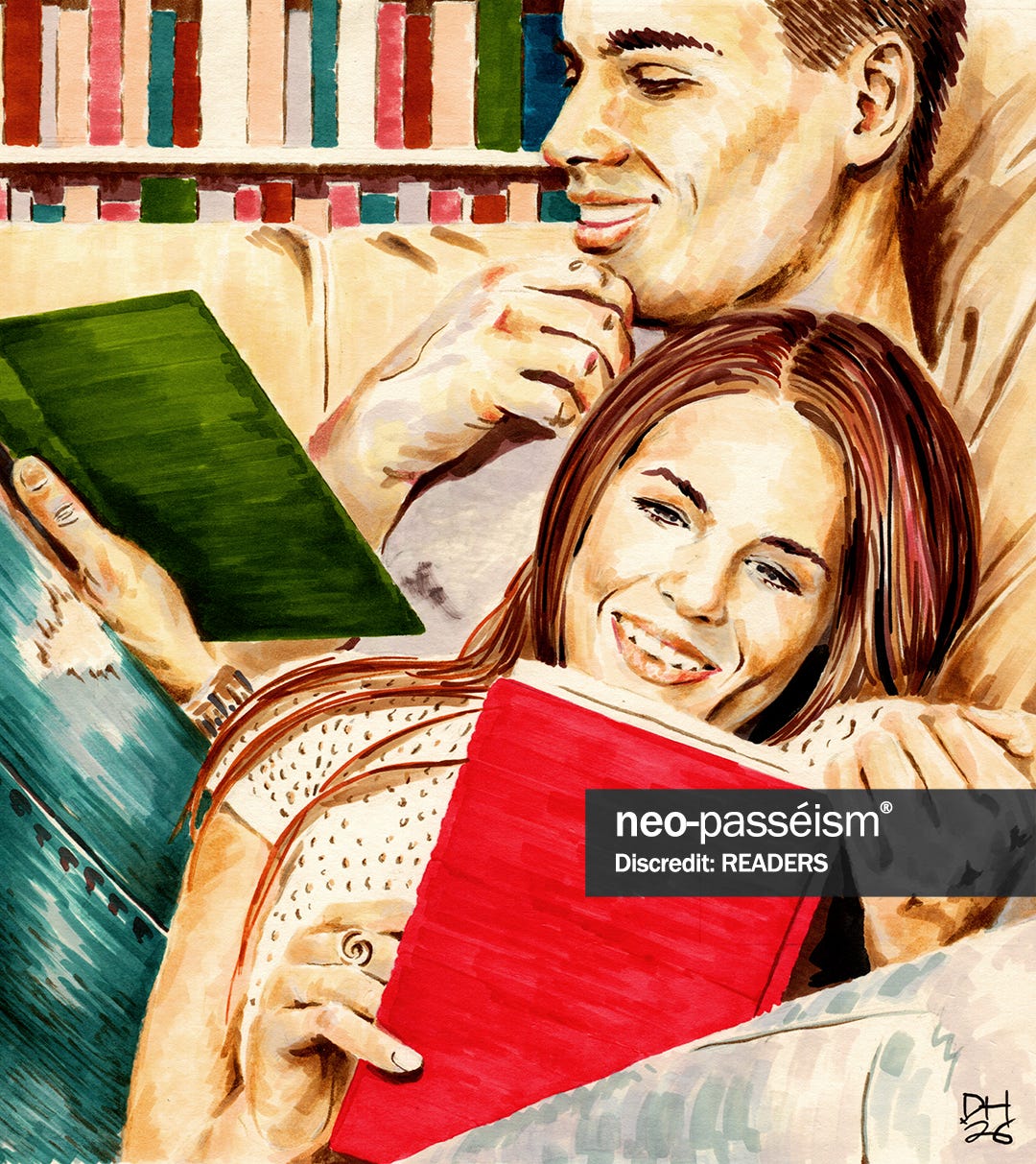
art by Dan Heyer



Very much agree. The only reason to write is to write for oneself. Most people are very retarded. Why stoop to their level-- if you're an interesting person, the things you write for yourself will also be interesting.
Also, a single paragraph of this piece would cause the entirety of 'booktok' to drop stone cold dead. 🏆
(The word booktok feels so unpleasant in my mouth. The word 'romantasy' brings me to convulsions. I feel strongly about these things because I heavily advertised my first book on tiktok and therefore was directly exposed to all that poison)
Peak NP. However, I must add that all this applies not only to readers. See: the existence of the redditor. This is the age of pseudointellectualism and pseudoculture - what happens when the high is accessible to any and everyone for consumption, for anything consumed must come out digested.