
Batman
The Dark Knight Rises (Below Vulgarity)

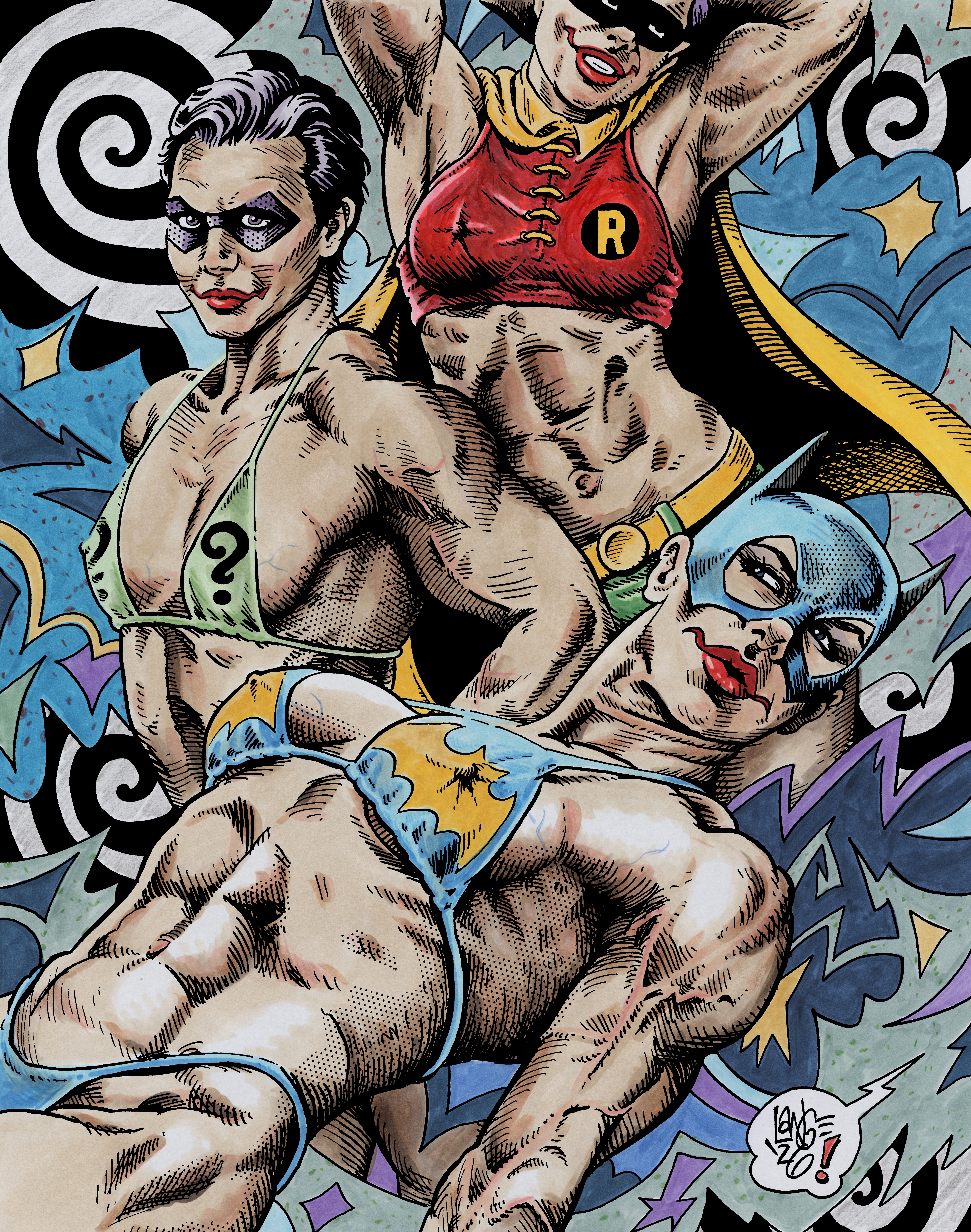
“This little rich boy pissant Bruce got his knickers twisted when his mom died clutching her pearls, father fighting back when he should have damn well known better, with the drop well put on them by someone with much less to lose, and much more hardware. Aw, lil Brucie…was Daddy more concerned with his material wealth than the life of his family? That must sting, huh? If you don’t understand that perspective and why it’s Daddy Wayne’s fault, even without empathy for the desperate man, then you are a bad person and don’t understand the word desperation. Bruce certainly missed the point, and you might have too. That would be very American of you, and by extension, very Neo-Passéist.
I am to understand that this crucial origin scene for Batman is often twisted in the now dozens of iterations of the story told at least twice a generation, and I get it. It’s crucial exactly how this one event went down, in the whole story arc. Why tweak it though? Societal attitudes or whims of the storytellers may be the initial culprit, but the result of the flux is a careless swiping to collect more cop recruits. The classic version of the Batman story depicts a petty criminal who helps a random lick go bad by pulling a trigger. This depiction is a broad-sweeping stroke to collect your run-of-the-mill asshole bound to be a cop, do-gooder assholes. But some assholes dream to be bigger assholes than others, so other versions of the story have that criminal, or even the Joker, commit the crime as part of a greater criminal conspiracy with the Mafia or something. So now the Batman psyop had caught American History X style honor vigilantes as well as everyday jerkoffs in its recruit net. See also: Punisher.
Believe me when I tell you that a good portion of City Cops and most Correctional Officers have either a Batman or Punisher tattoo on an arm, somewhere visible, t-shirt cuff height down to wrist, if not on their neck. It always pairs well with their TAPOUT tramp-stamps and non-tribal geometric meaningless symbols, sick with symmetry and done cheaply and poorly enough that the fills are splotches of grey. All these things, and the sheer magnitude of ready examples of these tattoos on law enforcement are proof that the Batman psyop worked well. It also follows that these tattoos represent the poor dumb white working-class worship of their lords, the rich men in their fortresses, capable of technological wonders and keeping you safe. It’s insane that we must write that this is bad to suggest and dumb ignorant to enjoy, even passively, but we must and it is, Hurst and Rockefeller and Carnegie’s witchcraft echoing sharply in our cavernous chests, our lungs black with coal and tobacco, our backs broken and aching from shoveling the engine, balling the hammer, and sucking our own cocks. These are very American tropes.
It is also very American that Batman celebrates Individualism to a sick degree. Batman can easily eliminate major threats himself, where his buddy the police commissioner and his army of badged high school bullies are always ineffective. This makes Batman, who has made himself Judge, Jury and Executioner, the highest and most perfect arm of the law in Gotham. What kind of message does that send to the irl cop recruit? Is that why he gets the tattoo? Is that what he wants me to feel when I see that tattoo, as I sweat out an orange jumpsuit or a green turtle-shell on a concrete shelf? I think it is exactly what we were meant to feel.
I had an acquaintance in the scene in Atlanta that got kinda famous with an Oddities show on TV, with his circus tarps and Houdini memorabilia. He always kinda pissed me off, dating women after they and I had broken up, but that’s not really the point. He is the kind of guy that brags about his 1950s Chevrolet that he took to prom, with a girl in a poodle skirt. I wouldn’t call him a Greaser, but it’s a fine fucking line. One day he starts going on about his Batman collection and love for the character. I read him the riot act out of the blue and ended our friendship on the spot. He now thinks I’m crazy, and I guess that behavior is a little irrational, but I’m not wrong. Fuck him and his Batmobile. That was the beginning of my hate for Neo-Passéism, long before I was introduced to Neo-Decadent ideas. Batman is a posterchild for Neo-Passéism.
I am sure that my ND friends that share authorship in this article will discuss how obviously Neo-Passéist it is to recycle the character so often, to reboot the franchise, to tweak the costume, to continue to closet the main characters, etc., so I will let them do that. My contribution here is to say that the police are deeply Neo-Passéist and their easily observable worship of the Detective Comics franchise is proof. Take a shower. 1312.”
—Ryan Pitchford
“Fuck Batman and here’s why. Look, Batman stopped being a guy in a suit (he was never a superhero, stop calling him that) sometime around the moment America collectively realized that ‘billionaire orphan beats up mentally ill people’ was not a character arc but a national fucking mood. (Staring right the fuck at you, Tim Burton.)
Batman is a tool. He’s a cultural tuning fork struck against the steel ribs of American anxiety. He vibrates at the exact frequency of whatever collective crisis we’re marinating in, decade after decade.
Batman is not a hero. Batman is not a franchise. Batman is not even a story.
Batman is an artistic medium.
Like ballet. Like jazz. Like stained‑glass iconography but with more sadboi rooftop brooding and fewer saints. (All the martyrdom, tho.) Batman has mutated and evolved into a whole-ass art form in a way that no other superhero, IP, or franchise has ever done.
Every generation picks up the Batman medium like a brush dipped in the shit-scented psychic runoff of the era and smears its fears, fantasies, and delusions across Gotham’s Neo-Noir, Art Deco skyline. Writers, directors, animators, actors—they’re not ‘re-making Batman.’ They’re interpreting Batman the way a dancer interprets Swan Lake or a painter interprets the Crucifixion.
And the interpretations tattle our fuck-ups, loud and clear.
The Golden Age: Batman as STEM Propaganda with a Cape
See, early Batman wasn’t about trauma or fascism or moral ambiguity. He was basically a noir‑flavored STEM poster child.
The cultural thesis was simple: Innovation and logic will save us.
This was the era when the American ethos was deeply rooted in science as moral obligation. Culture said science = progress, and progress = a better world. Remember how all of the technology that came out of the war was going to save us from ever having to go to war again? Batman was a walking Popular Mechanics subscription. A fucking TED Talk with fists. A man whose superpower was ‘I read the manual. And also…I’m rich.’
Artists in this era used Batman to express optimism. The belief that the world was fixable if you just applied enough elbow grease and maybe a grappling hook. Hard work and loyalty were the ultimate keys to success.
It was earnest. It was hopeful. It was a national pep talk in a pointy-eared cowl.
The Silver Age: Camp as Cultural Pressure Valve
Then the world got…strange. Like really fucking strange.
Nuclear dread. Cold War paranoia. Vietnam. Psychedelic everything.
Suddenly, Batman becomes a Day‑Glo fever dream where morality is a fucking punchline and villains are essentially drag performers with themed crime sprees.
This wasn’t just a tonal shift. It was a coping mechanism.
Artists used the Batman medium to say ‘If the world is absurd, then let’s be absurd louder.’
And here’s where we must pause and honor the Adam West era—the show many of us grew up on, the one that shaped our aesthetics. Our humor. Our kink‑art‑kink feedback loops. Our understanding that camp is not frivolous, but revelatory.
Adam West’s Batman wasn’t silly. It was strategic. It was the cultural release valve for a nation terrified of annihilation.
Example: The Batusi wasn’t just a dance, it was proto-Laugh-In. A burst of psychedelic absurdity two years before Rowan & Martin turned that aesthetic into a national language. Batman got there first, slipping surrealism into prime time under that ridiculously ill-fitting mask.
Camp Batman said, ‘We see the darkness. We’re choosing glitter.’
And that choice mattered.
It mattered in a world where women couldn’t open bank accounts without a man’s signature, where contraception required a husband’s permission, where abortion was illegal, and where the culture insisted—LOUDLY!—that women were decorative. Compliant. Grateful for whatever miserable fucking scraps of agency they were allowed.
Into that suffocating landscape strode Julie Newmar and Eartha Kitt. Two women who refused to shrink. Fresh air in Hollywood’s desert landscape.
They didn’t play Catwoman. They dressed themselves in her. They wore her like fashion. Like fine jewelry. Like a transgressive calling.
Julie Newmar slinked onto the screen like a satin-gloved revolution. She wasn’t the good girl, the scenery, the wife, the moral lesson. She was desire. With claws. She was a woman who wanted things—power, pleasure, control—and never apologized for it. Her Catwoman wasn’t a villain. She was a jailbreak from the cultural script. She made camp dangerous. Erotic. Subversive. A sensual and sparkling refusal to be small.
To Wong Foo, thanks for everything? Indeed!
Then Eartha Kitt arrived and turned the temperature up another ten degrees. My Kink Is My Art Is My Kink, and goddamn if pretending to be Eartha Kitt’s Catwoman with my best friend and his cousin growing up didn’t turn out to be a formative experience all its own.
I digress.
Point is, Eartha Kitt didn’t flirt. She prowled. She didn’t seduce. She commanded.
She was the first Black woman to play a major comic-book villain on American television and she did it with a sovereignty that made the country deeply uncomfortable. Her very presence was political. Her voice was political. And when she later used the full power of that voice to speak the truth about the Vietnam War—that young people were rebelling because they were being sent to die—the nation punished her for daring to be glamorous and honest.
The President punished her. For being a ‘nuisance.’
She was blacklisted for the same qualities that made her Catwoman unforgettable: clarity, courage, and a refusal to be ornamental.
This is why the Silver Age mattered. Not because of Batman (who, let’s be honest, is the absolute fucking billboard advert for ‘capitalism as white savior’—a billionaire who BLAM! punches symptoms instead of dismantling systems), but because of the women who stole the show out from under him.
The era’s camp wasn’t frivolous. It was a pressure valve. A way to smuggle danger, sexuality, and dissent into America’s living rooms under the guise of pop art.
Julie and Eartha weren’t side characters. They were the only ones telling the truth.
And the truth is this: no one has ever, never ever, never ever-ever come fucking close to measuring up to them. Not in the decades of Catwomen that followed. Not in the endless reboots. Not in the gritty reimaginings that mistake darkness for depth. Because Newmar and Kitt weren’t just playing roles. They were carving out space for women to be powerful. Sexual. Political. To be unapologetically themselves in a world that wanted them silent.
If camp was the pressure valve, then Julie and Eartha were the steam. And the world is still warmer because of them.
The 80s-90s: Capitalism and Altruism Hold Hands and Take a Fucking Swan-Dive
Enter the era where Batman leans into being a billionaire playboi savior, a philanthropist vigilante crybaby whose trauma is a goddamned tax write‑off.
This is when artists stop wanking it over BAM! POW! BIFF! and start using Batman to explore the ridiculous fantasy that wealth can be moral, that power can be benevolent, that the rich can save us if they’re only sad enough.
It’s the cultural equivalent of saying, ‘Sure, the system is broken, but what if one guy was rich and nice?’
I’m gonna pause and wait for you to stop fucking laughing.
…feel better?
In this cocaine-fueled era of stock market swindles and Reaganomics, Batman becomes a medium for interrogating the American Dream’s rotting underbelly: the idea that justice can be privatized, outsourced, franchised.
Sound familiar?
This is the era where Batman stops being a hero and starts being a brand of moral outsourcing.
Gotham as Chicago’s Shadow: The City That Invented Its Own Criminal Class
Let’s talk about Gotham. Not as a fictional city, but as Chicago’s shadow double.
Not New York. Not LA. Not some vague urban abstraction.
Chicago.
The city where modern organized crime wasn’t a glitch, it was a career path. A civic institution. A ladder with blood on the rungs.
When Gotham was conceived, the artists weren’t imagining a fantasy metropolis. They were tracing Chicago’s silhouette, then dipping it in ink until the skyline bled. The elevated trains. The industrial sprawl. The political corruption thick enough to mortar bricks with. The Prohibition‑era bootlegging empires that turned working‑class men into millionaires overnight. (Gatsby should never have taken place in New York. It’s a Chicago story that fails because it’s not set in Chicago.)
Gotham is Chicago’s funhouse mirror. Except the mirror isn’t warped, the world is.
And the mobster motif? Not aesthetic. Not flavor. Not ‘noir vibes.’ It’s a socioeconomic indictment. In the Chicago that birthed Gotham, the only way for ‘everyday people’—immigrants, factory workers, steel‑millers—to break into the wealthy class was through crime.
Not crime as moral failing. Crime as economic mobility. Bootlegging was entrepreneurship. Robbery was résumé building. This city taught its citizens one thing: the American Dream had a velvet rope, and the only way past it was to either be born on the right side or break the law so successfully you could buy your way in.
Gotham takes that truth and turns the contrast up until the screen burns.
Its criminals aren’t villains. They’re products of a system designed to keep them out unless they force their way in. And Batman—the billionaire vigilante who punches these men back into the shit-stained gutters they crawled out of—becomes the embodiment of the gatekeeping class.
He’s not fighting crime. He’s fighting upward mobility. He is the velvet rope, but with a grappling hook.
Batman: The Animated Series, a Noir Renaissance
Then we get the turning point. The interpretation of Batman that most influenced me, and so many of the Xenniel reprobates currently haunting the orange ghetto of Substack fiction.
Batman: The Animated Series.
The show that said, ‘What if we took this seriously? What if we treated Batman like a myth instead of a mascot?’
This show wasn’t just a cartoon. It was a noir renaissance and remains a masterclass in systemic injustice, economic desperation, environmental decay, institutional failure. The psychology of crime. The ethics of vigilantism.
It expanded the character carousel. It deepened the rogues’ gallery. It gave us antagonists who weren’t villains—they were case studies.
Mr. Freeze became a tragedy. Two‑Face became a commentary on identity fracture. Poison Ivy became eco‑grief incarnate.
And then—
Then came Harley Quinn.
Harley Quinn: From Simplicio to Cultural Powerhouse
Harley Quinn was born in this series—not in comics, not in film, but in animation.
She arrived as a sidekick, a comedic foil, a narrative accessory. The ‘simplicio,’ the character designed to ask the questions so the audience could learn the answers. A bright, empty toy for the Joker’s exposition and his cruelty.
And then came ‘The Harley and the Ivy,’ the episode that quietly rewired the entire Batman mythos without ever raising its voice.
This is the moment Harley slips free of the Joker’s gravitational pull—not through a tidy revelation of self‑worth in a saccharine sweet after school special. But by hitting the emotional event horizon where devotion collapses into clarity.
She leaves him.
She abandons the chaos, the manipulation, the endless cycle of harm disguised as love. And who catches her eye? Poison Ivy—eco‑terrorist, scientist, and a woman whose moral compass points toward planetary survival rather than personal validation.
Their partnership isn’t a plot beat. It’s a cultural pivot. Harley’s evolution begins here—not with a punchline, but with a choice.
And as the world changed, Harley changed with it.
Society’s understanding of trauma, mental health, abusive relationships, agency, recovery, and identity evolved. Harley evolved, too. She became a symbol of survival. A critique of toxic love. A reclamation of autonomy. A feminist icon. A queer icon. A narrative force in her own right.
Her rise mirrors a cultural shift from ‘mentally ill people are dangerous or silly’ to ‘mentally ill people deserve kindness, independence, and to be the focus of their own fucking stories.’
Harley Quinn is the mental‑health revolution in pigtails and Batman—the artistic medium, not the billionaire asshole miserably missing Mommy—made space for her.
The 2000s-Now: The ‘Villains’ Have a Point and We Know It!
This is where the Batman medium goes feral. Artists start using Batman to interrogate surveillance, militarization, economic collapse, moral relativism, the ethics of punching your problems.
And suddenly, the villains aren’t villains. They’re thesis statements.
The Joker becomes a commentary on nihilism. Bane becomes a commentary on revolution. Catwoman becomes a commentary on wealth inequality. Poison Ivy becomes a commentary on eco‑rage. The Riddler becomes a commentary on technological ethics.
Suddenly, Batman is revealed as what he’s always been: the least interesting part of his own medium. He’s the gesso that primes the canvas. He’s a rich, straight, white man in a world of compelling arguments and don’t nobody give a flying fuck about him or his point of view because he brings neither novelty nor interest to the table.
If Batman was a spice, he’d be flour. If he was a book, he’d be the owner’s manual to a Nissan Altima. Replace the ridiculous man nipples and cape with a Geek Squad polo and khakis and he would be just as ‘effective’ and ‘powerful.’
In our modern era, artists use Batman to ask, ‘What if the bad guys aren’t wrong? What if the system is the villain? What if Batman is the symptom, not the cure?’
And the medium answers, ‘Look closer.’
In Conclusion…
At some point—and nobody can pinpoint exactly when, but probably around the time Julie Newmar and Eartha Kitt got involved, if we’re being honest—Batman stopped being a character and became a genre of artistic expression.
You don’t ‘write Batman.’ You interpret Batman. Like choreography. Like opera. Like tarot.
Batman is symbolic language. A cultural dialect. A mythic toolkit for exploring whatever the world is spiraling about this decade.
Artists use Batman to:
critique capitalism
mourn lost innocence
explore trauma
interrogate justice
question power
scream into the void
Batman is the medium through which we confess our sins. It is the cultural seismograph we both need and deserve. It registers every tremor of our collective psyche. When we’re hopeful, he’s a detective. When we’re scared, he’s a clown show. When we’re delusional, he’s a billionaire savior. When we’re angry, he’s a fascist. When we’re grieving, he’s a trauma engine. When we’re lost, he’s a myth.
Batman is the medium through which we process the fact that the world is on fire and the fire has a tragic backstory.
Batman is the canvas. The world is the paint. The artists are the ones screaming into the night sky, hoping the signal reaches someone. And the signal always changes. Because the world always changes.
Because Batman is not a man; Batman is a mirror.
And we cannot stop looking.”
—Haly, the Moonlight Bard ✒️
“I. I FUCKING LOVE BATMAN RAHHHH
When this image from the latest Batman run (penned by Matt Fraction, drawn by Jorge Jimenez, coloured by Tomeu Morey) made the rounds, I recalled Alan Moore’s acerbic claim that ‘infantile love’ for superheroes (he was speaking about superhero movies, but the principle still applies) was often a ‘precursor to fascism.’ That vulgar urge for ‘simpler times, simpler realities’ lays itself bare here in the onanistic dialogue: an urge little to do with artistry or probity and everything to do with a desperation to arrest one’s development. It is writing motivated not by the manifold wonderment of the child but instead by his pettishness, his aversion from the interlocking ambiguities inherent to life.
The problem with portrayals such as these has never been one of canon or whether it be ‘in-character’ for Batman to act this way or even one of ethics—such discussion turns ouroboric very quickly—but rather why writers and editors have contrived him so. For what political, social, and corporate ends? Attempting to address real-world criticisms in comics is a self-reflexive business move that only neuters serious epistemological considerations: why Batman, let alone superheroes? Why linger on fiction when our world lies in ruin? Of course our chosen one must address the Times We Live In™, our cowled crusader must prove his doubters wrong, we must justify his existence until there be no more disbelievers, lest we run the risk of our consumerist icon—and by extension, our consumerist selves—fading into a pop culture memory hole.
Pay attention to the Big Two companies and their consumers long enough and you notice, rather quickly, a particularly frustrating class of people: people whose artistic and intellectual tastes never progressed beyond poptimistic horizons, who respond to genuine imperialistic violence with self-aggrandising cartoons and single-sentence tweets. Such behaviour demonstrates a painful ignorance of the genre’s inherent Americentric propagandisticism, as well as its political ineffectiveness in spite of it, but this is nothing new. It is merely the latest in a long line of embarrassments dating back to the Bronze Age, when puritans like Dennis O’Neill, David Michelinie and Steve Gerber thought it necessary to ‘ground’ these Arcadian archetypes in ‘our world,’ even more so than what Lee, Kirby, and the other Golden Age artists had done.
There’s Tony Stark reckoning with alcoholism in the oft-cited but largely purposeless ‘Demon in a Bottle’ storyline. There’s Howard the Duck, which found success more through Val Mayerik’s caricaturist compositions than Gerber’s attempts at Vonnegutian satire. And who could forget O’Neill’s dungheap of an arc not even the masterful Neal Adams could save, ‘Hard-Travelling Heroes’, where champagne socialist Green Arrow tags along with ‘cerebral, sedate model citizen’ (viz. authoritarian lunkhead) Green Lantern as they ride across America, dealing with such issues as racism and addiction in tones so melodramatic and preachy it would make the Pope keel; all in the name of instilling in both heroes (and by extension, the reader) the values of ethical moderation, of a fence-sitting nirvana. We see, quite evidently, the ripening of these values in those aforementioned individuals whose love for kitsch has calcified into sentimental rhetoric; who, through their unconditional adoration for a ‘blighted culture’, consign themselves to Mark Fisher’s concept of capitalist realism, unwittingly or otherwise. The system is rotten, but look there, up in the sky…

II. No One’s Watching the Watchmen
It should be made clear that comic books are not inherently unable to produce works which investigate issues of great importance (cf. Spiegelman’s Maus; Sacco’s journalistic works; Satrapi’s Persepolis). The oft-stated claim that ‘comics have always been political’ is certainly true in a myriad number of ways. Even the superhero genre—that twice-right clock—has sometimes allowed a genuinely subversive work to slip by, as in the case with Moore and Gibbons’ Watchmen, DC’s Vigilante, and Ennis’ Punisher MAX. But such work is almost always the exception and never the rule, owing to their breaking of conventions, their manipulation of rote narrative tropes, and their abandonment of Manichaeisms, all in pursuit of a conscious political aesthetic. They are worthwhile political texts precisely because they are terrible superhero stories.
None of this is to suggest that propagandistic works are always inferior. Golden Age pioneers like Jack Kirby, Joe Shuster, Jerry Siegel, Bill Finger, and Will Eisner were able to counteract the heavy-handedness of wartime programming through relentless artistic invention, regarding each issue as an opportunity to hone their craft or experiment with style, as seen in Kirby’s psychedelic collages or Eisner’s cartoonish blend of cinema with Yiddish theatre. The question of what makes a good comic then lies not necessarily with ideology or even morality but, as always, with aesthetics.
When Watchmen took costumed realism to its natural endpoint by revealing (quite literally in the case of Dr. Manhattan) how our emperors wore no clothes, and how self-victimisation and outwards totalitarianism often go hand-in-hand, it forever earned its spot in the canon. Caught between Watergate twelve years prior and 9/11 fifteen years later, the book became both a lode- and millstone for numerous imitators and divergents, many of whom learned not from its formal innovations or philosopho-political preoccupations, and instead focused on its surface-level genre commentary, as if the book were only a landmark because it dared to ask, ‘what if Justice League but bad?’
The landscape post-Watchmen was mired with pitiful, overlong stories hoping for critical purchase, as seen in Marvel’s Heroes Reborn and DC’s own ‘Death of Superman’ and ‘Knightfall’, as well as the founding of Image Comics and Wildstorm. In reaction to the lead-footed seriousness of the Dark Age of Comics, a renewed, almost post-postmodern sincerity began rearing its head, with authors like Kurt Busiek, Mark Waid, and Grant Morrison responding to the darkness with effusive light: a move which only distanced the medium further from the inflection point made by Watchmen. Astro City, Kingdom Come, Animal Man, and Moore’s own America’s Best Comics line attempted to at least reset the industry’s moral scales, if not the time passed. These works were in many ways emotively naive, driven by latent conservatism, by that same dreaded ‘urge.’ But there was, admittedly, substance to some of them, in particular ones by Morrison, someone who seemed to have more on their mind beyond the usual hermeticism of ‘canon’ and ‘continuity.’ Although you could see promise in their early homages to luminaries such as Borges and Crowley, they did not achieve aesthetic apotheosis, at least when it came to their superhero work, until their seminal approach to Batman.
III. Do What Thou Wilt
When Arkham Asylum: A Serious House on Serious Earth was published in 1989 (serendipitously coinciding with Tim Burton’s own fantastical Batman film), it became a massive commercial and critical success, and for good reason. Much has been written on its postmodern interpretation of the titular character and his rogues, its extrapolation of Alice in Wonderland, its relationship to gothicism, its psychosexual esotericism tracing back to men like Jung, Crowley, Freud, as well as the interdisciplinary nature of its artwork, influenced by (but not limited to) the proto-surrealism of Cocteau, anti-naturalism of Artaud, and the tactile blends of Švankmajer. Arkham Asylum stands as a landmark of not merely the mostly-barren Dark Age, but also of Morrison’s inclinations toward the unreal and occult. By playing fast and loose with the Batman mythos, accompanied by McKean’s own idiosyncrasy, Morrison did in a single graphic novel what Christopher Nolan, Tom King, and Matt Reeves never achieved with their staid, fussy attempts to pragmaticise the character. We see here, from the beginning, a discarding of patrician naturalism in exchange for a commitment to the bizarre and insensible.
Then Gothic comes out—serialised in Batman: Legends of the Dark Knight #6-11 from April to August 1990, pencilled by Klaus Janson—to equivocate Morrison’s commitment. The tale here is both more straightforward than Arkham Asylum—a murder mystery wrought with supernaturalism—but its phantasmagoric presentation works,for the most part. Morrison’s callbacks to the Romantic literary tradition, including texts like Byron’s Manfred, Coleridge’s Ancient Mariner, Milton’s Paradise Lost, and De Quincey’s On Murder... is mingled here with the diegesis of Batman, imbuing both the man and his city with a certain mythopoeticism. The plot revolves around a serial killer whose abilities emerged from a Faustian deal—an obvious nod to both Goethe and Don Giovanni. In tandem with Janson’s eclectic mix of Hugo Pratt classicism, German Expressionist lighting, and manga-style dynamism, the narrative is given full force. Already we see Morrison’s grasp of comic-book rhythm and a non-dilletantish knowledge of artistic traditions beyond it. With these, they take the bones of an otherwise potboiler and incarnate it with plenitudinous fabulism. As entertaining as Gothic is, however, it holds onto superheroic conventions which, while not explicitly harming the book, nevertheless prevent it from reaching the sublimity achieved by its predecessor. It is a lesser Morrison: a good yarn rather than a masterclass.
This commitment to the non-standard, though called into question with Gothic, is slowly resolved the longer they work for DC, and the longer they write Justice League, in which Batman stars. Inklings of their later reinvigoration of the character pop up here and there in the team book, but inklings. It isn’t until their run on the flagship book begins with Batman and Son that we see that commitment shaped into something entirely new.
IV. The Bat of Gotham Flies at Dusk
The run opens with a prologue in 52 #30 and #47, where Bruce Wayne travels to the snowy steppes of Nanda Parbat in order to undergo the Tögal ritual of Tibetan Dzogchen. Morrison alters the terms of the ritual, transmogrifying its contemplative practice into a 49-day ordeal where one simulates the death-process by sitting in an unlit cave. This alteration is deliberate, recalling both Plato’s famous allegory and Hegel’s circular process of the Spirit, and when Bruce Wayne emerges, it acts as Morrison’s declaration that this will not be a Batman anyone has seen before. This theme of rebirth reoccurs throughout the run—from The Joker cycling through personalities to emerge as a Derridean bodhisattva; to the introduction of Bruce’s son, Damian Wayne; to Doctor Hurt’s recasting of himself as ‘Thomas Wayne’; to the usurpation of a sociopathic ‘Zur-En-Arrh’ personality following Bruce’s psychological shut-down; to Bruce’s journey across time following his supposed death in Final Crisis; to the creation of Batman Incorporated. The idea abounds in the work but never constricts it, never makes it superfluous, thanks to Morrison’s restless ‘termitic’ imagination. As Manny Farber wrote, Termite art ‘feels its way through walls of particularization, with no sign that the artist has any object in mind other than eating away the immediate boundaries of his art, and turning these boundaries into conditions of the next achievement.’ In light of this, Morrison’s Batman doubtlessly resurrects the vibrant spontaneity of the old Ages which had faded since the 1980s through careful experimentation: from a two-issue arc spanning the entirety of Bruce’s biography, to a trip to a possible future where Batman completes his own Faustian bargain, to an issue conveyed almost entirely through prose, no fresh technique is left to rot. Everything is in service of revitalisation.
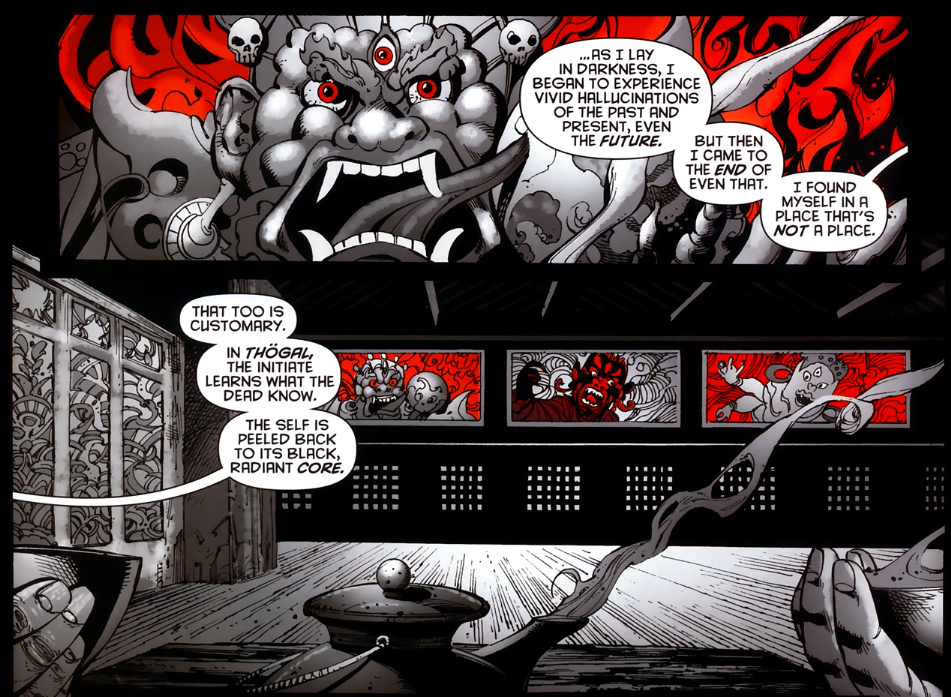
In lieu of Dadaistic horror and Thelemite undercurrents, Morrison opts not merely for a contemporary spin on Silver Age eccentricity, but a totalistic reinterpretation of Batman where everything—from Kane and Finger to O’Neill and Adams to Dini and Miller and more, to Pre- and Post-Crisis, to the live-action takes of West, Keaton, and Bale—happened, more or less. It is a profound response to problems identified in Umberto Eco’s essay ‘The Myth of Superman’: iconoclasms caught in the capitalist paradox of being both ‘consumable’ and ‘inconsumable’, lives as multiplex as gods, yet tethered to the ‘ways of everyday life’, leading to them existing atemporally, whilst simultaneously imposing themselves on the present via a ‘narrative of redundance.’ By conceiving a unified theory of Batman, Morrison circumvents this redundancy and pushes onwards with a new paradoxical teleology: telling fresh stories with a stale character, charting unfamiliar paths while carrying familiar debts. In this sense, the Morrisonian Batman resembles a Modernist Batman; the only way Pound and his kinfolk could ‘make it new’, after all, was by acknowledging those who came before.
Though the run shares DNA with postmodernism in its focus on fractal selves and deployments of non-linearity and metatext, it isn’t politically conscious the way a Pynchon, Atwood, DeLillo, or Burroughs might be. Instead, it formulates a previously-nonexistent Grand Narrative and positions Bruce as a man of order amidst a spiralling (yet entirely fantastic) world. And though it occasionally problematicises his ‘apophenia’, it ultimately redeems him time and time again as a paragon of Ultimate Good facing off against Ultimate Evil, the inexorable and ever-shifting Geist of his own mythos attempting to reconcile with the void at its centre (another common motif throughout the run, from Bruce’s childhood awareness of it, to Doctor Hurt, to Darkseid in Final Crisis). In this history-spanning confrontation, Batman slightly twists the Hegelian dialectic: he is the Subjective Spirit who resists his Objectivisation before sublating it, so that his Subjective becomes indistinguishable from the world’s Objective. Ergo, Batman becomes Gotham, Gotham becomes the world, and the world becomes Batman.

Post-O’Neill, Batman was made ghostlike, psychologised, ‘grounded.’ Now, Post-Morrison, he is so superhuman as to be inhuman. Where stood a man now stands a living, breathing edifice to his own idea. More than ever, he is made a spectacle unto himself, outstripping everyone and everything, even primordial concepts like death and time.
I extol the virtues of Morrison’s run in spite of its flaws—illustrators not all up to par, some colourists leaving much to be desired, a fidelity to editorial mandates like the New 52, the Resurrection of Ra’s Al Ghul, and Battle for the Cowl meaning occasionally an issue of lesser quality, but I digress—because it is an exemplar of the genre, one standing in diametric opposition to the comic deconstructionists. In this run, we see not the defensive ‘urge’ of Fraction’s police brutality panel but an imagination which expresses itself widely. It does not abandon heroes altogether as in Watchmen, because political considerations are less important than its ontological ones. Nor does it try to ‘elevate’ the genre with the fascistic austerity of Christopher Nolan’s trilogy, Matt Reeves’s rip-off of David Fincher’s worst film, or the torturous therapization/CIA apologia of Tom King. By mining the genre’s intertextuality and mythic capability, Morrison creates an anomaly: a superhero book which succeeds through its superheroism, not in spite of it.
In the years since its completion in 2013, Batman authors have remained unable to escape Morrison’s shadow. Scott Snyder’s initial run was ambitious and periodically interesting but ultimately overdetermined: straining for meaning when well-constructed entertainment would have sufficed. When Snyder got around to finally reading Morrison, he transplanted their ideas into Dark Knights: Metal and Dark Knights: Death Metal which gave us, among other things the single worst DC character ever created. By the end of these stories, all it proved to the reader was that he’d mistaken Morrison’s resourcefulness for bloatedness, and a careful repurposing of old comic lore for mere nostalgia. No better is this seen than in the Batman Who Laughs, a grotesque mockery designed to thoughtlessly raise stakes, whose 90s excess is presented as meaningful complexity, who represents the worst of a comic writer’s ‘kitchen sink’ mentality. Then there’s Peter J. Tomasi’s Batman and Son, wrought with a conservative mawkishness that wouldn’t feel out of place in the worst of Spielberg’s films. And the less said about Joshua Williamson and James Tynion IV—who returned to the social-justice melodrama of O’Neill with none of the pulpy, slapdash charm—the better. Chip Zdarsky seemed to be the only writer who’d actually respected Morrison’s run prior, but unlike Morrison, had no ideas beyond retreads and remixes of the old masters stripped of all their mythological vitality, or resorting to the same performative liberalism of his contemporaries.


Faced with Morrison’s multimodal approach, it’s become clear these successors could only regress or replicate. And so, it seems Ecclesiastes rings true yet again: there is nothing new under the sun, and especially not under DC Comic’s house style. it’s not as if it would be productive to rehash the Dark Age either, to deconstruct what’s already been deconstructed. Frank Miller happened, Alan Moore happened. Nor would it be worthwhile to reconstruct without qualification, as in Waid or Busiek, unless the goal is to simply reinforce the hegemony.
Thus, the industry stands at a crossing. Despite the market’s sizeable growth over the past few years and despite the tenuous profitability of blockbuster superhero movies, such statistics are unstable. The Chapter 11 bankruptcy of former industry titan Diamond Comic Distributors continues to haunt comics publishing, especially its small presses. And with overall saleability and popularity of superhero movies on a steady decline, it’s only natural to question how this has affected (and will continue to affect) comics themselves. Creatively speaking, this rut has led to some interesting explorations on Marvel’s side with its remade Ultimate Universe, and in DC’s counterpart, Absolute. Character designs are different, origins have been altered, and narratives certainly appear livelier than their respective main universes. But time is rarely so kind, especially in an industry constantly at war with its own medium. I suspect that before long (as is the case with every series which lives past its expiration date) these explorations will eventually ossify into their own particular sets of convention and rhetoric until all notion of the restless Termite is lost, until fans begin howling again, until experimentation is sacrificed at the altar of the status quo. All that is solid melts into air, all that is holy is profaned, und so weiter.
V. Wofür wir Worte haben, darüber sind wir auch schon hinaus
Once upon a time, a single floppy contained multitudes: ones which any eager reader could engage with if they so chose. Or at the very least a complete story, competently told. Not one stretched into oblivion across a company-wide event, formulated not for artistic reasons but for economic ones. Morrison (alongside J.H. Williams III, Tony Daniel, Chris Burnham, Andy Kubert, Cameron Stewart, Frank Quitely, Fraser Irving, Doug Mahnke, et al) brought this principle back from the brink and towards artistic fruition with their Batman, as each individual issue and arc cohered into an organic intertextual unity, one that constantly investigated and re-investigated itself until something genuinely transcendent came about.
But we are past the age of pioneers, it seems. Their spirits are buried, and though there are those who till and irrigate the soil, we see no buds. Our blossoms hide themselves in fear of society’s subsumptive sun. And if they did show their flowered faces, would we even know what to do with them anymore, like how we used to? Would we welcome a new Morrison, cheer them on as they ride a risky tide? Or would we balk at their fearlessness, their relentless pursuit of the Supergod? Such questions are met only with the silence of a diseased culture. To break both fever and silence, we must speak honestly on our crime, on the spectres which continue to haunt us. Before revival is even possible, we must acknowledge the blood on our hands:
“Batgod is dead: of his pity for man hath Batgod died.”
—JLG Noga
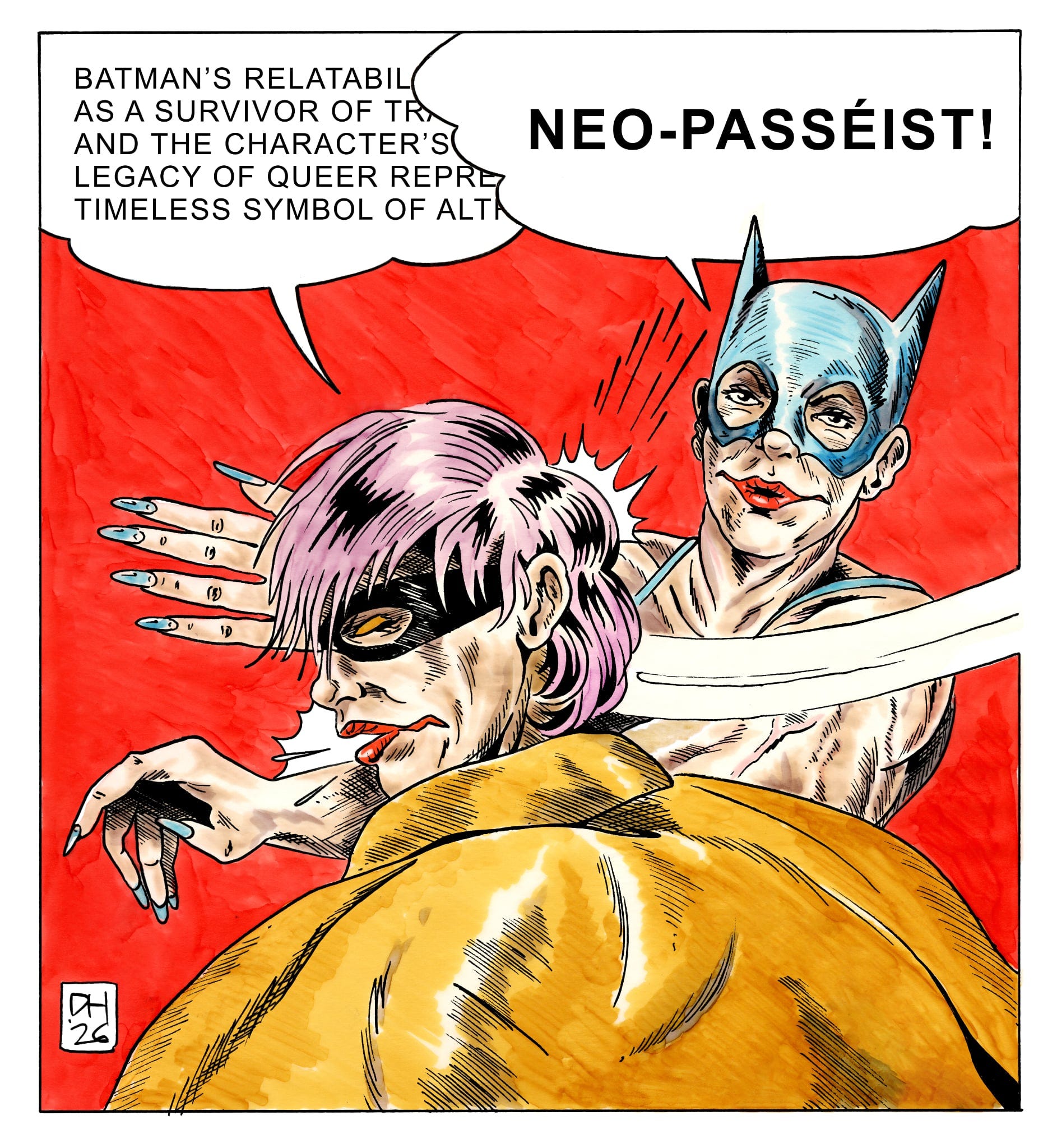
“The danger of analyzing the Procrustean choppings and changings of Batman in purely sociological terms, or even strictly aesthetic ones, is that we risk ignoring the obvious: Batman is an archon of the capitalist time hole, a shapeshifting blob of industrial mythology designed first and foremost for profits. The Dark Knight’s true brethren are other legacy characters kept alive through endless transfusions of franchising: Dracula, Frankenstein, and Sherlock Holmes. And like his older Victorian brothers, Batman has become a cipher, fully capable of meaning the opposite of what he originally meant. Just as Mary Shelley’s Plutarch-reading Byronic corpse-philosopher Frankenstein is more real for many as a comedic Munster patriarch or sugary breakfast cereal, capital can warp Batman into any shape it needs. The millionaire playboy Bruce Wayne can become a looksmaxxed working class hero, as in the recent Absolute Universe reboot, or, in a more frivolous era, a camp Dad Bod God like Adam West.
A memetic vampire capable of endless revivals and resurrections, Batman’s similarity to that other bat-themed shapeshifter Dracula would seem to be more than coincidental: both characters can morph from ‘serious social allegory’ to amusing cartoon or even Lego theme as needed, and both are reliable money makers. Draining vitality from aesthetic time in order to prolong the stasis of his existence, Batman, like Dracula, is an icon in the Church of Capital, the neoliberal content factory which has replaced the traditional mythic repertoire of world religions with its own improvised substitutes.
But, contra Grant Morrison, it wouldn’t do to attribute too much spiritual significance to Batman (or any of his DC stablemates). Bruce Wayne was never Jesus Christ, or even Hades; at heart, Batman was only ever The Shadow, a 1930s pulp vigilante with origins in the even earlier era of radio dramas. That this hoary fantasy has survived a century has less to do with its intrinsic merits than its defenders would like us to think; Batman exists in symbiosis with the structural production conditions pumping endless franchise money into his image, funding his next incarnation, toy line, film, cereal.
Can Batman end? Probably not, as long as the capitalist time hole exists, and creators are incentivized to feed him with their time, talent and attention. The next generation and the next after it will be raised on yet more Batman films, cartoons, toys, video games: transmitting the nostalgic contagion to their own children.
But the question remains—should a large segment of the populace still be aesthetically marooned in the 1930s? Can imagination triumph over Batman, as it has over other characters when their time was up? We suspect that, like Eliot’s sibyl, on some level Batman longs to finally die.”
—Justin Isis
“Batman is not a character, but rather a catena of successive representations of a chimeric chiropteran supertype. Periodically modulating the set of allowable Bat-elements since the first Batman representation was printed in 1939 has allowed for the creation of a Batman attuned to present commercial needs and social trends; constrained by the current boundary conditions of the comics industry; and implemented according to the needs and desires of each generation of Batman hagiographers, who are typically drawn from an aristocracy of creators that includes well-known writers, artists, actors, and directors. This repeated realignment has resulted in a variety of Batmen that emerge clearly from their given milieu: the campy Batman of the 1960s TV show and comics was designed to entertain the glut of post-WWII boomer children; Frank Miller’s aging and vengeful Dark Knight responded to feelings of apocalyptic helplessness in the 1980s; and the current anti-capitalist pseudo-anarchist working class Absolute Batman presented by Scott Snyder is a clear attempt to latch onto feelings of despair, as the noose of capital tightens around all our necks.
The observation that Batman and other comic heroes are nexuses of their various representations and adaptations is not new. Scholarship in this area includes The Superhero Multiverse edited by Lorna Piatti-Farnell (2024), Superheroes and Supertypes by Terry G. Kase (2018), and The Myth of the Superhero by Marco Arnaudo (2013). In 2021, following the profit-driven desire to formalize the structural elements that compose specific superhero representations in order to more efficiently target representations for specific conditions and constituencies, a group of entertainment industry magnates privately funded CLAW (The Comics Literary Analysis Workshop), a group of loosely affiliated independent scholars led by Isla MacPherson and Terry G. Kase. Over the past 5 years, CLAW-affiliated researchers have created the Literary Archetype Vector Algorithm, or CLAW-LAVA, a set of tools for the literary analysis of supertypes. CLAW-LAVA is based on a novel update of the Rank-Raglan mythotype system, integrating Bayesian statistical analysis and machine learning with work by Joseph Campbell, Christopher Vogler, and many others. A full supertype analysis using CLAW-LAVA can reveal up to 32 weighted vectors for a given representation nexus, but in most cases a basic set of eight unranked vectors is adequate and instructive, with the option to further expand the analysis as needed1.
Employing this groundbreaking system, a decomposition2 of various Batman comics and other media created over the last 85 years uncovers a set of characteristic vectors that are employed to construct nearly all representations of the Batman supertype, with a margin of error that excludes outlier depictions, most of which are scarcely identifiable as a version of Batman without an explicit contextualization by the creators involved—such as the child Bruce Wayne presented as a fan service easter egg in Todd Phillips’ The Joker. Because CLAW-LAVA is an attempt to reveal an orthogonal basis for a given supertype, the most useful vector-systems emerge when the analyzed representations are also as orthogonal as possible. The practical consequence of this qualification is that representations-sets must be carefully curated. For example, the Christopher Nolan films are best input as one composite representation, while the depictions of Batman by Frank Miller in The Dark Knight Returns, Batman: Year One, and The Dark Knight Strikes Again are distinct enough to be input as separate representations. Following this guidance, an analysis of the central Batman literature using CLAW-LAVA, including more than 50 essential Batmen from across comic book, film, and video game representations3, uncovers the following unranked system of Bat-vectors:
Unshakeable Resolve to Achieve Goals - Batman does not give up, continuing to work to achieve his goals (typically some iteration of the elimination of injustice or of fighting ‘crime’) regardless of the obstacles that stand in his way: extreme injury, loss of loved ones, and even nuclear attack. This resolve often manifests as a tendency towards mutual escalation of conflict, a desire for an ordered world, and unflinching commitment to ‘values,’ with many Batman representations refusing to kill, but more than willing to permanently cripple.
Tragic Events Determine Bat-Outlook - Most commonly, either or both of Batman’s parents are killed during Bruce Wayne’s childhood, often by Joe Chill, a mob hitman or petty criminal, depending on the iteration—this is why many Batmen are concerned with ‘crime,’ broadly construed. However, any tragic event that propels Batman into his role as Batman and contributes disproportionately to his Bat-values is acceptable.
Influential Encounter with Bats - An encounter with bats is what puts the Bat in Batman. Most commonly, Bruce Wayne discovers the caves underneath and adjacent to Wayne Manor, with the bats that live therein swarming him, but other possibilities include a childhood obsession with bats or a traumatic encounter at the zoo, each of which is part of the Batman origin presented in Absolute Batman. On rare occasions, the bat encounter might be transitively conveyed via the tutelage of a prior Batman.
A Recurring Rogue’s Gallery - Batman has a set of enemies that he encounters again and again, some of whom he pities (Two-Face and Mr. Freeze), others of whom he occasionally works with (Catwoman and Poison Ivy), and the irredeemable totally Other antagonists who torment him endlessly (The Joker and Mister Zsasz). While a rogue’s gallery need not be composed of any specific characters, its constituents should match Batman’s level of flamboyance, resolve, and tendency towards escalation.
Access to and Use of ‘Fabulous Toys’ - Typically either procured via wealth or created using his personal engineering prowess, Batman is well-known for the various gadgets he employs in the execution of his goals: Batmobiles, Batarangs, Batsuits, the Batzooka, the Batpoon, and the Bathtub, along with a variety of more standard equipment, such as smoke bombs, helicopters, and thermite.
Access to Massive Material Wealth - As Bruce Wayne, Batman is the heir to a massive fortune and the enterprises that continually renew that fortune. However, Batman’s access to material wealth need not be personal—a Batman might be part of a wealthy secret organization or supported by a wealthy government.
Extremely High Human Aptitudes - Batman typically has extreme physical and intellectual prowess, combined with education and training: Batman is often accomplished in multiple martial arts, with knowledge of several scientific and engineering fields. Though arguably part of his resolve, Batman also often heals from extreme injury unusually quickly. As an important caveat, these aptitudes must fall into the human range, and are invalidated in the case of possible non-human Batman representations, such as the vampiric Batman of Red Rain and Bloodstorm.
Devoted Supporting Characters - While Batman is typically a loner, most Batmen are not alone in accomplishing their goals. Almost all Batman representations have a variety of devoted supporting characters, such as followers or sidekicks (Robin), someone to patch Batman up and keep his life organized (Alfred), and an interface with ‘legitimate’ law enforcement (Jim Gordon), among others. While these supporting characters may occasionally offer some criticism of Batman, they almost always accept that Batman is gonna Batman, no matter what, and offer their support regardless of what actions Batman takes.
Following the guidance associated with the CLAW-LAVA toolset, these vectors are arranged into a rubric, which is deployed to determine the extent to which individual representations of Batman adhere to the now-clarified Batman supertype, with each Bat-vector assigned a value of 0-2 based on narrative involvement, and a total Bat-score of 0-16.
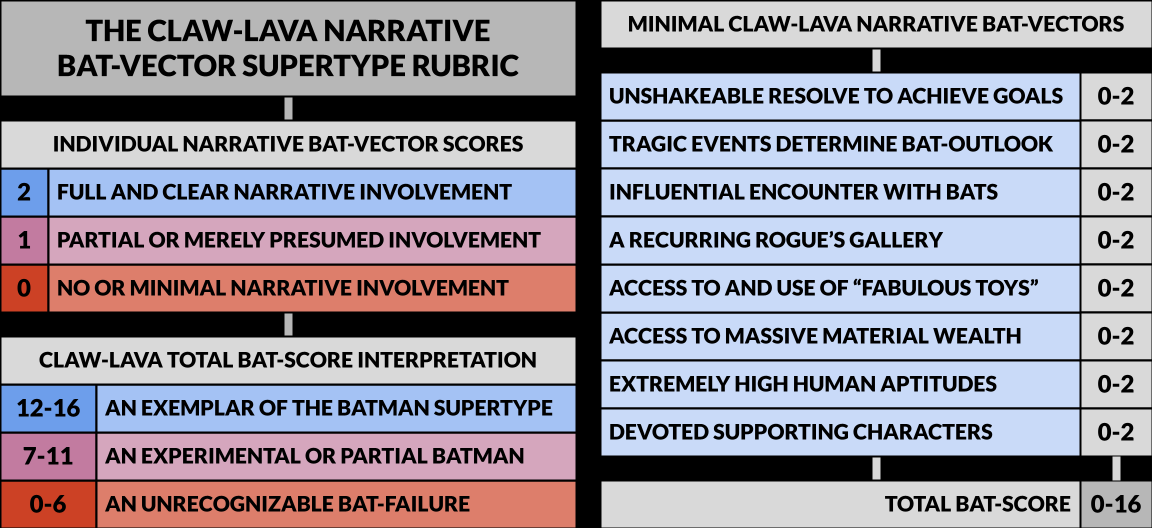
As a basic example in the application of this rubric, consider three narrative depictions of Batman: the animated Batman film Mask of the Phantasm (bundled with Batman: The Animated Series for comparison purposes); the critically acclaimed Batman: Year One by Frank Miller and David Mazzucchelli; and Jean-Paul Valley (Azrael) from the ‘Knightfall’ storyline, who took Bruce Wayne’s place as Batman after Bane broke Bruce Wayne’s back. By employing the CLAW-LAVA Narrative Bat-Vector Supertype Rubric, we see that the Batman of Mask of the Phantasm is a near perfect exemplar of the Batman supertype, only failing in his resolve, as Bruce Wayne considers abandoning his goals in favor of a romantic relationship with Andrea Beaumont, who turns out to be somewhat of a Batman herself (she scores 10 on the rubric, indicating that she is a partial Batman). The recently cowled Batman of Year One highlights the sort of Batman that exists in the range of experimental Batman representations: this young Batman, who occupies a relatively realistic world, is lacking in several areas that can only cement over years of work as Batman: unshakeable resolve, a rogue’s gallery, ‘fabulous toys,’ and devoted supporting characters. Finally, Jean-Paul Valley is an unrecognizable Bat-failure: a deeply damaged person, who is nevertheless wholly without resolve; is largely unsupported, especially given his unrepentantly violent actions; and has not had an influential encounter with bats, never having seen a living bat prior to his adoption of the Batman persona. To highlight just how poorly Jean-Paul Valley meets the Bat-qualifications, I’ve also included Robert Eggers’ Nosferatu in the Bat-comparison: the mustachioed vampire is more of a Batman than Jean-Paul Valley, edging into the range of partial Batmen, with his wealth, unshakeable resolve, and fabulous toys (plague boat, stone coffin, and contract-enforcing blood pen).
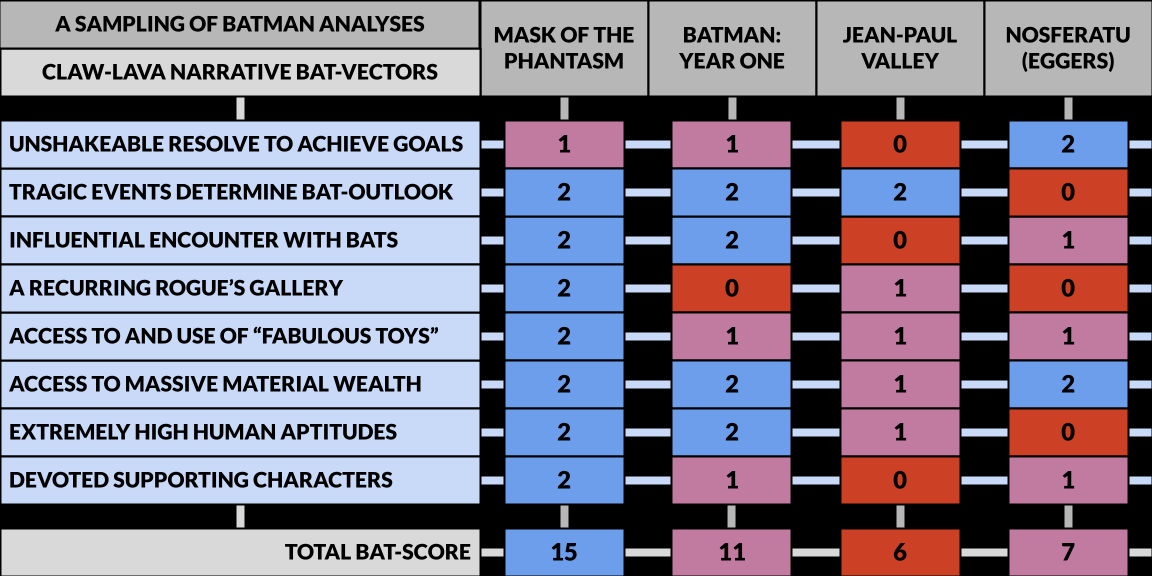
As the score assigned to Nosferatu might indicate, there has been some pushback against CLAW-LAVA and other supertype analysis systems by those comics fans aware of CLAW-LAVA, typically because the produced vector systems commonly ignore arbitrary surface-level constraints that seem important to those fans, but fail to contribute to the narrative essence of the given supertype nexus. For many, Batman is Bruce Wayne, a tall and handsome white man who lives in Gotham City. CLAW-LAVA would readily allow that a small and heavily scarred Chinese woman living in Beijing is a Batman, provided that she appropriately occupies the space carved out by the given system of Bat-vectors. Put simply, this expectation mismatch is because CLAW-LAVA is a system based on qualification, whereas many comic book aficionados determine their interest based on exclusion criteria. From the perspective of the capitalization of supertype representation, qualification is preferred; surface-level constraints are irrelevant, as they can be applied at any point in the process of narrative implementation.
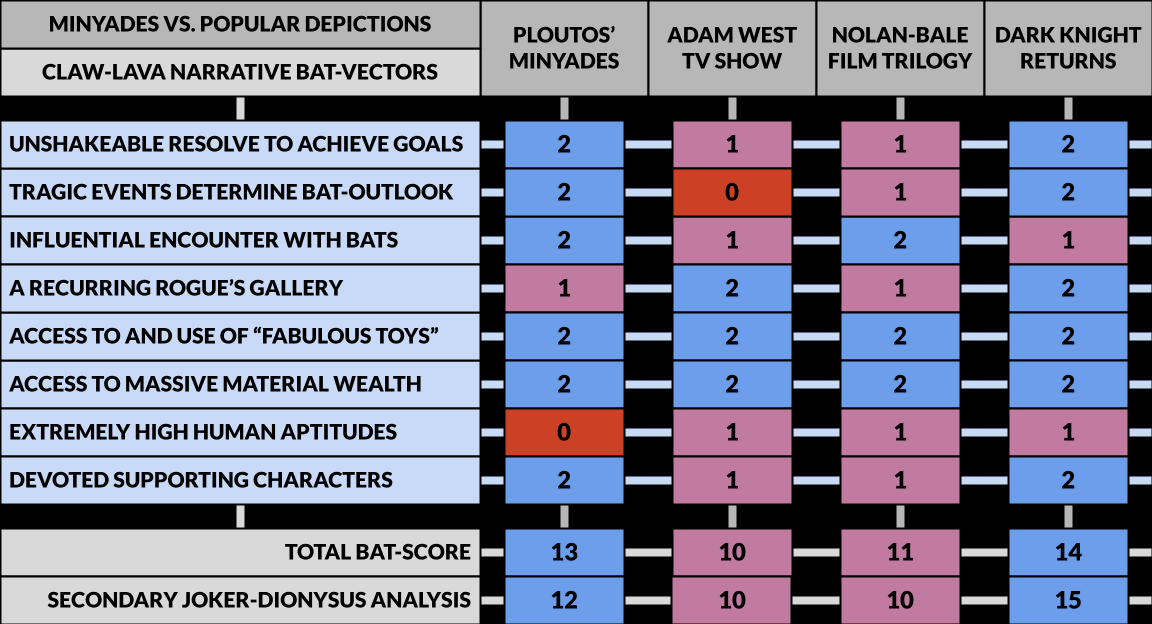
A concrete example of how CLAW-LAVA functions as a qualifying rather than excluding system, is found in the 1984 Greek underground comic Minyades, written and drawn by Lucius Ploutos, a neo-Delphic scholar, artist, and sometime occult figure, who is best known internationally for his brief 1977 theft of the Omphalos of Delphi. In Minyades, the namesake trio of Arcadian sisters, remade for the 1980s, act as vengeful agents for a secret wealthy Apollonian cult. After refusing to ‘profane their minds and bodies’ by participating in the Dionysian mysteries, the three are transformed into strange bat-creatures by Dionysus himself. Terrified and nearly driven mad following their transformation, Apollo takes pity on them and offers them rehabilitation, training, a variety of both divine and mundane equipment, and the chance for revenge against Dionysus, their tormentor. Applying the CLAW-LAVA Narrative Bat-Vector Supertype Rubric, we can see that not only do the Minyades conform to the Batman supertype, scoring 13 on the rubric, they also exceed many attempts to more obviously employ the Batman supertype commercially, including the marginally successful Batman presented in the trilogy of Christopher Nolan directed Batman films (11) and the depiction of Batman by Adam West in the 1960s (10). The vengeful sisters of Minyades are a Batman par excellence, nearing the same level as Frank Miller’s Dark Knight (14). Further, a secondary CLAW-LAVA analysis reveals that the Minyades presentation of Dionysus (12) better meets the Joker supertype than the Jokers depicted by Cesar Romero (10) and Heath Ledger (10), though Dionysus is well exceeded by Frank Miller’s character-defining presentation of the giggling psychopath (15).
As a second example of a non-obvious Batman, consider Ozymandias from Alan Moore’s Watchmen: aside from having neither a deterministic tragic event nor an influential encounter with bats, Ozymandias scores perfectly on the CLAW-LAVA Narrative Bat-Vector Supertype Rubric (12), demonstrating that he is an exemplar of the Batman supertype. In fact, an analysis of the characters in Watchmen easily leads to the conclusion that almost all of the central characters are at least partial Batmen in a pseudo-Batworld of Moore’s devising: Rohrschach (10), Nite Owl II (9), Silk Spectre II (9), and The Comedian (8).
From the examples provided by Minyades and Ozymandias, a route for the subversion of CLAW-LAVA becomes clear: creators can construct Bat-representations that exist on the edges of the Bat-vector system presented here, but that are still exemplars of the Batman supertype. This allows for the creation of narratives that reach an audience by implicitly evoking Batman, while existing in their own creative space. To demonstrate this possibility, I present Rabid Randy, a character who scores perfectly on every Bat-vector aside from two: he has no access to material wealth and no fabulous toys. This character, Randy Jacobson, is born poor on the Alabama shore with a genius-level intellect. After learning martial arts and playing college football, Randy has a moderately successful career as an MMA fighter. While visiting Mexico for a fight, on an outing Randy becomes accidentally trapped in a cave with several thousand bats, who bite and scratch him, permanently damaging his face. Traumatized, Randy is unable to continue his MMA career, especially after the other fighters and the MMA press dub him ‘Rabid Randy,’ due to his bat-derived injuries. Randy takes up with a group of gutter punks in Montgomery. After the police beat two of Randy’s new friends to death, in a bid to scare them off and increase the value of local property, Randy begins to engage in vigilantism in defence of his new community, unflinchingly and doggedly engaging in physical violence against a recurring rogue’s gallery of corrupt police and corporate ‘good old boy’ interests. Randy begins to wear a mask, to hide his identity and his massively scarred face. Traumatized, but resolute and supported by his gutter punk community, he now accepts the role of Rabid Randy—a Batman.
Despite the possibility of subversion, and aside from its routine use in service of creating superhero narratives to serve the current needs of capitalist media, CLAW-LAVA is, of course, accompanied by the same concerns that typically come with any new data aggregation and analysis system: misuse in the service of the ongoing creation of an integrated and invisible panopticon. Confidential leaks from CLAW researchers to the reporters of Comics News4 reveal that the surveillance company Zamyatin has licensed the CLAW-LAVA Batman model as part of a pilot program, with the ultimate goal of attempting to identify potentially disruptive citizens by associating them with subversive literary supertypes, starting with Batman. According to this confidential source, Batman was chosen for the pilot due to the relative availability of data indicating material wealth, human aptitudes, tragic events (via new reports), and encounters with bats (determined by rabies vaccination records). The remaining vectors are scored based on a combination of purchase history (access to fabulous toys); social media data (rogue’s gallery and supporting characters); arrest records (rogue’s gallery); and employment history (supporting characters and resolve). So far, this approach has uncovered more than 15,000 Americans with partial Batman tendencies and roughly 500 who Zamyatin believes are highly likely to engage in illegal Batman-style activities at some point in the next three years. Part of the danger in companies like Zamyatin is in the secrecy with which these technologies are deployed. It’s likely that those with Batman tendencies have already been flagged for additional surveillance by several enforcement elements of the solidifying fascist panopticon. Some of these pseudo-Batmen may even have already been incarcerated. Even more worryingly, Zamyatin and CLAW plan to expand this pilot collaboration to deploy several other supertype vector sets, including Spiderman and Professor X, placing puttering parkour-practicing high school students and wheelchair-bound sensitive bald boys in danger.
Periodically remolded to remain commercially successful and presented in a vast number of narrative modes, Batman is clearly more than an entertainment asset. The Batman supertype is part of a propaganda and profit machine that flexibly conforms to the current needs of the capitalist system. With tools like CLAW-LAVA, the relationship between the Batman nexus and the capitalist system it serves becomes even more explicit. At the same time, any tool can be subverted to critique and undermine that system—in this case, by the creation of a variety of insurgent evocations of the Batman supertype that explicitly contravene the use of Batman in the service of capital. The experimental use of CLAW-LAVA by Zemyatin to identify uncontrolled citizens that are isomorphic to the Batman supertype even further highlights the extent to which the paranoid and controlling features of capitalism are in a constant battle against unbroken anticapitalist elements that seek to redirect and repurpose the tools of control. I encourage any creators reading this to subvert the subtle capitalist propaganda of targeted supertype application and build better Batmen, in service of us all.”
—Siobhán M. La Grippe
“A Run in My Tights: The Batman Timeline
‘Paco glanced at the comic—Batman and Robin against the Cat-woman—and tossed it into the waste basket.’
—J.G. Ballard, Hello America, 1981
1939: Millionaire playboy Bruce Wayne fights crime as ‘The Bat-Man.’ Debuting in Detective Comics #27, the character is considered to be the ‘creation’ of Bob Kane, though the majority of early creative work is done by ghostwriter Bill Finger. It’s rough going at first: the vigilante’s pointed ears stick out funny, and he drives a RED car, not a signature ‘Batmobile.’ There’s some Dick Tracy-style violence (early Batman isn’t averse to murder), and the general tone is inspired by serialized pulp and radio characters like The Shadow.
1940: Sidekick Robin (‘The Boy Wonder’) makes his first appearance in Detective Comics #38, and arch-nemesis the Joker makes his first appearance in Batman #1. The two characters are currently credited to Kane, Finger, and Jerry Robinson—though most modern scholars agree that Kane’s contributions are minimal. For his own part, Jerry Robinson claims the Joker as his own creation, with the caveat that ‘Bill created all of the other characters—Penguin, Riddler, Catwoman. He was very innovative. The slogans—the Dynamic Duo and Gotham City — it was all Bill Finger.’
Flamboyant comics artist and historian Jim Steranko shares this sentiment and in a long Twitter/X thread from 2013, he writes:
We were introduced and Kane began talking about my Batman chapter in the History of Comics […] He felt I credited Robinson & Finger (both of whom I knew intimately) too much. Kane was beyond pretentious, an intolerable ass […] Our conversation ended, but not before he said: ‘See you later, Jim, baby,’ and cuffed me across the face—like some rat-pack street gesture he’d seen in some cheap flick […] That night, I couldn’t sleep and the next morning began combing the halls [of the convention] for his Bat Majesty. Around noon, I found him in another group, which I walked into. ‘Good to see you, Bob, baby!’ I said, then bitch-slapped him across the face.
1941: A dedicated Batmobile is introduced, as are villains the Penguin and the Scarecrow; Two-Face, the severely-scarred District Attorney, arrives on the scene the following year.
1943: Dick Sprang—the definitive Batman artist of his era—becomes an uncredited ghost for Kane. He eventually co-creates the Riddler, streamlines the Batmobile, and establishes an aesthetic of grotesque villains and dynamic layouts. Less remembered is a Sprang-illustrated adventure from ‘43 where the Dynamic Duo take to the Batplane in search of a Nazi submarine base. Such propagandistic elements are common; a Detective Comics story (with pencils by Jack Burnley), cover-dated August of the same year, features Batman and Robin actively encouraging the purchase of war bonds.
1947: A gigantic copper penny features prominently—alongside an equally large postage stamp—during an encounter with the Penny Plunderer, in an adventure (from World’s Finest #30) that is notable for the inclusion of irregularly-scaled props.
1949: The Dynamic Duo engage criminals while atop a giant typewriter (Batman #52)—continuing what will be an ongoing motif of oversized props and unusual deathtraps.
1951: Batman #63, ‘The Joker’s Crime Costumes’: another giant penny.
1954: Fredric Wertham’s Seduction of the Innocent is published, which warns of the social ills he believes are caused by young people reading comic books. Ironically, the psychiatrist is misremembered as a conservative censor, but in his own time he was in fact a progressive left-wing intellectual. Wertham is concerned with juvenile delinquency, racism, sadism, and the then taboo subject of homosexuality—which he sees all throughout Batman. Wertham isn’t imagining things, and provides a surprisingly accurate snapshot; as such, Seduction is worth quoting from at length:
Batman and Robin, the ‘dynamic duo,’ also known as the ‘daring duo,’ go into action in their special uniforms. They constantly rescue each other from violent attacks by an unending number of enemies. The feeling is conveyed that that we men must stick together because there are so many villainous creatures who have to be exterminated. They lurk not only under every bed but also behind every star in the sky. Either Batman or his young boy friend or both are captured, threatened with every imaginable weapon, almost blown to bits, almost crushed to death, almost annihilated. Sometimes Batman ends up in bed injured and young Robin is shown sitting next to him. At home they lead an idyllic life. They are Bruce Wayne and ‘Dick’ Grayson. Bruce Wayne is described as a ‘socialite’ and the official relationship is that Dick is Bruce’s ward. They live in sumptuous quarters, with beautiful flowers in large vases, and have a butler, Alfred. Batman is sometimes shown in a dressing gown. As they sit by the fireplace the young boy sometimes worries about his partner: ‘Something’s wrong with Bruce. He hasn’t been himself these past few days.’ It is like a wish dream of two homosexuals living together.
During a moral panic, the Comics Code Authority is established the same year, forcing restrictions across the industry.
1955: Created by Kane ghosts Bill Finger and Sheldon Moldoff, Ace the Bat-Hound debuts in Batman #92.
1956: Showcase #4 introduces the Barry Allen iteration of The Flash, an occasion which marks the shift from the previous ‘Golden Age’ of comics into the ‘Silver Age.’ Broadly speaking, pulp roots are abandoned in favor of science fiction, including fantastical elements such as time travel…or an invading army of snowman soldiers (who shoot lasers out of their coal eyes). This editorial model works well for The Flash and Superman (the Cosmic Treadmill, multiple colors of kryptonite), but is a clumsy fit with Batman.
1957: ‘The Rainbow Batman’ appears in Detective Comics #241. Dressed all in pink, the Caped Crusader explains to a confused Robin, ‘I must wear a different-colored costume each night!’
1959: Bat-Mite, a reality-warping imp from the Fifth Dimension, makes his first appearance in Detective Comics #267.
1964: In response to diminishing sales, editor Julius Schwartz introduces ‘The New Look’ era: a yellow oval is added to Batman’s chest symbol, there’s an intentional reduction of perceived homosexual undertones, a diminished presence of fantastical characters such as Bat-Mite, and a general streamlining of elements both visual and narrative.
1966: Andy Warhol and Nico appear in Esquire magazine photographed as Batman and Robin; Bob Kane attempts to cash in on trends and sell his own ‘pop art’ paintings. What’s going on? The Batman TV series, of course. Starring Adam West and Burt Ward as Batman and Robin, the series is considered silly today, despite the fact that it was intentionally ironic and in no way naïve. A mixture of both the ‘50s and New Look eras, the series plays a large role in defining Batman’s ‘rogues gallery’ of villains.
1967: Despite introducing Yvonne Craig as Batgirl, Batman’s ratings dip in the third and final season. The Joker rides a surfboard and Joan Collins guests as The Siren, but the program is still cancelled the following year.
1968: ‘Batgirl—get over here!’ screams Batman, from the cover of Detective Comics #371. ‘Help us! We’ve got a problem!’ ‘I have a bigger one,’ she responds while examining her lifted leg—‘a run in my tights!’ Twenty years later, Alan Moore has the character sexually assaulted and paralyzed from a gunshot wound.
197?: At some point during the ‘70s, unknown filmmakers shoot a low-budget porno in which ‘Dora Dildo,’ aka ‘Bat Pussy,’ gets a ‘twitch in her twat’ that alerts her to unwelcome sexual activity in Gothum [sic] City. The title, of course, is Bat Pussy.
1971: Writer Denny O’Neil and artist Neal Adams begin their collaborations on both Batman and Detective Comics. Interjecting a sense of ‘realism’ (the restrictive Comics Code is weakening) and James Bond-style adventuring, the creative team give comics a big push during the slow slide into the darker ‘Bronze Age.’ O’Neill replaces Silver Age science fiction with horror tropes and themes of urban decay, while Adams updates outdated Sprang aesthetics with detailed anatomy and dramatic uses of shadow. Supervillain Ra’s al Ghul is introduced (in ‘Daughter of the Demon’), and this is the ‘70s so there’s also kung fu.
1973: O’Neil and Adams end their collaboration with Batman #251, ‘The Joker’s Five-Way Revenge.’ The story is notable for establishing the Joker—who had been absent from the Bat-mythos for nearly four years—as a homicidal maniac, and not merely a pointy-chinned criminal with a neurotic compulsion for absurd gags.
1974: An impoverished Bill Finger dies in obscurity at age 59. Bob Kane is off having martini lunches with his friend Stan Lee.
1979: Adam West and Burt Ward reprise their Batman and Robin roles for two installments of Legends of the Superheroes. The deeply distressing television specials are notable (if that’s the right word) for also including cheaply-costumed Justice League members such as Green Lantern and The Flash, as well as Bat-family side character Huntress.
1984: DC Comics President and Publisher, Jenette Kahn, appears on the cover of Savvy: The Magazine for Executive Women. Billed as ‘Superman’s Boss,’ she sports hard ‘80s fashion and stands next to an illustrated ‘Man of Steel’—the company’s most iconic hero. Kahn redefines DC’s brand for the Reagan era, ushering in a wave of ambitious projects; and considering how many of those projects involve Batman, perhaps Savvy chose the wrong do-gooder to share the exec’s spotlight.
1985: A bog-standard Batman and Joker confrontation is interrupted by an apparition of a distressed Flash, his red spandex hanging loosely off his emaciated frame. ‘Please…can’t you see the world?’ he begs Batman. ‘I-It’s dying all around me!’ Crisis on Infinite Earths is a 12-issue ‘maxi-series’ designed to clean the convoluted and decades-long history of DC comics, which was further complicated by parallel universes, all with distinct Earths (‘Earth-One,’ ‘Earth-Two,’ etc.). During the cosmic chaos, Flash and Supergirl are destroyed, as are the inhabitants of countless other worlds. Later, Batman explains to an assembled group: ‘We now understand the multiverse was reborn as one universe. While most of our origins survived…a few didn’t. For instance, there is now only one Joker, one Penguin…one Riddler.” (In the face of a multi-dimensional holocaust, Batman can only think of his villains.) Robin, slightly more helpful, elaborates: ‘The others didn’t die…on this new Earth they just never were.’
1986: Comics’ Bronze age is over, and followed by what is sometimes called the ‘Dark Age.’ The shift is cemented by two DC series from ‘86: Alan Moore’s Watchmen and Frank Miller’s The Dark Knight Returns—two titles which have exerted an oversized influence now for four decades. The latter runs across four square-bound issues, and concerns an older Batman coming out of retirement in a Gotham City (and larger world) that is cyberpunk and media-saturated. Miller (aided by inker Klaus Janson and watercolorist Lynn Varley) crafts a story in turns sophisticated, expressionistic, and satirical—nuances which are all lost on the book’s many imitators. That same year, Denny O’Neil returns to DC, after a stint at rival publisher Marvel, and is made editor of the entire ‘Batman Family’ line of books—a position he holds until 2000.
1987: Frank Miller returns (now with artist David Mazzucchelli) with ‘Year One.’ Unlike the fancy Dark Knight, this influential post-Crisis origin story was printed on cheap newsprint in the regular monthly Batman title—specifically #404-407. Despite featuring themes of sex and violence (Catwoman/Selina Kyle is a prostitute), the original ‘Year One’ still contains advertisements for Lazer Tag and Cap’n Crunch cereal.
1988: Batman: The Killing Joke is released, a 48-page one-shot featuring the sexual assault of Barbara Gordon, aka Batgirl. Artist Brian Bolland is so unhappy with the book’s coloring, he stays in bed for three days. That same year, a new Robin is killed by fans who vote via a paid 1-900 number to have Joker murder the replacement Boy Wonder. (The ‘Clown Prince of Crime’ beats the minor to death with a crowbar.)
1989: A busy year: Tim Burton’s Batman film is released; DC publishes Grant Morrison’s Arkham Asylum; Neil Gaiman writes two Bat-villain stories for Secret Origins; and an older teenager in my neighborhood spray-paints the Bat-Symbol on his car hood.
1990: Dick Sprang emerges from obscurity and draws two covers for Detective Comics.
1992: Batman: The Animated Series begins airing on the Fox Kids network. While largely drawing from previous Bat-history, the cartoon also introduces new elements, like the proto-femcel Harley Quinn; a breakout character who eventually storms canonical comics continuity, inspires slutty Halloween costumes, and ultimately enters a bisexual relationship with fellow villain Poison Ivy.
Later in 1992, ‘The Death of Superman’ story arc begins, and instigates a media frenzy involving gullible journalists who don’t understand how comic books work. A trend of multi-part complex crossovers is established, which affect Batman the following year, in the similarly-minded ‘Knightfall’ (aka, ‘Batman gets his back broken’) arc. Jenette Kahn Joker-laughs all the way to the bank.
1993: Paul Dini, a producer and writer for Batman: The Animated series, is seriously attacked during a mugging, leaving him with injuries that require surgery.
1994: Green Lantern discovers his murdered girlfriend’s body stuffed in a refrigerator (Green Lantern #54, ‘Deadly Force’). The fictional incident is so upsetting to a fan named Gail Simone, that she compiles a list of over 100 female comic book characters who have been ‘either depowered, raped, or cut up and stuck in the refrigerator’—a list which prominently includes the brutalization of Batgirl. Later, the Women in Refrigerators website is founded, and ‘fridging’ becomes fan shorthand for the violent diminishment of female characters.
1995: Joel Schumacher takes over the Bat-film franchise with the second sequel, Batman Forever. Updates include: garish colors, villains Two-Face and Riddler, and Val Kilmer in a Bat-suit with visible nipples.
1996: DC publishes the Kingdom Come miniseries under their Elseworlds imprint. Written by Mark Waid and overly-illustrated by the painter Alex Ross, the epilogue features Superman, Wonder Woman, and Batman (all in their civilian alter-egos) having dinner together at a theme restaurant—like Planet Hollywood or Rainforest Café, but for superheroes—called ‘Planet Krypton.’ A server in a Burt Ward Robin costume greets the party: ‘Today’s special is the Power Girl Chicken Sandwich.’
1997: Schumacher returns with his Batman & Robin…now with George Clooney, and a Bat-suit with even harder nipples. Costume designer Jose Fernandez:
Well, in the first one, they were just a little blob of clay. It was subtle—it was a blip. But for Batman & Robin, Joel Schumacher loved the nipples, so he said, ‘Let’s showcase them.’ Schumacher wanted them sharpened, like, with points.
1998: Bob Kane dies, age 83; The Los Angeles Times obituary mentions that the Golden Age cartoonist did not approve of the recent Bat-movie rubber nipples.
1999: The so-called ‘Batman Rapist’ of Bath UK, receives his nickname after dropping a Batman Forever baseball cap while fleeing the scene of a failed abduction. (The gray hat’s logo, which depicts a question mark surrounding a Bat-Symbol, also earns him the lesser used nickname ‘Riddler Rapist.’) Known for having a fetish for women’s tights, the unidentified man is thought to be guilty of at least 17 serious crimes, and he remains the subject of Britain’s longest-running serial rape investigation.
2000: Bat-Mite fights Mr. Mxyzptlk, in the Elseworlds title World’s Funnest, and the resulting damage destroys the pre-Crisis multiverse, the post-Crisis universe, and the non-continuity universes of Dark Knight Returns and Kingdom Come.
2001: Frank Miller disappoints or pisses off almost everybody with The Dark Knight Strikes Again (also known as DK2), a three-issue sequel to his celebrated Dark Knight Returns. Miller’s art style changed significantly over the course of the ‘90s, growing chunkier, looser, and at times nearly abstract—all of which is on full display in DK2, with the added deficit of often looking rushed or sloppy. Received even more poorly is Lynn Varley’s new neon-digital coloring technique, which replaces her hushed watercolors; it seems cheesy and instantly dated in the moment, but somehow, looking back, Varley was actually ahead of her time. Miller’s writing and plotting is equally garish, adding unexpected Silver Age elements, and a weird ensemble cast that includes both Plastic Man and a washed-up Elongated Man. Despite being deeply flawed, no sane person can accuse DK2 of being boring or predictable; there’s a manic energy on display across all 256 pages and it’s often thrilling to see Miller push irony past its breaking point into territory that is truly sadistic and perverse. If there is such a thing as a Neo-Decadent Batman comic, then DK2 is it.
2002: Jenette Kahn leaves DC. That same year, she publishes In Your Space: Personalizing Your Home and Office, ‘an inspiring book on design and a lively autobiography.’ The Girl-Boss details the renovation and decorating ‘odyssey’ which took place across her office, her Manhattan apartment, her Harlem townhouse, and her guest houses (plural) in Connecticut. To Kahn’s credit, she has good taste: there’s Memphis furniture, Art Deco, a fireplace surrounded by tiles that look like a crossword puzzle, a folding closet door with a painted musical score, and throw pillows stitched with biff-bang-pow-style onomatopoeia. In short, Kahn lives in the high style of a Batman villain.
2003: Gail Simone becomes writer for the Bat-adjacent Birds of Prey series. Ironically, the all-girl Gotham-based ‘super team’ was initially created by Chuck Dixon, who is later associated with ‘Comicsgate,’ a right wing culture war movement; the loose coalition frequently attacks Simone and the ideas associated with the original ‘Women in Refrigerators’ critique, along with the later ongoing concerns of ‘diversity’ and ‘inclusion’ (Simone goes on to create the character Alysia Yeoh, a queer transgender Singaporean activist, and best friend to Batgirl).
2006: Grant Morrison returns to Gotham (starting with Batman #665) and begins a years-long run across multiple titles. Morrison, a practicing chaos magician, blends elements from Batman’s entire history (Gold, Silver, Bronze, and Modern ages) into a singular continuity sometimes described as ‘Alloy Batman.’ Included in this arc are Bat-Mite, Batwoman (not to be confused with Batgirl), Zur-En-Arrh (a weird Bill Finger co-creation from the ‘50s), and Damian Wayne (a character who was vaguely introduced in Son of the Demon, a non-canon graphic novel from ‘87). Is such maximalist complexity welcome? Alan Moore made a similar meta-commentary much more succinctly with a single throwaway image from Killing Joke: a realistically drawn Batman looks at an old ‘family photo,’ which is drawn in the simple house style of Bob Kane’s studio. In the image, a smiling Batman and Robin pose alongside Bat-Mite, Ace the Bat-Hound, and earlier versions of both Batwoman and Batgirl—all the anachronisms and strangeness of Batman, expressed (with melancholy) in one single panel.
Fittingly, LEGO Batman is also introduced to this world, in the year of our Lord 2006.
2008: A 20th anniversary hardcover edition of Killing Joke is released, with new coloring by Brian Bolland—which is bland and vastly inferior to the original psychedelic color palette by John Higgins. That same year, Christopher Nolan’s The Dark Knight is released, featuring Heath Ledger, who died from an overdose nearly six months earlier; the actor’s ‘Joker Diary’ becomes a subject of fascination and speculation.
2009: Neil Gaiman releases his two-part story ‘Whatever Happened to the Caped Crusader?’ Page one features a giant typewriter, and the ending is a riff on Goodnight Moon.
‘Goodnight, house. Goodnight, Batcave. Goodnight, mechanical dinosaur. Goodnight, giant penny. Goodnight, Batmobile. Goodnight, Alfred. Goodnight, Boy Wonder. Goodnight, Joker. Good night, all of you.’
If there’s a clear line marking Batman’s descent into Neo-Passéism, this is assuredly it.
2010: Cartoonist J.R. Williams assembles Guano!, a bootleg collection of various musical ‘novelties from the Batcave’ produced during the ‘Batmania’ trend of the ‘60s. Highlights include ‘Robin’s Theme’ (by an initially uncredited Sun Ra and The Blues Project) and ‘Boy Wonder, I Love You’ (a collaboration between Burt Ward and Frank Zappa).
2011: Frank Miller’s Holy Terror graphic novel is published by Legendary Comics. Originally proposed to DC as ‘Holy Terror, Batman!’—a riff on Robin’s old ‘Holy ____’ catchphrase—at some point the Caped Crusader was completely dropped from the concept. Miller credits himself with the decision, though it’s exceedingly likely, given both the subject and the poor reception of DK2, that DC declined to continue with such an inflammatory vanity project. The story—conceived in the aftermath of 9/11—concerns Batman stand-in ‘The Fixer,’ who fights Islamic terrorists after an attack on ‘Empire City.’ The final product is undeniably kinetic and holds value as a formal exercise, even if the political and social commentary is devoid of nuance— but this was intentional. Miller specifically described the project as ‘propaganda’ in the tradition of Golden Age comics (like Batman’s war bond schilling during WWII), and the increasingly conservative cartoonist elaborated:
Superman punched out Hitler. So did Captain America. That’s one of the things they’re there for.
That same year, DC launches their ‘New 52’ campaign—a house cleaning effort similar to 1985’s Crisis event, but more sweeping in its scope. Titles which weren’t cancelled were rebooted and had their numbering systems restarted. For example, Detective Comics (the longest-running Batman title) went from #881 back to #1. The change also affected newer titles, like Grant Morrison’s Batman Incorporated, which ended with #8; unsurprisingly, in the revamped Vol. 2 version of the title, Morrison continued to reference previous events and continuity.
2012: James Holmes conducts a mass shooting during a midnight screening of Christopher Nolan’s The Dark Knight Rises.
2013: DC significantly rolls back its newsstand distribution, and Marvel exits newsstands completely (a decisive move that DC would follow just a few years later). Single-issue ‘floppy’ comic books are now almost impossible to find outside of specialty shops and the idea of a general readership is abandoned. Instead, the focus is now completely aimed at a dwindling audience of diehards, in a confusing and hostile landscape of endless ‘variant covers’ and other abstruse and cult-like marketing gimmicks. Gone are the days of grandma buying you a Batman funny-book at the neighborhood drugstore.
2015: Jeet Heer writes a critical essay for The New Republic in which he includes a quote from ‘alternative’ cartoonist Chris Ware:
Writing serious stories about superheroes for adults is like writing pornography for children.
That same year, Bill Finger is officially credited as the co-creator of Batman.
2016: Dark Night: A True Batman Story, is released by DC’s Vertigo imprint, which means the work is ‘mature’ in nature. The graphic novel, written by Paul Dini, is an autobiographical account of the events surrounding his 1993 attack. More specifically, Dini (an adult human male) confronts his lingering trauma head-on…BY HAVING IMAGINARY CONVERSATIONS WITH BATMAN AND HIS VILLAINS. The book is universally praised by critics, with Neil Gaiman describing Dark Night as ‘a powerful tale of healing and redemption.’ But my favorite bit of press comes from The Hollywood Reporter:
‘What makes Batman and what makes other superheroes work is the myth that when life is at its lowest, and when you need a hero, a hero swings down and helps you,’ Dini says over breakfast in Studio City, suddenly overcome by emotion and choking back tears.
2017: Writer/artist team Snyder and Capullo introduce a Cenobite-like character called ‘The Batman Who Laughs,’ who wears a heavy spiked ring around his head, completely obscuring his eyes. From Wikipedia (and poorly written):
[The Batman Who Laughs is a] version of Bruce Wayne from Earth-22 who was driven insane by Joker venom and murdered the Joker and the rest of the Batman family. Currently serves as the leader of the Dark Knights and a lieutenant to Barbatos.
In truth, I have no idea what’s going on here, as I stopped following Batman as a teenager in the ‘90s. More familiar to me is Something Weird Video, who in partnership with the American Genre Film Archive, releases a painstaking restoration of Bat Pussy on Blu-Ray, with a new cover illustration by Johnny Ryan.
2021: The first DC Pride annual is released, ‘celebrating a parade of LGBTQIA+ characters and creators!’ and featuring queer updates of Batwoman and Poison Ivy on the cover. Many, many, many DC characters are made gay or bisexual during this general time period (including a version of Robin the Boy Wonder), much to the frustration of Comicsgate members. In truth, there is some legitimacy to be found in the complaints of (the admittedly reactionary) Comicsgate, just as there are some legitimate grievances to be located within the opposing Women in Refrigerators camp. However, if any of these individuals are so exceedingly unhappy with the direction of superhero comics, wouldn’t the reasonable reaction be to—bear with me now—move on to something else and develop mature interests? Back in the 1950s, Dr. Wertham’s main concern wasn’t the moral content of comic books, rather, his true emphasis was that children would be better served by reading more sophisticated material. This is an ‘elite’ position, but one that has ultimately been proven true. Wertham would certainly be shocked to see that most children aren’t reading anything at all, and that comic books have turned into an adult-driven multi-media monoculture of nerdism. The effects of this shift are everywhere, with cops placing Punisher-skull decals on their squad cars, and elected politicians using infantile terms like ‘good guys’ and ‘bad guys’ during debates around what should be serious issues like gun control and immigration.
We live in a fractured world where Batman (and his ‘family’) can be whatever you want them to be. You can be an edgelord Joker incel who curates memes…or you can fight the patriarchy by buying a Funco Pop! DC Pride Poison Ivy Glitter Figure from Nordstrom. There’s no middle, but the choice is yours.
2022: An updated Blu-Ray of Bat Pussy is released, containing additional footage from a newly discovered 16mm print. Crucially, this footage also includes the long-lost ending.
2023: George Clooney tells an interviewer: ‘I regret doing fucking Batman.’
2024: A documentary about Frank Miller is released, with the exceptionally hyperbolic subtitle American Genius.
2025: Chuck Dixon posts a sketch of Batman on Twitter/X depicting the Caped Crusader as an ICE agent; the image receives over 6,000 likes.
2026: Filming for The Batman: Part II is scheduled to begin in the spring. A sequel to 2022’s unambitiously titled The Batman, the film is considered part of a ‘shared universe’—referred to as the ‘Batman Epic Crime Saga’—which also includes The Penguin TV series. I’ve seen none of these, but apparently Paul Dano plays a Jonkler-fied creepy-scary Riddler. In truth, there’s a lot of recent televisual Batman I haven’t seen. I haven’t seen Ben Affleck Batman or ‘Snyder Cut’ Batman. I have seen Michael Keaton Birdman, but I have not seen Michael Keaton’s Batman Flash cameo, nor have I seen the deep-fake Adam West cameo in said Flash. Nobody saw the Batgirl movie, because it wasn’t released, but there is a Batwoman TV show, which might be part of something called ‘the Arrowverse.’ I started watching a Harley Quinn/Margot Robbie movie, but turned it off quickly, and I remember seeing something with Batman and Scooby-Doo when I was a child—but that’s not to be confused with the Scooby-Doo! & Batman from 2018. I’ve seen maybe three of the 26-plus Batman animated movies, and none of the various additional animated films, like DC League of Super-Pets, which feature Batman in bit parts. I have not seen Gotham, Gotham Knights, or the Batman Unlimited web series. And I will not be seeing Batman: Part II, III, or IV.
As a boy in the ‘90s, I eagerly anticipated new installments of the ‘Knightfall’ comics, and I sat Indian-style in front of the TV, hypnotized by Batman: The Animated Series. I read Killing Joke out loud to my little brother, and I did countless drawings of Batman on stray sheets of paper. In my youth, I thought—and dreamed—of Batman with a constancy; but I never imagined a future where there’d be so much goddamn Batman that I’d lose interest…and I certainly never imagined a world with a LEGO Batman Movie.
2039: Batman’s centennial.
Batman…FOREVER.”
—Aaron Lange
art by Bat-Aaron Lange and Bat-Dan Heyer
I. MacPherson, K. Langstrom, P. Malley, V. Fries, and T.G. Kase, “The Literary Archetype Vector Algorithm: Constructing and Employing Supertype Representation Systems in Narrative Creation,” Proceedings of the Comics Literary Analysis Workshop, vol. 3, pp. 50-100, 2024
The decomposition process begins by including all input representations to create an initial set of vectors. Using this initial set, the representations are then scored, and outlier representations are omitted in a renormalized vector set. All representations, including the omitted ones, are then rescored, and the process is repeated iteratively, until a final vector set is reached. Though CLAW-LAVA is a relatively stable set of algorithms, in roughly 3% of given sets of input representations iterative decomposition results in an unstable vector set, with iteration either continuing indefinitely or continually decomposing the input set into multiple stable sets of pseudo-outliers, one of which is excluded in each iteration.
The full set of input Batman representations is given below. In many cases, a leading “Batman” has been omitted from the name, for ease of review. For comics, issue numbers are given. Mini-series and original graphic novels are denoted by name alone.
[Absolute Batman #1-12]
[All-Star Batman #1-16]
[All-Star Batman and Robin the Boy Wonder #1–10]
[Batman #1–100; Detective Comics #27–232] representing Golden Age Batman
[Batman #101-116; Detective Comics #233–257] representing Silver Age Batman
[Batman #404-407] collected as Batman: Year One
[Batman #426–429] collected as A Death in the Family
[Batman #492–504; Detective Comics #659–670; Batman: Shadow of the Bat #16–20]: collected as Knightfall vol. 1-3
[Batman #608–619]: collected as Hush
[Batman #655–658, 663–683]: collected as Grant Morrison’s Batman
[Batman #686; Detective Comics #853] collected as Whatever Happened to the Caped Crusader
[Batman (vol. 2) #0, #21-27, #29-33] collected as Zero Year
[Batman (vol. 2) #1–17] collected as The Court of Owls, The City of Owls, and Death of the Family
[Batman (vol. 2) #35–40] collected as Endgame
[Detective Comics #871–881] collected as The Black Mirror
[The Brave and the Bold #74–200] representing Bronze Age Batman
[Red Rain; Bloodstorm; Crimson Mist]
Arkham Asylum: A Serious House on Earth
Ayn Rand’s Batlas Shrugged: Who is Bruce Wayne?
Batman ‘66
Batman vs. Pontius Pilates
Batman vs. Predator
Damned
Dark Knights: Metal
Dark Victory
Earth One
Gotham by Gaslight
Kingdom Come
No Man’s Land
President Batman: 9/11 Response Team
Red Batman: To Everyone According to Their Crimes
Son of the Demon
The Batman Who Laughs
The Cult
The Dark Knight Returns
The Dark Knight Strikes Again
The Killing Joke
The Long Halloween
The Man Who Laughs
Year 100
[Batman (1966-1968); Batman: The Movie (1966)] representing the Adam West Batman
[Batman (1989), Batman Returns (1992)] representing the Burton-Keaton Batman
[Batman Begins (2005); The Dark Knight (2008); The Dark Knight Rises (2012)] representing the Nolan-Bale Batman
[Batman v Superman: Dawn of Justice (2016); Zack Snyder’s Justice League (2021)] representing the Snyder-Affleck Batman
The Batman (2022), the Reeves-Patinson Batman
[Batman: The Animated Series(1992-1995); Batman: Mask of the Phantasm (1993)] representing ‘90s animated Batman
Batman Beyond (1999-2001)
[Splatman (1992); Splatman Returns (1994); Splatman Forever (1996)] representing ‘90s pornographic Batman
Batman (1986) published by Ocean Software
Streets of Rage vs. Batman (1992) published by Sega
[Lego Batman: The Videogame (2008); Lego Batman 2: DC Super Heroes (2012); Lego Batman 3: Beyond Gotham (2014)] representing Lego Batman video game series
[Arkham Asylum (2009); Arkham City (2011); Arkham Origins (2013); Arkham Knight (2015)] representing the Batman: Arkham video game series
Due to ongoing litigation brought by Zemyatin against Comics News, the article containing this essential reporting is currently unavailable at the Comics News webpage. Images of the article were temporarily available on the comics subreddit, but, as of the time of publication, those images have been expunged.
Everyone’s contributions here are excellent. Particularly enjoyed the timeline by Aaron at the end, shoutout to batshit TDK Strikes Again and batshit Frank Miller, as well as Siobhan’s statistical disquisition. If he wasn’t before, the bat has surely been broken now
God that image is nightmare fuel