
Fandom
not dissimilar to findom

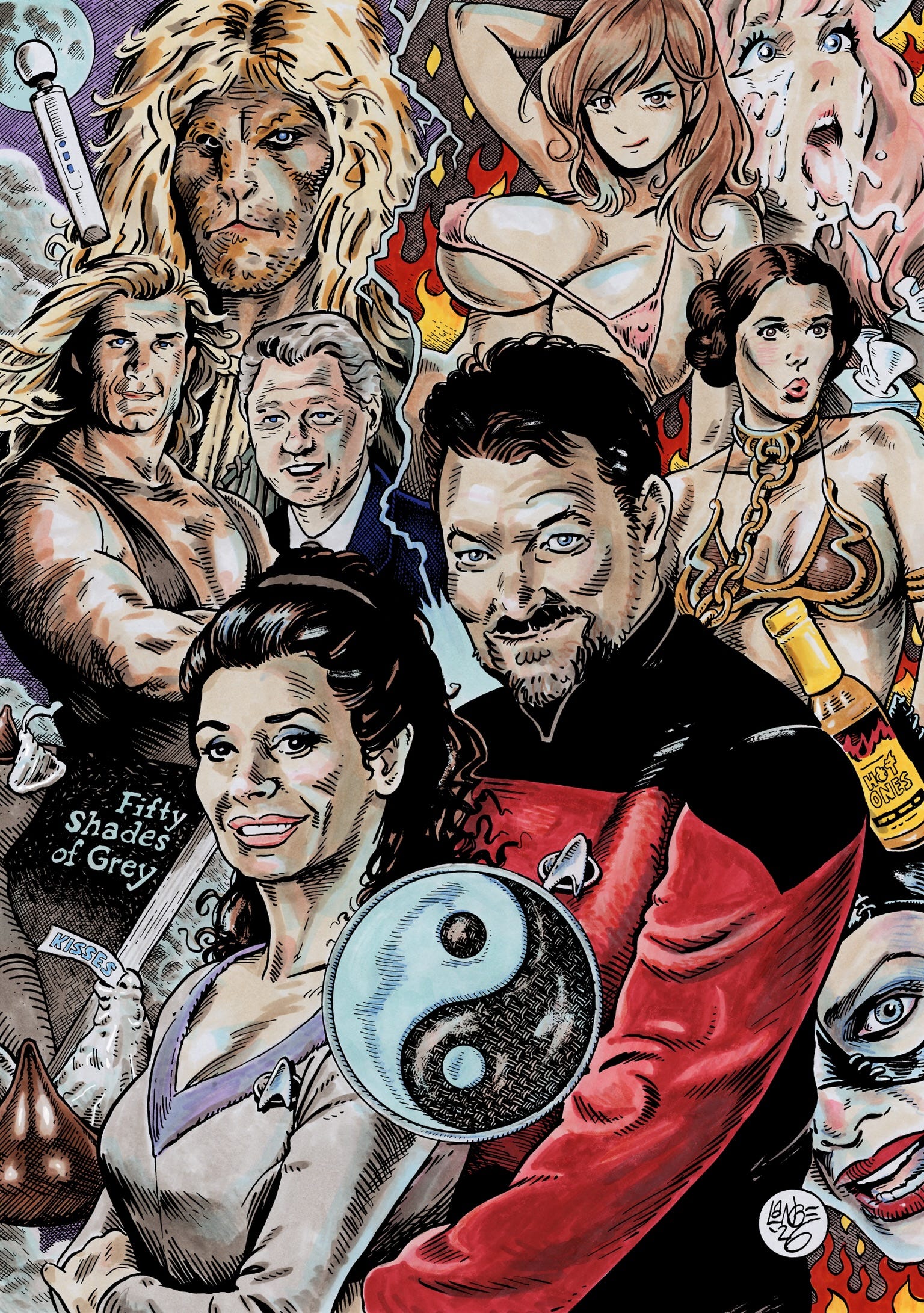
“The production mechanics of this ‘intellectual property’ then become the governing principles of creation. The emotions of Neo-Passéists overflow into these tired vessels, and the final result is a sort of constipated myth cycle, the promise of various dithering apocalypses that never fully arrive. With this new feudalism of film franchises, fiction series from corporate publishing houses, and repetitive gallery shows displaying the artists of the past (all of it presided over by the academic guilds), we have reached an entirely medieval age.”
—Against Neo-Passéism (2019)
“Public toleration of fandom and of general Neo-Passéist cultural production can be linked to thirdhand misinterpretations of Sontag and Bourdieu, along the lines of: ‘There’s really no difference between ‘high’ and ‘low’ art, or if there is, the idea of this distinction itself is a symptom of cultural elitism and ingrained class hierarchies of taste. Mixing high and low culture means that corporate franchise products are as important/complex/worthy of time investment as the original creations of artists without access to mainstream funding and distribution, academic support, or other channels. Also, original artworks don’t sell well. So, you should probably stop making them. Here are some more Netflix shows based on legacy comics characters from 40 years ago. Everything interesting was already present in your childhood consumption patterns, so why not just keep repeating them? No need to change or develop.’ This narrative is so firmly embedded in culture at this point that it functions as a thought-terminating soporific. Collapsing hierarchical taste distinctions through Bourdieu-style critiques made sense 40 or 50 years ago, but we now live in the dominion of the detritus, and something like the New Yorker running a think piece on the politics of Deadpool is no longer any kind of subversive gesture, it’s simply the status quo—while original forms of expression have been marginalized; it would be one thing if people liked reading Marvel comics and playing with toys as an adjunct to appreciating a wide range of art and writing, but they don’t. As for the ‘cultural capital’ of ‘tastemakers’—the last thing they want is to be perceived as elitist, which means they continue to play along with the system and its infrastructure (academia, major publishers, big galleries). A widespread ignorance of art history and of any kind of expanded possibility for expression eventually means that people are no longer able to think or feel in certain ways, which reinforces their limited tastes, which reinforces their inability to think or feel in certain ways.
The capitalist time hole is a perpetual motion machine in which immortality in the physical sense figures as the ultimate out of reach prize. ‘Immortality for the rich’ is the vampiric ambition of financial and technological elites, who are attempting transhumanist schemes to reach it. Life extension, looksmaxxing, anti-aging and the pursuit of youth correspond to the pursuit of childhood, which is played out in terms of Neo-Passéist cultural productions. In this conception of time, the future leads to the past and nothing is ever truly dead or transcended. The vampire constantly revives itself by draining the vitality of its victims; similarly, the ‘revival’ of musicals, TV series, film franchises, etc. proceeds as vitality is drained from aesthetic time itself. Popular characters from the Victorian era are still alive and with us, as if the corpses of our great grandparents were shuffling around downstairs in the kitchen, hungering blindly for fresh fluids. The concepts of Dracula, Sherlock Holmes, etc. are themselves memetic vampires capable of superficial shapeshifting and endless revivals. Capitalist Tradition becomes a repertoire or breviary, a stained glass window of familiar figures, and the consumer a peasant who reads only his memorized bible of trivia.
As faithful adherents of capitalist mythology, fans fill the interior void with pilgrimages and conventions; these are explicitly religious, in the sense of U.K. residents describing themselves as Jedi on census responses. Consumption choices have become sacraments, and fans are monkish and nunnish in their devotions. Here we have the Passion of the truly MEDIOCRE.
It is possible to conceive of the idea of worshipping art as a noble one. But those sunken in fandom, with their addictions to identity-through-consumption, are far from the refined Aesthetes of earlier ages. The childhood lore-worlds of fandom function as escapes from real life, not escapes INTO it. The best art makes us stronger, bolder, more adventurous, more capable of facing and integrating the unknown; fandom instead is a contraction that impoverishes the spirit and rewards only the most slavish impulses.
Fandom in its final form becomes ouroboric, obsessed with itself. We can see this in the increasingly disastrous and dull 1990s films of Kevin Smith: the consumer as hero, consumption and referential mania as the quest. The zero point endgame of fandom is this masturbatory panopticon. Soon there will only be artists who can’t draw, writers who can’t write, creators who can’t create: all endlessly admiring themselves in front of a machinic mirror. Fandom, as a pool of talent that feeds on itself, will quickly succumb to the fractally derivative ‘creations’ of generative AI. Human attempts at presaging this process, such as the Ready Player One series, can only be bare sketches of what fully automated processes will allow.
The best art and writing lead to passionate confrontations with the Other (we could use the term love here, in all its myriad implications, from the spiritual to the slavering). Fandom leads us only into narcissistic reinforcement; the imputed ‘solidarity’ and ‘communion’ of the fan experience are merely repetition-compulsions, massed retreats from the Real.”
— Justin Isis
“There is a surface between self and stimuli that both denies us direct access to reality and allows any experience at all. This surface is pitted and warped with a variety of constituent perspectives, modes of understanding and interpretation, through which all stimuli travel. By describing the topology of this surface, we might uncover regions inaccessible to one another, allowing us to hold contradictory ideas; or enclaves hidden away from routine experience, where we might be protected, somewhat, from misery and fear. Historically, these two have combined into protected or central worlds of our own making to which we can safely retreat when experience becomes miserable. These worlds are built from extremely variable materials, ranging across a variety of spectra that are physical, intellectual, and spiritual: religious ideals, self actualization, nationalism, frantic sex, alcoholism, myth. These worlds have always been shared among communities, often in highly regional ways. (Arguably, shared perspectives are central to what makes us human.) With the advent of a robust communications infrastructure, for the past century and a half, worlds are easily shared widely among people across the globe. Communities become large.
Coinciding with this knitting-together of perspectives, the same communications infrastructure is used to entertain via globally distributed media: Star Wars, BTS, Supernatural, Buffy, Harry Potter. These expansive media provide wholly artificial worlds that a consumer can adopt and inhabit. Watch the 327 episodes of Supernatural once or twice or six or seven times, and allow Sam and Dean and Castiel to dwell comfortingly in you. When you hear the coordinated march of jackboots outside, retreat with the Winchesters safely into the Men of Letters bunker and think about that Destiel slashfic you wrote. If rough and sexy man-boys hunting monsters, fighting God, and rubbing stakes with gruff angels isn’t your thing, choose any other obsession. After all, the bunker can transform into Hogwarts, where everyone carries a custom magical phallus and teenage rivalries create endless options for slashfic, head canon, and academic debate (Is Ron’s broken wand symbolic of the way that poverty leads to feelings of emasculation?).
We come to fully inhabit the ready-made bunkers and castles provided by fandom, sallying forth into our external encounters rather than occasionally retreating into a temporary refuge away from the pain of existence. But these furnished worlds are not truly protected. When we pull them into us, they retain permanent outward connections to the commodified infrastructure that produces them. Through these connections, we are infiltrated and made vulnerable: our ways of engaging with these fandoms can be measured and monetized so that we become part of the commodity. And, as this commodification occurs, changes ripple across the worlds that we have come to rely upon for a sense of being. These worlds, meant to provide temporary safety, instead become sites for the manufacture of pain: intensified commodification often destroys the features that made a world comforting or attractive in the first place.
There is power in the creation of worlds, but we must take care to construct and position them in ways that provide us with strength and beauty, so that we can confront life anew, rather than enervate us by placing us in thrall to the uncaring jackals who own media properties. I acknowledge, however, that abstinence-only education is never effective. If some media outside of your control provides an irresistible lure, then at the very least take care to use a prophylactic to prevent direct contact with your psyche; and make sure to routinely inspect implanted worlds for connections to global media infrastructure and to sever them.”
—Siobhán M. La Grippe
“In the ancient world, it was the charisma of kings and generals that citizens feared. Max Weber, much to the dismay and embarrassment of academic sociologists, knew that charisma was a supernatural force. Alexander of Macedonia entered the Siwa Oasis a man and emerged a god. His true father, he said ever after, was Zeus-Ammon, a major deity in the Hermopolitan Ogdoad. It was here, many historians say, that he ‘lost touch.’ It was also here, in the infinite expansions of ambition, that his campaign took on the monstrous and magical dimensions that gave him the title ‘Great.’
Charisma is dangerous in a world where gods have been denigrated to mere figures of ‘entertainment.’ Much decadent literature has been written about this—what is Rachilde’s Monsieur Venus about if not the dangerous abandonment of all societal forces in the name of charismatic determination? As a radical shattering of the norm, charisma is difficult to articulate positively on purely rationalist principles. Once humanity loses its supernatural explanation, nothing remains to justify our susceptibility to it.
Before we are Aristotle’s ‘rational animal,’ we are pattern-seekers. We survive on recognition. Inferring that something is like something else has always been the basis for our social, psychological, and cultural development. Our desire, as Rene Girard made a lifelong career of demonstrating, is memetic. Girard’s frequently questionable extrapolations from this aside, memetic behavior is clearly the gravitational locus of fandom, introducing the black-hole distortions of perceptions and behaviors inherent in all instances where ‘being-like’ becomes in every way more ‘real’ than ‘being’ itself. Hence, the close and ancient ties between sports fandom and war.
(In this way, the supernatural remains at work, particularly in notions of identity. The disenchantment of civilization is never total.)
Counter to charisma, fandoms are forces of flattening. If, like the institutional religions, fandoms claim charismatic foundational figures, they nervously organize their utterances into dogma. They homogenize what is heterogenous. Sovereignty is not the fandom’s share. Its language is the gestureless and forced communication of the workplace. If difference is itself significance, the fandom has nothing to say.
Flattening, but not flat. It may be easy to overlook the worrying fact that fandoms are increasingly vertical. With every new media platform, more fans have come into second-order fandoms, which function as powerful nodes to the growing necro-system. YouTube, TikTok, and other apps associate ‘influencers’ with fandoms, personalities who gather smaller eddies of fans and imitators alike amid the vast, swirling pool of mimesis. There are more sites and services than ever to meet the specific needs of the fandom, which is, of course, the crux of it all: the fandom is a target market, one easily identified by algorithms and marked by its eagerness to spend.
The full-time fandom is the consumer’s duty to capitalism: Earn by day, spend by night, and somewhere in the endlessness of market exchange the time and attention for art is lost. Unlike in Arthur’s mythic reality, there is no sovereignty in the mere, a word that once indicated purity or, as a noun, a small body of water, but to my mind evokes its alternative definition as a boundary or a wall. Mere entertainment, mere interest, mere devotion—these are the weakened forms of worship, powerful locutions separated from their energies.”
—Justin A. Burnett
“‘Let us have the courage to resist a pedantic definition of what FAN is. Precise and rigorous definitions are the domain of the nerd.’” — Schopenhauer
I first understood a FAN as a FAN-atic, an obsessive, a devotee. I have no beef with the FANATIC, I respect the discipline, the irrational mania of it!
But! When I hear of the modern FAN I am not assailed with images of football hooligans gouging the eyes from a Chelsea Headhunter or Hassan-I-Sabbah dosing his followers with hash and imploring them to willingly leap to their death from the Alamut fortress. I don’t picture rival schools of philosophy in Classical Athens punching on in the streets over the nature of reality or punks versus skins versus mods versus herberts. When I hear of the modern FAN I am assailed with images of the FAN-cier, a lukewarm pedant with a sycophantic identity motivation, a withered creature hoarding trinkets substituting a commitment of flesh and blood for a shelf full of DVDs or figurines.
The FAN-atic is rare and the FAN-cier common because modern world, modem world, is the world of the nerd.
Why despise the nerd? The nerd, the fancier, does not play for high stakes. The fancier does not elevate the subject of their interest past the point of comfort, the fancier does not bleed. There is a passivity and laziness and a fickle arbitrary notion to the interest of the fancier, a consumer mentality. The level of your commitment is measured by your wallet, not your sweat, not your blood. The nerd’s credentials are their scarf, their badge, their membership card, their possessions, the facts they have collected. A fan-cier will point to these things as credentials for their fancy, but it’s not about anything beyond consumer identity.
The fanatic has no credentials, no membership, no trinkets, and for this reason they are dangerous, they are a threat to identity of the fancier. The fanatic starts a punk band at the age of 15 with their friends who have never touched an instrument before and instantly becomes the only true punk band in their city, maybe the world!
We all have hobbies and indulgent fancies. I am partial to Finnish hardcore, Thai food, flamenco and will occasionally watch a game of Australian Football. My objection is not to fancy, but to the IDENTITY of the fancier. This is the means by which nerds have seized control of culture, to normalise nerd identity, fan-cier identity, by which I mean, the tendency to attempt to own these pockets of fancy as aligned with an identity and restrict access to those without credentials. If you like dubstep, you should wear this… if you enjoy French food, you should listen to this… this is the insidious means by which rules of conformist consumerist behaviour are enforced on impressionable minds and contributes to a flat, drab nerd culture.
The fancier might exhibit some kind of interest in the subject of their fancy.
The fancier has absorbed the stats of Westham’s home and away form,
the astrological signs of every Star Trek character,
the disparity between Iron Man’s character in 70’s comic book lore versus todays blockbluster rendition,
the personnel who played on Hawkwind’s Doremi,
the precise composition of ingredients in a Café de Paris sauce,
Ryuichi Sakamoto’s preferred tailor, etc.
These facts are as interchangeable in the nerd as any other facts they have absorbed, be it the Heideggarian concept of volk or the best Burgundy of 2019.
All becomes ash and dust in the mouth of the nerd because the nerd has no commitment, no loyalty. Their fancy is determined by their income, their devotion measured not in flesh but in their wallet.
Compare this to the experience of proximity to a fanatic.
Westham’s likely relegation will determine their posture, the way they face the world, their gait. They bleed claret and blue.
Star Trek becomes their entire mythos, their way of relating to Nordic runes or the austere beauty of a Shinto shrine will be determined by the lore of the Star Trek universe.
Iron Man becomes their Beowulf.
They might not know who recorded Hawkwind, but they can tell you about the visions of Greek triremes hallucinated on DMT while listening to the album, they can offer you an experience and insight into the record earned from brain damage and self-destruction our hapless fancier has no access to.
The fanatic chef discovers café de paris sauce by experimentation, a fever ritual of throwing a pinch of anchovies in at the right moment, and will relay the experience as a physical revelation.
A fanatic would wear clothes cut from Sakamoto’s tailor and weep at the mention of his name.
Many of these fanatics may seem pathetic, but they are entirely respectable: there is a certain PHYSICALITY to the fanatic, a willingness to push beyond the acceptable barriers of docile consumption and to find the GODS in the detritus.
When the fan-cier wears the costume of a hero, it is a soft performance, a LARP. Nobody worries about the fancier trying to lift a bus. A fan-atic who dons a cape is a terrifying prospect because they just might attempt to leap off a building or punch on with a villain or stop a bullet with their teeth. The nerd in a cape is a nerd in a cape. A fanatic in a cape is a monster, an imminent disaster, a potential hero!
I find nerds utterly contemptuous but I have no contempt for the followers and true believers. A fanatic provides a kind of unconditional loyalty and elevates the subject of their obsession into godhood, provides the world with colour and energy, and energises the object of their devotion. An artist armed with fanatical devotion is capable of breaking the world open and ushering in new gods, new modes, new blood.
But the fancier, the passive consumer, the nerd, they offer nothing to the object of their interest but to crowd it, to prevent access, to gatekeep. If you don’t know who Darby Crash is, you shouldn’t even pick up a microphone! I see you are wearing a cool Burzum shirt, can you name three of their songs? Why would you read Dennis Lehane when you could be reading Dostoevsky? Why would you read Dostoevsky when you could be reading Nabokov? Why read Nabokov would you could be reading Zola? Why read Zola when you could be reading Dennis Lehane? Did you not know that Cioran was a fascist sympathiser? You don’t know film unless you’ve watched Tarkovsky’s masterpiece, Dumb & Dumber!
An abundance of fanciers deters the fanatic, an abundance of nerds corrupts and decays the potential of a poem, a painting or a song from becoming a weapon of mass destruction, ensures that it will remain a commodity, something to be bought, sold, traded among other fanciers.
The fanatic steals, raids, kicks in your door. The fanatic can not be bought.
Loyalty is of most value. The fancier has not loyalty. The fanatic will bleed for you.
Death to the culture of passive FAN-ciers! Praise the emergence of the rabid FAN-atic!”
—DX Aminal
“Fandoms have to be the worst thing to happen to any series. As someone who is working on multiple fictional universes (because my subconscious loves punishing me with too many ideas for fiction) i dread any of them getting big, the fanbases manifesting like mold and whatnot, and yet i occasionally think about writing fanfiction......what is this disease I’ve been afflicted with? Everyone is a fan of something. Another problem with these goddamn bio computers in our heads. The dopamine flooding in and engaging in pointless arguments about which is better, Star Wars or Star Trek (it’s Lexx by the way, neither of the big 2 of space fiction will ever beat Lexx in a million years).”
— Carrion
“Xenophanes said: ‘If cattle and horses, or lions, had hands, or were able to draw with their feet and produce the works which men do, horses would draw the forms of gods like horses, and cattle like cattle, and they would make the gods’ bodies the same shape as their own.” This would also mean that Fandom among animals would be as congruently passé as that of humans. The arch-passéist non-human primates' fandom would most resemble ours, taking up rudimentary carving and passing the statuettes as S.H. Figuarts and crude stuffed dolls as dakimakura. Pack animals would have their own conventions, vending single-stroke fanart and the most desirable of the bunch would sell vials of pheromones as gamer girl bath water. Birds would sing fanfiction. Chameleons would cosplay. The noble pig and octopus, however, are too culturally and intellectually refined to indulge. The roles of furries, of course, would be reversed.”
— Colby Smith // YUUGENPRAXIS
“Fandom culture is amazing. It is the true gender equalizer. Its the one space, in the meatspace or abstract, that is truly liberated from gender differences, where true mixed, non-binary, groups exist. Fandom culture is the only place you can go to where men and women actually do have the same amount of testosterone.
We’re living in truly interesting times in media, and (of course) fans demand excellence from the series they often follow—they will settle for no less. Batman, the animated series, has nothing on what we are seeing today. Could you imagine, 30 years ago, reading a comic where Batgirl’s friend was misgendered at a fertility clinic? The horror, the fiendishness, the depravity (have Batman villains ever reached such a low)? We don’t force diversity here, we marinate in it. Over here, at Marvel Comics, we believe in Captain ‘White men built this nation on the back of slaves’. Next issue, instead of throwing his shield, he throws reparations at minorities.
Yawn, the jokes write themselves in terms of capeshit fandoms, but it’s also like beating a dead horse. You can practically insert hundreds of YouTube channels now, with right wing rednecks with aviator glasses in their trucks ranting about how Disney Star Wars, clearly not made for them, is pissing them off because they suddenly see a brown woman jedi actually having plot development not focused around a male lead.
Fandoms are boring, conventions are boring, comics are boring, Tumblr is boring. The kinds of people you see at fandom conventions, are not the kinds of people who you want to associate with.”
—Nurgul Jones
“From the Symbolist perspective, the modern phenomenon of fandom could be categorized as a secular psychosis that, in more primeval times, was a harnessing of psychic energy directed towards a religious or spiritual impulse. By which I mean, the temple priests of Ancient Egypt, the Greco-Roman mystery schools (be they Eleusinian, Dionysian, Orphic, and what have you), the leviathanic Abrahamic monotheistic faith systems, Masonic lodges and other divers secret societies (Rosicrucianism, the Bavarian Illuminati, the Crocodile Society, the Royal Antediluvian Order of Buffaloes, Keishintō, etc.), all the way down to the opportunistic mind control cults that began manifesting in the 20th century. The actual appearance of fandom itself is a bit more nebulous. Prior to a period of time before the 1980s, it tended to be more of a harmless underground abnormality: see, for example, the Cthulhuism and Yog-Sothothery of the adherents of E’ch’Pi’El, or the hippie cults that sprung up around Tolkien and Dune in the 1960s. At some point, however, it metastasized, and the point of infection seems to have been the realm of so-called populist ‘science fiction,’ firstly from the Trekkie subculture of Star Trek and later in the Fandom Menace of Star Wars fanatics. Perhaps the initial mutation was some manner of evolutionary defense mechanism on the part of its practitioners: nerdlings, deciding there was safety in numbers, chose to begin banding together in ever-increasing numbers.
Certainly many aspects of the mystery schools/secret societies/cults/monotheistic faith systems can also be found in the modern-day fandom cultural pathology strains: ritualized activities, the repetition of certain key phrases by rote, sartorial mimicry (in Antiquity, it was not uncommon for priests or shamans to assume god forms, and it could be argued that in the Catholic process of Transubstantiation, the Eucharistic bread and wine cosplay as the Body and Blood of Christ; granted, one can also find secular examples of cosplaying in premodern civilization, see for instance the manner in which kings and nobles of the High and Late Middle Ages would often, at jousts and feasts, costume themselves as King Arthur and his Knights of the Round Table), along with holy books and sacred texts, dogmatic thinking, heretics and schisms, social gatherings (both public and private), mass delusions, the veneration of relics (African fetishes, ikons of the saints), theological speculations, the utilization of specialized language and barbarous tongues, and the prophesized future arrival of some Messianic figure.
By way of an example, I would like to now focus my attention on the A Song of Ice and Fire (ASOIAF)/Game of Thrones (GOT) fandom, especially as it manifests itself at the asoiaf reddit platform, that axis mundi being one of their more popular online haunts and gathering places. I chose ASOIAF/GOT mainly because this is an area I’m very well-versed in, being a fan of both the books and the TV shows they’ve spawned since 2013. And certainly the ASOIAF/GOT fandom displays many of the aspects more commonly attributed to the esoteric spiritual modes of thought and being previously mentioned. To wit: you have the repetition of certain key words and phrases ad nauseum (“You know nothing Jon Snow,” “Winter is Coming,” “words are wind,” “oh, my sweet summer child,” “a Lannister always pays his debts”) coupled with specialized language (“Valar Morghulis,” “dracarys’), cosplaying via sartorial mimicry (though not to the extent of Star Wars fans or MCU zombies), holy books and sacred texts (essentially, the books by George R.R. Martin himself: aside from the mainline ASOIAF series, see also Knight of the Seven Kingdoms and Fire and Blood), dogmatic thinking (“The GOT TV show was only good from seasons 1-4”), heretics and schisms (“The last few seasons of GOT are underrated”), social gatherings (typically WorldCon, ComicCon, etc.), mass delusions (“George R.R. Martin is writing the last two books at the same time so he can get everything just right”), the veneration of relics (Funco Pop figurines), theological speculations (R+L=J, Aegon vs. fAegon, the hips of Jayne Westerling, Jon Snow is Azor Ahai/The Prince That Was Promised, the true identity of the Valonqar, the Grand Faceless Men and/or Grand Maester Conspiracy Theory, the Dragon has Three Heads, the Eldritch Apocalypse, the Night Lamp, who wrote the Pink Letter?, Varys is a merman, Tyrion is a time-traveling fetus), the prophesized future arrival of some Messianic figure (“If Martin dies before the series is completed, Brandon Sanderson will finish the books”)…the list, needless to say, could go on and on.
In conclusion, the modern blight of fandom is a direct result of Man turning his gaze from the numinous to instead prostrate himself to the sewer of mainstream consumer culture. A mere thwarted religious impulse, hijacked to evil ends by our insufferable nerd overlords. Meet the new boss, same as the old boss, hickory dickory dock, my old man’s a mushroom, et cetera.”
—James G. Champagne
“Fuck You and the Fandom You Roll With.
I’m standing at my desk, staring at the blank stretch of wall above it like I’m revisiting a crime scene. The pointer arrow sits on the Neo‑Passéism homepage, a white, bone‑clean little triangle with all the warmth of a scalpel. Their unapologetic refusal to offer merch radiates from the screen like the chill of a morgue.
Click. I refresh the page again. Not because I expect anything to change, but because fandom turns hope into a repetitive stress injury.
‘Where are the posters?’ I ask my Goose‑colored cat, Remus. ‘Where are the prints? The mugs? Where is my Batman entry cover on 24×36 matte archival paper, you ascetic cowards?’
I hear myself. I do. I know I sound like that woman in the McDonald’s parking lot shrieking about Sichuan sauce, a pilgrim mistaking a condiment for communion.
I sound like…a fan.
Click. I refresh again, as if Justin Isis might feel the tremor of my devotion and reward me with a pop‑up shop.
Nothing.
Just the same austere grid of essays, each one a silent middle finger screaming ‘FUCK YOU!’ at the idea that culture should be collectible.
‘Give me the poster!’ I demand, fully aware I’ve become the exact consumer‑goblin Neo‑Passéism would vivisect with their particular brand of bored glee. I am performing the pathology in real time, a toxic fan begging for a relic from a church that refuses to sell candles.
And the worst part?
They’d love this. They’d feast on it. They’d write a whole essay about people like me, the ones who swear they’re above fandom until the moment they want an object. A token. A proof‑of‑devotion artifact to hang on the wall and whisper: I was here. I believed.
Click. Refresh. Again.
At first, it’s just the posters. Just the prints. Just the innocent desire to have a Neo‑Passéism cover on my wall like a normal adult who definitely does not have a FOMO‑shaped hole where her dignity should be. But the absence begins to echo. It begins to itch.
Click. Refresh. Again. Again. Again.
Each click a tiny prayer. Each non‑result a tiny crucifixion. Each breath a tiny confession. The poster will make me whole.
Somewhere in the back of my skull, a Star Wars fanboy whimpers about ‘ruined childhoods.’ I swat at the air. There’s nothing there, only the lingering ghost of a man who once petitioned Disney to remake an entire trilogy because he didn’t like a woman with purple hair.
‘Shut up,’ I mutter, pacing before the blank wall, an IMAX‑sized void begging like a porn star: fill me, fill me.
‘This is different!’
But it isn’t. I can feel the metamorphosis beginning, the slow, sticky decomposition from reader to problem. The kind of person who writes 3,000‑word Reddit manifestos about canon violations. The kind who corrects strangers about warp‑core physics. The kind who stands in a park at 2 a.m. screaming at a Pokémon Go gym because someone named xX420SnorlaxXx stole it.
The kind who will angrily explain why an interstellar speed brag is absolutely measured in parsecs.
I am becoming them.
Click. Refresh.
The pointer arrow hovers over the grid, motionless unless I move it, a tiny white witness refusing to participate in my unraveling. It’s the raven on the bust of Pallas, except instead of ‘Nevermore,’ it radiates a silent, surgical, ‘You did this to yourself.’
Still there is nothing to buy. No prints. No posters. No merch. No physical manifestation of devotion. My wall remains blank. An empty longing. A gaping wound. A shrine with no idol.
I press my palm against it.
Cool. Indifferent. Judgmental.
‘I would treat it so well,’ I whisper. “I would frame it. Dust it. Give it a place of honor between my Muppets Christmas Carol Funko Pops pyramid missing only Sir Michael Caine as Ebenezer Scrooge and the glittering orange Taylor Swift Life of a Showgirl Portofino orange cardigan collector’s box.’
The wall does not respond.
Click. Refresh.
Somewhere deep inside my psyche, a football hooligan throws a chair.
This time the absence feels personal. Like Justin is withholding on purpose. Like he’s whispering to Aaron Lange, ‘Let’s see how long before she cracks.’
And I do crack. Not loudly. Not obviously. Internally, the way toxic fans always do. Quiet corrosion. The kind that devolves community into a battlefield and belonging into a hostage situation.
In a corner of my mind, a Star Trek purist clears his throat, ready to explain why my desire for a poster violates the Prime Directive. I ignore him. He adjusts his imaginary rank pips anyway.
Click. Refresh.
This is how it starts, isn’t it? Fandom doesn’t rot from outrage; it rots from need. From the belief that the thing you love owes you something. That devotion is a contract. That community is a vending machine.
I can feel the Pokémon Trainer pacing inside me, muttering about territory and raids and gotta catch’em all. I want to tell her to calm down, but I’m the one refreshing a litmag homepage like it’s a sneaker drop.
Click. Refresh.
The pointer arrow sits there, steady and cruel. The tell‑tale heart under the floorboards, except instead of thump‑thump, it goes click‑click. Each click louder. Each click more accusatory. Each click a reminder that I am no longer reading Neo‑Passéism.
I am haunting it. Or maybe…hunting it.
And then, right on cue, the Sichuan‑sauce ghost slinks back in. Not the screaming woman this time but the quieter, more dangerous version. The one who believes the universe owes her a taste of something she once loved. The one who thinks scarcity is a personal attack. The one who would burn down a franchise for a flavor packet.
The one who identifies, on a profound level, with Pickle Rick.
She settles beside me like a bad smell.
Click. Refresh.
And the even worse worst part? I can feel myself turning hostile. Not outwardly; I’m not sending death threats or staging a Discord coup. This is the internal poison, the one that convinces you your desire is righteous, your frustration justified, your hunger sacred.
This is the toxin at the core of fandom. The belief that love entitles you to ownership. That passion grants jurisdiction. That community exists to feed your appetite.
Click. Refresh.
Somewhere, the hooligan cracks his knuckles and shows a checkerboard grin.
The wall starts whispering before I do.
Not in words, nothing so polite. It whispers in lack. In the hollow throb of a space that should be filled by a Neo‑Passéism cover blown up to poster size, framed in black wood, lit like a shrine. The blankness becomes a presence. A pressure. A judgment. The unblinking eye of Sauron shining from the foil-pressed holographic slipcover of my Lord of the Rings Special Edition Blu‑ray set.
Click. Refresh.
The spinner cycles like a wheel. Like a countdown. Like a warning.
And somewhere inside me, the phantom community begins to murmur. Not the real one made of humans who read essays and occasionally touch grass. No. The spectral one fandoms invent to justify their worst impulses. The one that claims to be about belonging while sharpening knives behind its back.
The Star Wars man‑child whines about betrayal. The Trekkie straightens his imaginary uniform. The Pokémon zealot breathes heavily, ready to sprint across a park at midnight.
And the hooligan cracks a bottle on a pub table.
They all want something. They all think they deserve something. They all believe the thing they love owes them tribute.
And now I do too.
Click. Refresh.
This is the hinge. The fulcrum. The turning point. The moment love becomes leverage, devotion becomes demand, and the desire for a poster metastasizes into the belief that its absence is a personal attack.
I tell myself I’m not like them. I tell myself I’m better. I tell myself I’m a reader, not a consumer. That I only want to support the art. That this is my way of giving back.
But the wall is still blank. And the grid is still sublime. And the whispering is getting louder.
Click. Refresh.
The Neo‑Passéism homepage stares back with its granite refusal to be commodified. No merch. No prints. No posters. No idols.
No offerings for the altar I’ve built in my mind and therefore, no meaning to a life defined by demonstration.
This is how toxic fandom destroys itself, not with violence but with expectation. With the belief that community is a service. That art is a product. That creators are vending machines. That devotion is a currency that must be honored.
Click. Refresh.
The walls lean closer. The phantom fans chant. And I realize, with a sick clarity, that I am no longer asking Neo‑Passéism for a poster.
I am demanding proof that I matter. Proof that my love counts. Proof that my hunger is valid. Proof that I exist in the eyes of the thing I admire.
Click. Refresh.
Nothing changes. Nothing arrives. Nothing is offered. There is still a Sichuan‑sauce‑sized hole in my self‑worth.
And in the nothing, I finally hear the truth:
The community I claim to love cannot survive the version of me that wants to consume it.
The wall stays blank. The whispering fades.
I sit in the quiet, staring at the space where the poster should be, realizing that the only thing more toxic than a fandom that demands too much is the fan who believes she deserves anything at all.”
— Haly, the Moonlight Bard ✒️
art by Cleveland, Ohio resident Aaron Lange
DX Animal put into words what I have always felt
Fandom: Patrick Bateman's Genesis essay begins:
"I've been a big Genesis fan ever since..." and the exquisitely banal tone is sustained at peak level - a peak whose rarefied air of fandom can be breathed in over and over.
"... and ''Sussudio" (great, great song; a personal favourite)". A personal favourite indeed.